
What Is Executive Functioning in Children? A Parent & Teacher Guide with Strategies That Work

Executive functioning means the brain skills that help us plan and manage life. These skills let children pay attention, switch tasks, control impulses and follow instructions as well as remember what to do next. Without them it becomes hard to start homework, organise toys or get ready for school. When you understand these skills, it becomes easier to support children who struggle with them.
Executive functions develop gradually through childhood. They are not fixed at birth, and they can be strengthened through practice and supportive environments.
In this guide I’ll explain what executive functions are, why they matter, how neurodivergent children may experience them differently, and what you can do to help. I’ll draw on current research and real-world strategies so that you can be proactive in your role as a parent or teacher.

Quick Summary: How to Support Executive Functioning in Kids
- Executive functions are brain-based skills like planning, memory, flexibility, and impulse control.
- Children develop these gradually, and challenges are common, especially in neurodivergent kids.
- Signs of executive dysfunction include disorganization, task avoidance, emotional outbursts, and poor time management.
- Support includes breaking tasks into steps, using checklists, timers, visual schedules, and consistent routines.
- Neurodivergent children (e.g., with ADHD or autism) often have both challenges and strengths that can be supported with accommodations.
- Real-world tools like planners, positive reinforcement, and modeling help build independence and confidence.
What Is Executive Functioning?
Researchers describe executive functions as “mental processes that guide goal-directed behaviour“. They help us coordinate problem solving tasks and achieve our goals.
Psychologists like me often group executive functions into three important areas:
- Inhibition: the ability to self-regulate and resist impulses. In young children this means waiting their turn or stopping themselves from blurting out answers, for example.
- Working memory: the capacity to hold and manipulate information in our mind. This helps children remember multi-step instructions or keep track of a story plot.
- Cognitive flexibility: the skill of starting tasks, switching between tasks and adjusting to new demands. It allows a child to change plans when something unexpected happens or try another approach when they are stuck.

These skills work together like an air traffic control system for the brain. They direct attention, schedule mental “take-offs and landings,” and keep everything running smoothly.
Each child develops these skills at a different pace. Most children make big gains during preschool and primary school years, but the brain continues maturing well into adolescence.
TAKE THE QUIZ!
Why Executive Functions Matter
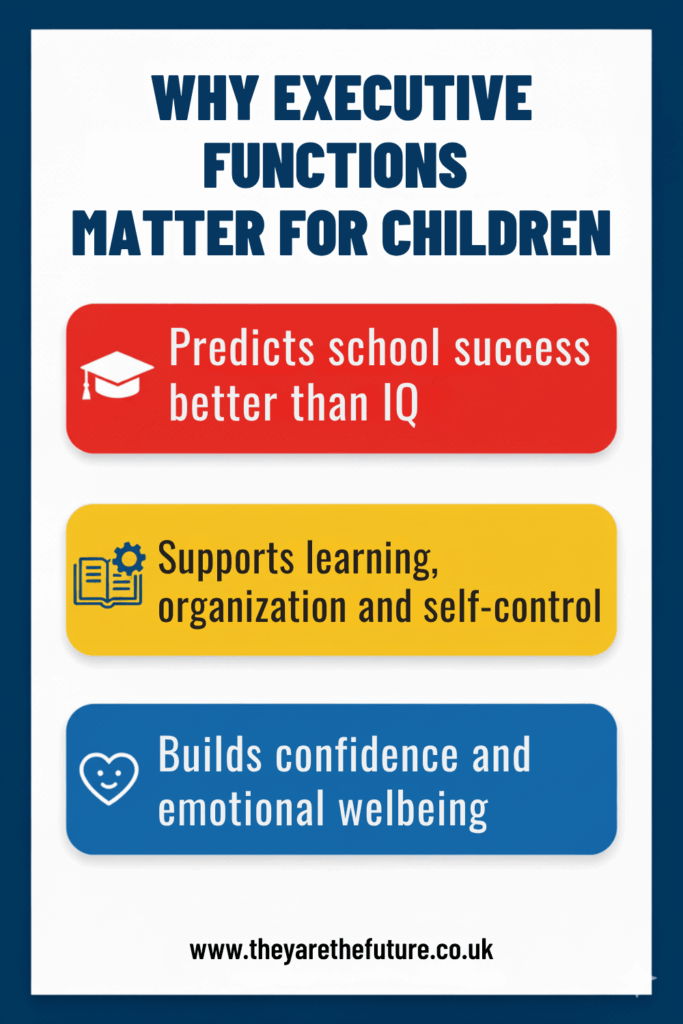
Strong executive functioning has a big impact on success across many areas of life. Studies have shown that better executive functioning is linked to higher academic achievement. Working memory predicts maths ability, and reading and writing skills depend on inhibition and cognitive flexibility. Executive function has even been found to be a better predictor of school performance than IQ.
When executive function skills are weak, children may struggle with organisation, planning and self-control. They may forget homework, lose track of time or become overwhelmed by multi-step projects. They can get unfairly labelled as unmotivated or poorly behaved.
Poor executive functioning is common in children with learning difficulties, and difficulties can sometimes carry into adulthood if they are not supported. As you can imagine, these challenges can also affect wellbeing, self-esteem and mental health.
The good news is that executive function skills are teachable. With your guidance and practice, children can become more organised and independent. Even small improvements can make daily life smoother and reduce stress for everyone involved.
Neurodiversity and Executive Functioning
Understanding Neurodiversity
Neurodiversity means that there is no single “correct” way for brains to function. Some people are “neurotypical”, meaning they process information in a way considered typical for their age. Others are neurodivergent, meaning they think, learn or behave in ways that are different from the majority. But remember, different definitely doesn’t mean there’s anything wrong!
Neurodivergence includes conditions such as autism, attention-deficit/hyperactivity disorder (ADHD), dyslexia and dyspraxia.
Neurodivergence is not a diagnosis but a perspective that honours differences. Neurodivergent people often have unique strengths, including creativity, accuracy, innovative problem solving, intense focus and reliability. They may also face challenges such as sensory sensitivities, anxiety, difficulties with social cues or focus. When you understand these differences, you can create supportive environments that play to their strengths strengths while accommodating their challenges.

Executive Functioning in Neurodivergent Children
Research shows that children with ADHD, autism, dyslexia and other neurodivergent conditions may have trouble with certain areas of executive functioning like inhibition, working memory and flexibility, which can affect learning and daily living.
For example:
- Autism spectrum disorder: Autistic kids may have uneven executive skills – known by psychologists as a “spiky cognitive profile“. This means both significant strengths and significant problem areas. For example, they may have an incredible memory for facts and recent events but poor planning skills.
- ADHD: ADHD is characterised by impulsivity, hyperactivity and distractibility. Executive function difficulties are common and may include poor working memory and poor time management. Research shows that children with ADHD and executive function impairments are at greater risk of academic underachievement.
Although neurodivergent children may face executive functioning challenges, they often also have great strengths.
Many autistic people have intense focus, honesty and unique problem solving. People with ADHD often display creativity and energy, and also the same “hyperfocus” that autistic people often benefit from.
When you recognise these strengths, you can help shift the focus from deficits to potential.
TAKE THE QUIZ!
Real-Life Example: Supporting Executive Functioning with ADHD and Autism
Jamie is 11 years old and has both autism and ADHD. His mum describes him as creative and funny, with an encyclopaedic knowledge of marine biology.
At school, though, Jamie struggles. He forgets to write down his homework, loses his PE kit regularly, and becomes overwhelmed when faced with multi-step maths problems.
His teacher notices that he can hyperfocus on topics he loves but finds it nearly impossible to switch to less preferred activities.
When routines change unexpectedly, Jamie sometimes shuts down or has a meltdown.
Jamie’s challenges reflect weak executive functioning across three areas. His working memory difficulties make it hard to hold instructions in mind. His inhibition difficulties mean he blurts out answers about sharks even during history lessons. His cognitive inflexibility shows, when he cannot adapt to last-minute timetable changes.
But Jamie’s support team worked together to help. His teacher created a visual timetable with pictures, so Jamie could see what was coming next. They broke homework into smaller chunks and used a timer for each section.
At home, his mum introduced a morning checklist with tick boxes and laid out his school uniform the night before. They also built in “shark time” as a reward after he completed less preferred tasks.
Within a few months, Jamie was getting to school with the right equipment more often. He still needed reminders, but he had started checking his list independently. His meltdowns reduced because he felt more prepared. Most importantly, Jamie began to see himself as capable. He told his mum, “I’m getting better at remembering stuff.”
Jamie’s story shows how targeted support can make a real difference. You do not need to fix everything at once. Small changes, applied consistently, help children build skills and confidence.

Recognising Executive Functioning Challenges
Children with executive function difficulties may:
- Have trouble starting tasks or feel overwhelmed by big projects. They may only think of the final product rather than the steps involved.
- Forget homework or lose track of items because working memory is limited.
- Struggle to manage time or underestimate how long tasks will take.
- Have difficulty switching between activities or coping with changes in routine.
- React impulsively or have emotional outbursts when frustrated.
These behaviours are often misunderstood as laziness or defiance. In reality, they reflect skills still developing.

Practical Strategies for Parents and Teachers
Break Tasks Into Manageable Steps
Many children with executive functioning challenges struggle to plan a sequence of actions. When you create a step-by-step checklist, you make tasks less daunting and reduce mental strain.
You can use checklists for getting ready for school, completing homework or following a morning routine. When you post a checklist where the child can see it, you provide a visual prompt and reduce the need to remember every step.
To use this strategy:
- Work with the child to list each step. Use simple words or pictures.
- Keep the list short and specific. For example, “Put on shoes” instead of “Get ready.”
- Encourage the child to check off each step as it is completed. This provides a sense of progress and accomplishment.
Set Time Limits and Use Timers
Long tasks can feel endless to a child. When you assign a time limit for each step, you help children learn how long things take and prevent projects from dragging on[35]. Use kitchen timers, phone alarms or visual timers to signal when to start and when to take breaks. If you break homework into 15-minute blocks with short breaks, you can keep a child engaged. Over time, they learn to estimate durations and manage time more independently.
Use Planners and External Aids
Planners are essential for children who struggle with working memory and organisation. Many schools require planners, but children need you to teach them how to use them.
Encourage your child or student to record assignments and due dates immediately. For digital learners, apps or school platforms may serve the same purpose.
Explain the “Why” Behind Strategies
Older children and teenagers may resist planning strategies if they don’t understand their purpose.
When you explain how each tool saves time and reduces stress, children are more likely to adopt new habits. Ask for their input and let them adapt tools to suit their needs. When you make decisions together, you foster ownership and build motivation.
Explore Different Learning Styles
Every child processes information differently. Some understand concepts better with visual aids such as graphic organisers or diagrams. Others remember information when it is linked to motion or storytelling.
Social stories (short narratives that describe social rules through the eyes of a child) can be especially helpful for young learners.
Focus on one new strategy at a time and give the child at least two weeks of practice before you evaluate its effectiveness.
Establish Consistent Routines
Routines provide structure and reduce uncertainty. When you start homework at the same time each day, you help children develop a habit of task initiation.
A quiet, well-lit space with minimal distractions supports sustained focus. Some families find working at the kitchen table effective, as you can supervise and answer questions.
Outside of homework, routines for bedtime, meals and chores build predictability. Try to prepare as much as possible the night before. You can pack backpacks, set out clothes and prepare lunch. Morning checklists can then guide the child through dressing, brushing teeth and leaving on time.

Teach Through Modeling and Scaffolding
If you are a teacher, you can build executive skills by modeling how to plan and organise tasks. A direct instruction approach (“I do it, we do it, then you do it”) gives students a clear example before you gradually shift responsibility.
Show students how to use planners and break tasks into steps. Provide repeated practice until the skill becomes natural. Use games and collaborative activities to make learning interactive.
Classroom management strategies such as structured routines, visual schedules and checklists reduce uncertainty and allow practice of time management for students with executive functioning difficulties.
Make Everyday Activities a Training Ground For Executive Functions
You can practice executive skills through daily life.
For example, cooking together requires planning, measuring and following steps. Games such as board games or card games encourage turn-taking, strategic thinking and flexible problem solving.
Focus on Strengths and Accommodation
Remember that executive function challenges are only one part of a child. Neurodivergent children often excel in other areas such as creativity, intense passions or honesty. Celebrate these traits, and children can use these strengths to develop weaker skills. For example, a child who loves trains might design a “train schedule” to manage homework tasks.
Accommodation is as important as skill building. As adults we need to adjust the environment for students with executive function challenges. This might mean – for example – allowing extra time for assignments, reducing clutter or providing noise-cancelling headphones.
When you meet children where they are, you reduce stress and increase chances of success.
When to Seek Professional Help
If the child’s executive function difficulties significantly interfere with daily life or cause distress, consider consulting a professional such as an educational psychologist. Sometimes you can access one through your school, but you can also seek private assessment.
The educational psychologist can conduct an evaluation that assesses thinking, memory, attention, mood and social skills. They will identify strengths and challenges and recommend interventions. In some cases, therapy, coaching or medication may help address attention issues while still honouring the child’s individuality.
Early support makes a difference. Interventions that improve executive functioning help prevent difficulties from compounding over time and can improve academic and emotional outcomes. Even without a formal diagnosis, children benefit when you understand their needs and provide structured support.
Frequently Asked Questions
What are signs of poor executive functioning in kids?
Children may appear disorganized, forgetful, easily distracted, or emotionally reactive. They might struggle to start or finish tasks, follow multi-step instructions, or switch between activities. You may notice they lose belongings frequently, forget homework, underestimate how long tasks take, or have meltdowns when routines change.
Can executive functioning improve with support?
Yes! Executive skills are teachable. With practice, tools like planners and timers, and supportive environments, children can build better focus, organisation, and independence. Research shows that targeted interventions, consistent routines, and breaking tasks into steps all help strengthen these brain-based skills over time.
Is executive dysfunction the same as ADHD or autism?
Not exactly. Many neurodivergent kids experience executive challenges, but executive dysfunction can also appear in neurotypical children under stress or without structure. ADHD and autism often involve executive function difficulties, but not everyone with executive challenges has ADHD or autism. A professional evaluation can help clarify what support is needed.
How can teachers help students with executive functioning challenges?
Teachers can use strategies like modeling planning, using visual schedules, providing checklists, and breaking assignments into steps. Classroom routines and predictable transitions also help. Direct instruction (“I do it, we do it, you do it”), collaborative learning, and games that build planning skills all support executive function development in the classroom.
Executive Functioning in Children: My Final Thoughts
Executive functioning underpins our ability to navigate school, relationships and daily tasks. These skills (planning, remembering and adapting) develop over time and can be nurtured.
Remember, research shows that strong executive functions predict academic success better than intelligence.
You play a vital role in building these skills. When you break tasks into steps, establish routines, use planners, explain the reasons behind strategies and tailor interventions to individual strengths, you help children become more independent. Real-life practice, encouragement and accommodations create an environment where every child can thrive.
Supporting children with executive function challenges is not about forcing them to fit a mould. It is about teaching skills, celebrating differences and shaping environments that allow young people to flourish. With patience, creativity and empathy, you can help all children (neurotypical and neurodivergent) reach their full potential.
Related Articles
Creating a Stress-Free ADHD Morning Routine For Your Child
How to Help Your Teenager Focus in School: 7 Psychologist Strategies
Developing Flexible Thinking Skills in Kids: Why and How?
Dr Lucy Russell is a UK clinical psychologist and Clinical Director of Everlief Child Psychology. She qualified as a clinical psychologist from Oxford University in 2005 and worked in the National Health Service for many years before moving fully into her leadership and writing roles.
In 2019 Lucy launched They Are The Future, a support website for parents of school-aged children. Through TATF Lucy is passionate about giving practical, manageable strategies to parents and children who may otherwise struggle to find the support they need.
Lucy lives with her family, rescue cats and dog, and also fosters cats through a local animal welfare charity. She loves singing in a vocal harmony group and spending time in nature.
