
Dyspraxia and Autism: Understanding the Connection and Supporting Your Child

Dyspraxia, commonly known as Developmental Coordination Disorder (DCD), affects planning and coordination of movement. While it’s distinct from autism, these two neurodevelopmental conditions frequently overlap, creating unique challenges that can impact everything from classroom participation to playground activities.
I’m Dr Lucy Russell, a clinical psychologist with over twenty years of experience working with autistic children and teens. In this article, we’ll explore the connection between autism and dyspraxia (DCD) and share practical strategies that can make daily life easier for children experiencing both. Then we’ll look at how you can ensure your child gets effective support.
Understanding Dyspraxia: More Than Just “Clumsiness”
Dyspraxia affects approximately 5-6% of school-aged children in the UK and the statistics are thought to be similar in other countries.
Rather than simply being “clumsy,” children with dyspraxia experience genuine neurological differences that affect how their brains plan and coordinate physical movements.
These challenges typically appear in:
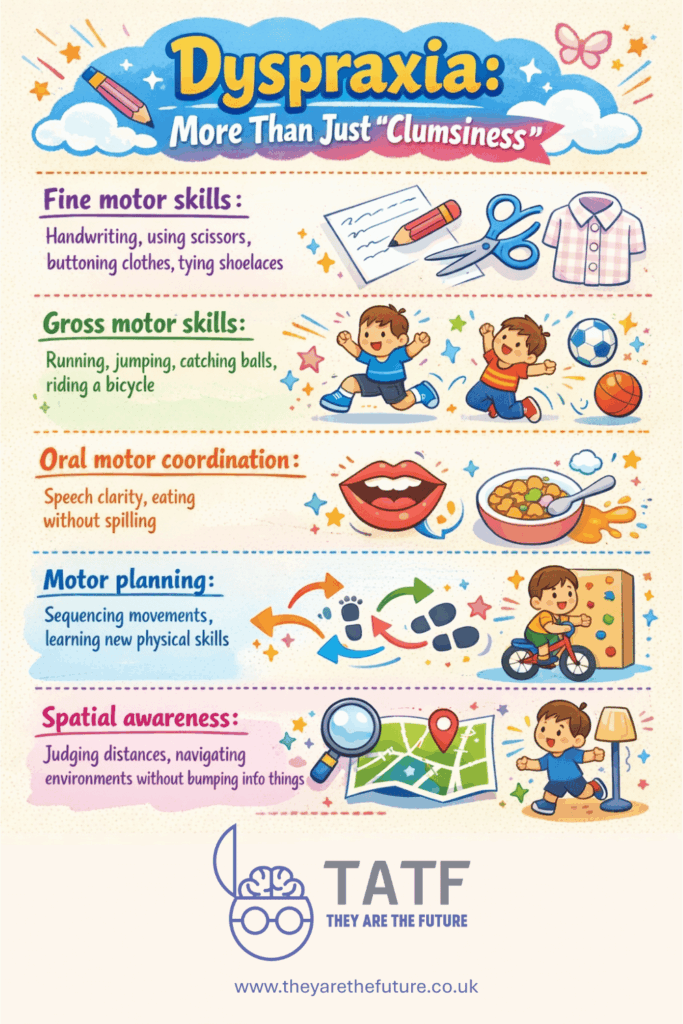
- Fine motor skills: Handwriting, using scissors, buttoning clothes, tying shoelaces
- Gross motor skills: Running, jumping, catching balls, riding a bicycle
- Oral motor coordination: Speech clarity, eating without spilling
- Motor planning: Sequencing movements, learning new physical skills
- Spatial awareness: Judging distances, navigating environments without bumping into things
What makes dyspraxia particularly challenging is that intellect remains unaffected. Many children with dyspraxia have average or above-average intelligence, creating a frustrating gap between what they understand and what they can physically demonstrate.
Why Autism and Dyspraxia Often Co-occur
Research from the University College London Institute of Child Health suggests that up to 80% of autistic children show some degree of motor coordination difficulties. This striking overlap isn’t coincidental, as there are shared underlying brain differences:
- Brain structure and function: Both conditions – autism and dyspraxia – involve differences in neural pathways that affect how sensory information is processed and how movement is planned and executed
- Sensory processing: Many children with either condition process sensory information differently, which affects how they respond to their environment and plan movements
- Genetic factors: Growing evidence suggests overlapping genetic influences contribute to both conditions
- Developmental timing: Both conditions start very early in brain development and can knock on to many areas of growth, affecting things like movement, learning, and everyday skills as children get older.
How Dyspraxia Might Present Itself in Your Autistic Child
The signs of dyspraxia can sometimes be overshadowed by more obvious autism characteristics, or they might be mistakenly attributed to autism rather than recognised as a co-occurring condition. Here’s what to look for at different developmental stages:
Early Years (Ages 3-5)
Young children with both conditions might:
- Be delayed in reaching motor milestones like crawling or walking
- Struggle to learn to pedal a tricycle despite interest
- Have difficulty with self-feeding or dressing
- Appear to fall or bump into things frequently
- Show reluctance to engage in physical play

School Age (Ages 6-12)
During primary school, you might notice:
- Handwriting that is particularly laborious, messy, or illegible
- Difficulties with PE activities compared to peers
- Challenges with self-organisation and following multi-step instructions
- Struggles with using scissors, rulers, and other classroom tools
- Avoidance of playground games involving ball skills or physical coordination
Teens and Beyond
In adolescence, watch for:
- Continued difficulties with handwriting and organisation
- Challenges learning new motor skills like cooking or DIY activities
- Particular anxiety around activities requiring coordination
- Reluctance to participate in team sports
- Difficulties with time management and planning practical tasks
Autism and Dyspraxia: Diagnosis in Childhood
Autism and dyspraxia diagnoses are often (but not always) given separately. One reason for this is that dyspraxia or DCD is often diagnosed by an occupational therapist or pediatrician, whereas autism is often diagnosed by other professionals including psychologists.
I have a whole article about seeking an autism assessment for your child.
If you think your child may be dyspraxic (have DCD), whether they already have an autism diagnosis or not, here’s what to do:
- Begin with your GP: Request a referral to a paediatrician or specialist paediatric OT, explaining your specific concerns about coordination alongside autism
- Seek occupational therapy assessment: Occupational therapists specialise in evaluating motor skills and can provide detailed insights into your child’s specific challenges
- Consider educational psychology input: Educational psychologists can assess how coordination difficulties impact learning and recommend school-based accommodations
- Document your observations: Keep specific examples of your child’s coordination challenges ready to share with professionals
- Connect with support organisations: The Dyspraxia Foundation and National Autistic Society can provide support and guidance
A formal identification of dyspraxia alongside autism can really help your child. Obviously multiple “labels” are not always helpful, but it could unlock specific support strategies and help everyone understand your child’s complete profile.

Practical Strategies for Daily Challenges
Understanding the connection between these conditions is just the beginning. Here are evidence-based approaches that can make a meaningful difference:
Supporting Motor Development
- Break down movements into small steps: Rather than saying “get dressed,” break it down into specific actions: “First put your arm through this sleeve, now the other arm…”
- Consider specialist input: Occupational therapists can provide tailored exercises to develop specific motor skills
- Focus on functional skills: Prioritise activities that enhance independence, such as dressing, using cutlery, or handwriting
- Allow extra time: Rushing creates anxiety that can worsen coordination difficulties
Handwriting and School Work
- Consider alternatives to handwriting: Typing, voice recording, or scribing may be more effective ways for your child to demonstrate knowledge
- Use adaptive tools: Pencil grips, sloped writing boards, and specially lined paper can make writing easier
- Request reasonable adjustments: Schools should provide accommodations like extra time for written work or reduced copying from the board
- Develop touch-typing skills: Learning to type efficiently can be liberating for children who struggle with handwriting
- Use assistive technology: Speech-to-text software and organisational apps can bypass areas of difficulty
Organisation and Executive Function
Children with both conditions often struggle with organisation and executive function. These strategies can help:
- Use visual timetables and checklists: These provide clear reminders of sequences and expectations
- Create consistent systems: Having designated places for belongings with visual labels reduces the cognitive load for your child
- Use colour-coding: Using colours to organise materials can help with visual processing
- Develop routines: Consistent routines reduce the need to plan new sequences of actions
- Use timers and alarms: These provide concrete reminders for transitions and time management
Physical Activity and Sport
Physical activity is important for all children, but those with autism and dyspraxia may need adaptations:
- Choose activities that match strengths: Swimming, martial arts, and cycling often work well as they involve repetitive movements
- Prepare in advance: Visit new physical environments during quiet times to reduce anxiety
- Use visual demonstrations: Show rather than tell when teaching new movements
- Break skills down: Teach complex movements in small, manageable steps
- Celebrate effort over outcome: Recognise the courage and perseverance involved in attempting challenging physical activities

Supporting Emotional Wellbeing
The impact of having both conditions extends beyond physical challenges to emotional wellbeing:
- Acknowledge the extra effort required: Simple tasks for others may require significant concentration and effort for your child
- Build self-advocacy skills: Help your child understand their needs and how to request appropriate support
- Focus on strengths: Actively celebrate your child’s areas of capability and interest
- Create successful experiences: Ensure your child has regular opportunities to experience competence and achievement
School Strategies For Dyspraxia That Make a Difference
Effective school support requires staff to understand both autism and dyspraxia:
- Share knowledge: Ensure teachers understand how autism and dyspraxia interact and affect learning and development
- Request specific accommodations: These might include extra time for writing tasks, use of a laptop, or modified PE requirements
- Maintain communication: Regular updates between home and school for consistent support
- Consider the physical environment: Classroom seating, equipment accessibility, and movement requirements all impact your child’s success
Conclusion: Autism, Dyspraxia, and Seeing the Whole Child
Understanding how autism and dyspraxia link will help you make sense of your child’s difficulties.
It explains why some tasks are harder than they look. It also shows where the right support can really help.
The aim is not to change how your child’s brain works, it’s to give them tools, adjustments, and environments that reduce their daily stress and help them fulfil their potential.
With the right understanding, children with autism and dyspraxia can do well. Many develop strong problem solving, persistence, and creative thinking, and go on to be happy and successful adults.
Dr Lucy Russell is a UK clinical psychologist and Clinical Director of Everlief Child Psychology. She qualified as a clinical psychologist from Oxford University in 2005 and worked in the National Health Service for many years before moving fully into her leadership and writing roles.
In 2019 Lucy launched They Are The Future, a support website for parents of school-aged children. Through TATF Lucy is passionate about giving practical, manageable strategies to parents and children who may otherwise struggle to find the support they need.
Lucy lives with her family, rescue cats and dog, and also fosters cats through a local animal welfare charity. She loves singing in a vocal harmony group and spending time in nature.
