
Why Won’t My Child Follow Instructions? Strategies for Autistic and ADHD Children

When getting your child to follow instructions feels like a daily battle, it’s easy to wonder what you’re doing wrong. The truth is, for many children, especially those with autism, ADHD or other learning and thinking differences, following instructions isn’t a matter of willingness. It’s a matter of how their brain processes what they hear.
As a clinical psychologist with more than twenty years of experience, I’ve worked with hundreds of families facing this exact challenge. The good news is that small, intentional changes to the way you give instructions can make an enormous difference. In this article I’ll explain why your child struggles and share practical strategies that work.

Why Your Child Struggles to Follow Instructions
Understanding the reasons behind the difficulty is the most effective way to start helping your child. Here are the most common causes I see in my clinical work.
Executive Function and Multi-Step Directions
Executive function is the brain’s ability to plan, organise, remember and get started on tasks. Many neurodivergent children find this genuinely difficult. When you give multi-step directions such as “get your shoes, grab your bag, and don’t forget your water bottle,” your child’s working memory may only hold the first step, or none of them at all. The instruction feels overwhelming before they have even begun.
Breaking down tasks into a sequence of steps and giving them one at a time is far more helpful than repeating a long list. This is true for children with ADHD, autism, dyslexia, and language processing issues alike. Can your child follow instructions more easily when they are broken down into tiny chunks? In my experience this is the case almost every time.
Vague Directions and Decision Paralysis
Vague directions are a significant stumbling block for many children. When you say “tidy your room” or “sort yourself out,” your child’s brain may flood with questions: Where do I start? What counts as tidy? What am I supposed to do first?
Rather than choosing one step and beginning, they freeze. This is particularly common in autistic children, who tend to think literally and need clear directions and specific tasks rather than open-ended requests. Replacing vague language with precise instructions (for example, “please put your books on the shelf, then put your dirty clothes in the basket”) removes the guesswork entirely.
Language Processing Issues and Slow Processing Speed
Some children take longer to make sense of spoken language. They may have language processing issues that mean they need extra time to decode what they have heard before they can act on it. If you give an instruction and immediately ask “did you hear me?” or repeat it straight away, you may be interrupting the processing that was already underway.
Building in wait time after you give an instruction is one of the simplest and most overlooked strategies. Pause, give your child time to process, and resist the urge to repeat directions immediately. If they genuinely haven’t understood, then rephrase rather than repeat.

Distraction and Sensory Overload
Noise, light, movement, and uncomfortable clothing can all take over your child’s attention. Even a ticking clock or background conversation can make it hard for them to listen or stay focused. It’s worth taking a moment to minimize distractions before giving an important instruction, rather than calling it out from another room or over the noise of the television.
Learning to get their attention fully before you speak is a skill in itself. Moving close to your child, using their name, and waiting for eye contact (where this is comfortable for them) significantly increases the chance that your instruction will land first time.
Anxiety and Fear of Getting It Wrong
If your child has been corrected a lot, or often feels overwhelmed, they might freeze as soon as they hear a request. They may want to do the right thing but feel stuck or panicked.
Not Rewarding Enough
Children (especially those with ADHD) often find it easier to start tasks that are fun or rewarding right away. If the outcome feels distant or dull, they may struggle to get going. A small reward or a bit of choice can make a big difference.
How to Help Your Child Follow Instructions
Small changes to the way you communicate can make instructions much easier for your child to understand and act on. These strategies are drawn from what I recommend to families in my clinical work every day.
Give Clear, Simple Directions
The most effective way to help your child is to keep your language simple and direct. Use simple directions with one or two steps at most. Avoid idioms, sarcasm or hints.
Instead of “can you sort yourself out for school,” say “please put on your uniform.” Instead of “let’s not make a mountain out of a molehill,” say “this is a small problem, not a big one.” Clear directions in a calm even tone are far more effective than raising your voice or issuing empty threats that you are unlikely to follow through on. Children respond to consistency and clarity, not volume.
Break Down Tasks and Use a Sequence of Steps
Breaking down tasks into a manageable sequence of steps is one of the most powerful things you can do. Rather than giving the whole instruction at once, give one step, pause, wait for completion, then give the next.
For children who benefit from seeing the steps rather than just hearing them, visual cues make a real difference. You could use a picture schedule on the wall, a simple checklist they tick off, or a “first, then” board.
These tools help your child understand what to do, what comes next, and when they have finished, without relying solely on working memory. Supporting your child to follow directions in this structured way is a genuine life skill that will serve them well beyond the home and contribute to their school success. This approach works well for young children aged 5 to 7 in particular, as they are still building the working memory and attention skills needed to hold multiple steps in mind.

Get Their Attention Before You Speak
Before giving any instruction, make sure you have your child’s full attention. Move close to them, use their name, and wait. For some children, eye contact helps signal that they are ready to listen, though for autistic children this may not be comfortable or appropriate. What matters is that they are oriented towards you before you begin.
Trying to give instructions while your child is mid-task, absorbed in a screen, or in the middle of a social interaction is rarely going to work first time. A brief “I need to tell you something important, can you stop for a moment” gives them the chance to shift their attention before the instruction arrives.
Build In Wait Time and Check for Understanding
After giving an instruction, pause. This wait time gives your child’s brain the processing time it needs, particularly if they have language processing issues or a slower processing speed. Count to ten in your head before repeating or prompting.
If you are unsure whether your child has understood, check for understanding by asking them to tell you what they are going to do. “Can you tell me back what I just asked?” is more useful than “did you understand?” (which almost always gets a yes, regardless of actual comprehension). This approach also builds your child’s ability to repeat directions back to themselves as a self-regulation strategy.
Give Choices to Support Motivation
Give choices wherever possible. Choice builds motivation and a sense of control, which is particularly important for children who feel they have little autonomy over their daily routines.
Try: “Do you want to get dressed first or brush your teeth first?” or “Shall I set the timer for five minutes or ten?” These are not open-ended questions that risk vague directions and confusion. They are contained choices with clear boundaries, both of which lead to the same outcome. Positive behaviour is far more likely when your child feels they have some say in how a task is approached.
Use Visual Cues and Predictable Routines
Many children with learning and thinking differences benefit from seeing the steps rather than just hearing them. Visual cues such as picture schedules, checklists, or simple written reminders reduce the cognitive load on your child and make routines more predictable.
When your child knows what to expect, they do not have to work as hard to stay on track. Using the same words for instructions each time, keeping daily routines in the same order, and giving a warning before changes or transitions all contribute to a sense of safety and control. Consistency in your approach is one of the most important parenting skills you can develop in this area.
Use a Calm Even Tone and Avoid Empty Threats
The way you deliver an instruction matters as much as the words you choose. A calm even tone signals to your child that you are in control and that the request is reasonable and expected. Raised voices, urgency, and frustration tend to trigger anxiety or shutdown rather than cooperation.
Avoid empty threats such as “if you don’t do it now I’m switching off the Wi-Fi” unless you genuinely intend to follow through. Children quickly learn which threats are real and which are not, and empty threats erode trust and reduce the effectiveness of future instructions. State what will happen clearly and once, then follow through calmly if needed.
Let Them Move While Listening
Some children need to move while thinking. That might look like standing up, bouncing on a cushion, or walking around while listening.
Build in short breaks between steps. For example: “Five minutes of homework, then a quick movement break.”
Tailored Strategies by Diagnosis
Different types of neurodivergence call for slightly different approaches.
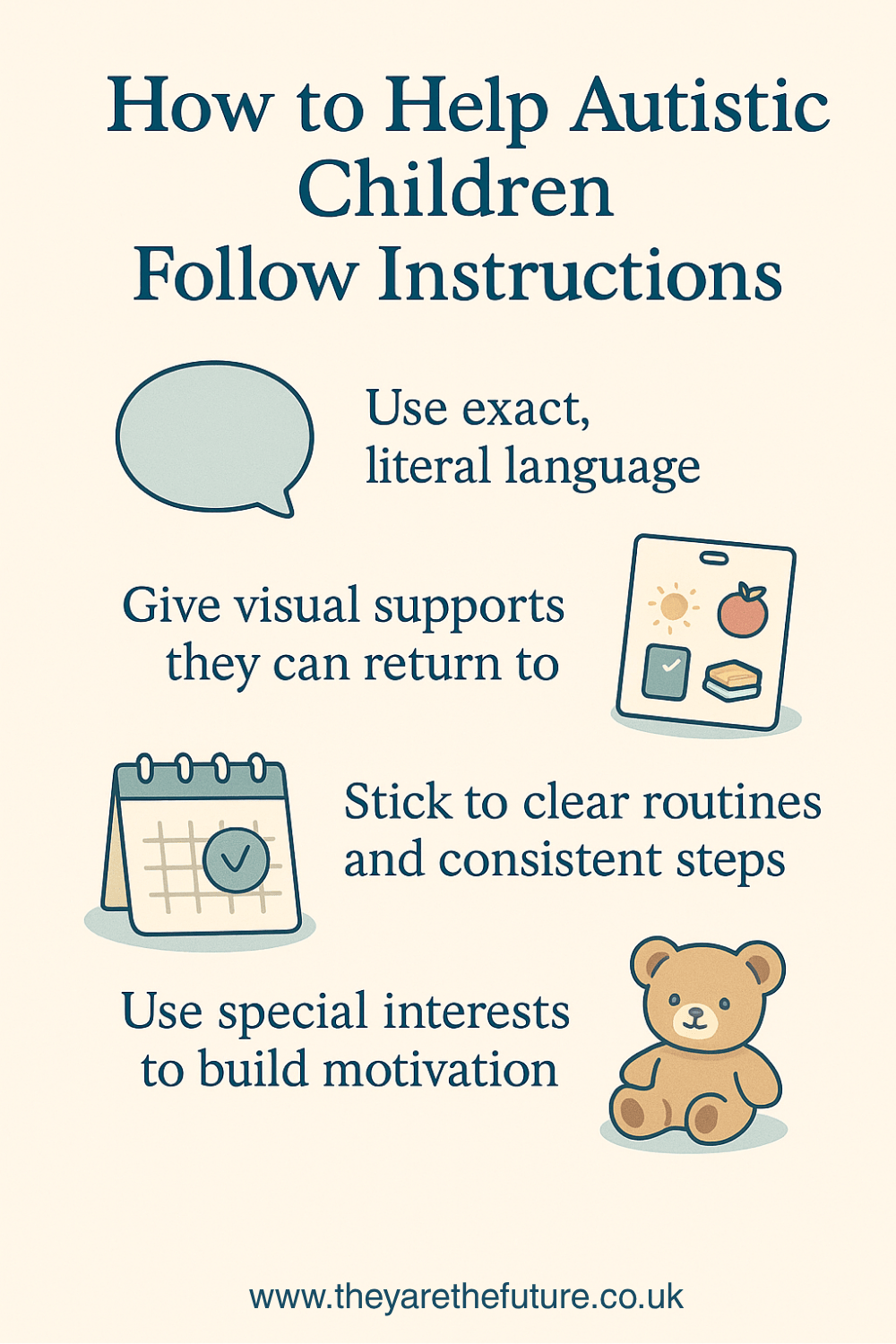
How to Help Autistic Children Follow Instructions
- Use exact, literal language and avoid idioms
- Give visual cues they can refer back to
- Stick to clear directions and consistent routines
- Use special interests to build motivation
- Allow wait time after each instruction
How to Help Children with ADHD Follow Instructions
- Keep instructions short and give simple directions one at a time
- Use timers, reminders, or countdowns
- Allow movement while listening
- Give frequent small rewards for positive behaviour
- Breaking down tasks into very small chunks works especially well

Supporting Children With Dyslexia or Language Difficulties
- Pair spoken instructions with visual cues or gestures
- Highlight key words
- Give extra wait time for processing
- Check for understanding by asking them to repeat the instruction back
Helping Your Child Build Independence in Following Instructions
Can your child follow instructions independently, without prompting? This is the goal, and it is absolutely achievable with time and practice.
Breaking down tasks is not just a strategy for getting things done today. It is how children gradually build the confidence and life skill of managing instructions independently, which is a foundation for school success and wider mental growth in terms of their development.
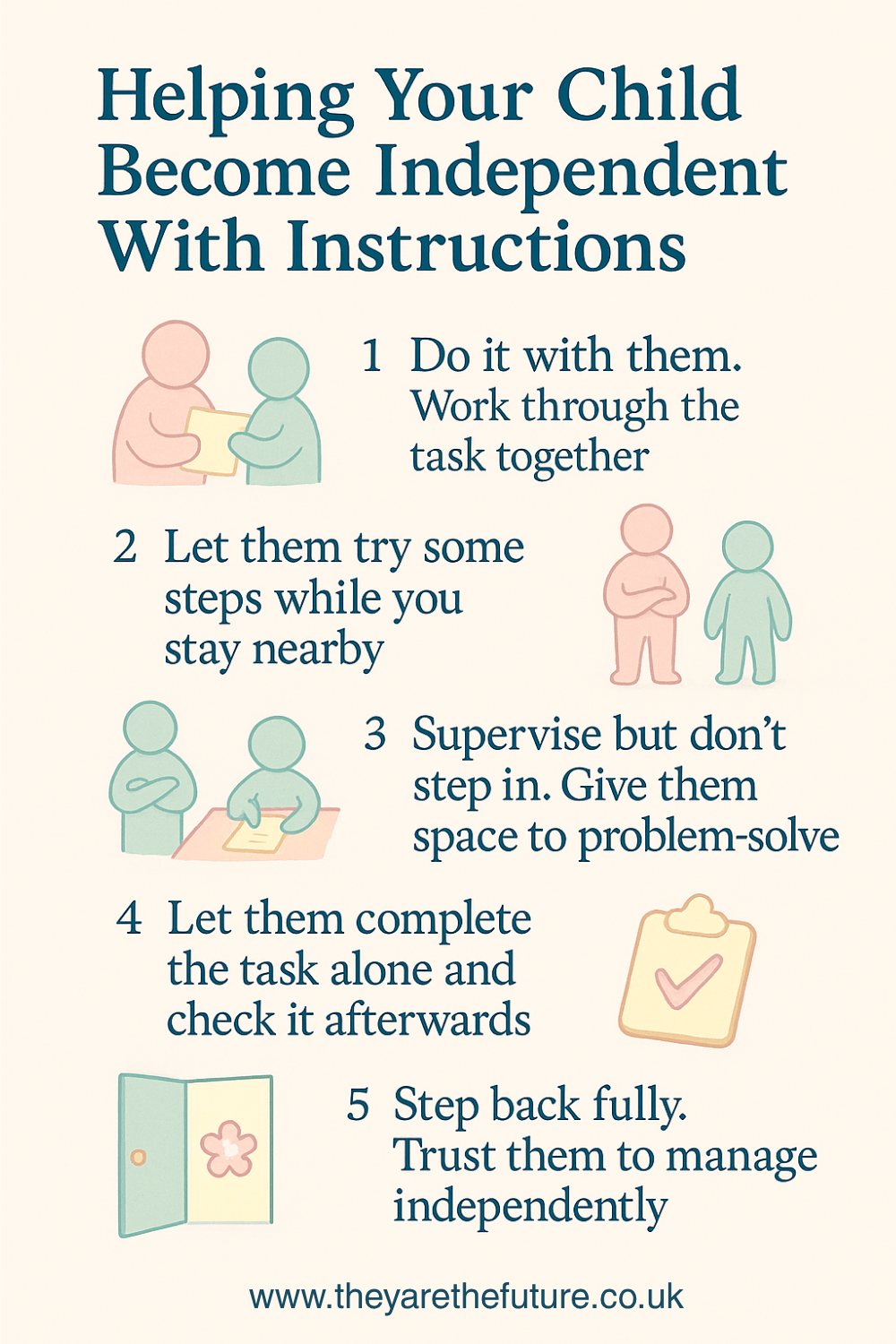
You might need to guide your child closely at first. Over time, reduce your help gradually as they build confidence. Work through tasks together, then let them try some steps while you stay nearby, then supervise without stepping in, and eventually step back fully. Celebrate each new step of independence, however small.
When to Seek Professional Help
Some children need more support than home strategies alone can provide. It may be worth seeking professional help if your child becomes regularly distressed when asked to complete tasks, daily routines remain unmanageable despite trying multiple strategies, or school is noticing the same difficulties.
People who can help include occupational therapists, speech and language therapists, educational psychologists, and therapists or clinical psychologists who work with anxiety or low confidence. The school may also be able to offer extra support or a formal support plan.
Frequently Asked Questions
How can I get my ADHD child to follow instructions at home?
Keep instructions short and simple directions to one or two steps. Use timers, visual cues, and allow movement while listening. Avoid long verbal instructions. Offer immediate, tangible rewards for completed steps, and give frequent encouragement. Children with ADHD respond well to novelty and choice, so give choices and let them have some input into how tasks are approached.
Why does my autistic child struggle with instructions like “get dressed”?
Autistic children often need literal, specific tasks and thrive on routine. Vague directions like “get dressed” can cause confusion or overwhelm because they do not break the request down into what to do first, second, and third. Instead, try: “Put on your pants. Now put on your shirt.” Visual cues also help autistic children understand the sequence of steps and feel more in control.
What visual tools help neurodivergent children follow directions?
Try picture schedules (photos or drawings showing each step), checklists they can tick off, “first, then” boards, or timers with visual countdowns. Visual cues make tasks more predictable, reduce anxiety, and help children remember what comes next without relying solely on working memory.
When should I seek professional help?
If your child regularly becomes distressed when asked to complete tasks, daily routines are unmanageable despite trying multiple strategies, or both home and school are struggling, it is worth consulting a professional. Occupational therapists, educational psychologists, and speech and language therapists can assess underlying challenges and provide targeted support.
What is the difference between defiance and genuine difficulty following instructions?
Defiance is a choice to refuse, while genuine difficulty stems from neurological differences in processing, memory, or sensory regulation. If your child seems confused, frozen, or overwhelmed rather than oppositional, they most likely need different support rather than consequences. Look for patterns: do they struggle with all multi-step directions? Do they respond better to visual cues? This will help you identify whether it is a skills gap or a behavioural issue.
Final Thoughts
When getting your child to follow instructions feels impossible, it is almost always because the environment or communication style does not match how their brain works. Clear directions, visual cues, and breaking down tasks into a sequence of steps make it easier for your child to succeed.
These strategies are not just about getting things done. They help your child feel capable and calm, build genuine life skill, and contribute to long-term school success. The smallest changes can lead to more peaceful mornings, smoother routines, and a stronger connection between you and your child.
Struggling With Mornings or Bedtimes?
If mornings or bedtimes often feel chaotic or tense, my short on-demand course will help. Low-Stress Mornings and Bedtimes is a short, practical mini course for parents of autistic and ADHD children aged 5 to 17.
It’s packed with simple strategies to create calmer, more predictable routines that suit your child’s needs.
You can complete it quickly, keep it forever, and dip back in whenever you need a reset.

Dr Lucy Russell is a UK clinical psychologist and Clinical Director of Everlief Child Psychology. She qualified as a clinical psychologist from Oxford University in 2005 and worked in the National Health Service for many years before moving fully into her leadership and writing roles.
In 2019 Lucy launched They Are The Future, a support website for parents of school-aged children. Through TATF Lucy is passionate about giving practical, manageable strategies to parents and children who may otherwise struggle to find the support they need.
Lucy lives with her family, rescue cats and dog, and also fosters cats through a local animal welfare charity. She loves singing in a vocal harmony group and spending time in nature.
