
Special Interests in Autistic Children: What They Are and How to Support Them

“But we’ve already watched the solar system documentary three times today…”
Many parents of autistic children notice their child’s intense focus, deep knowledge of specific topics, and strong desire to return to the same interest repeatedly.
Intense interests, sometimes called obsessions or hyperfixations, are common in autism.
These special interests, whether it’s memorizing train schedules, learning everything about dinosaurs, or mastering every detail of a video game, are much more than just hobbies or passions. They’re often a core part of how many autistic children experience and understand the world.
I’ve worked with hundreds of families in autism parenting in my clinic, Everlief, and prior to that in the NHS. In my experience, these obsessions can really help your child grow and connect with others, but they can also become something you’re constantly working around. For example, dealing with awkward public moments related to the special interest, feeling like you can’t get through to them, or watching family life take a completely different shape than you’d planned.

What Makes These Interests “Special”?
When Jamie (not his real name), one of my clients, became interested in football, he memorized every World Cup score since 1930, created detailed ranking systems for players, and could recall the exact minute of every goal scored in the Premier League this season.
This level of intensity and hyperfixation shows what makes autistic special interests different:
Exceptional focus: Many autistic children can concentrate on their interest for hours without getting bored or distracted.
Remarkable memory: They often remember tiny details about their interest that go far beyond typical development.
Deep emotional connection: The interest usually provides comfort, joy, and predictability.
Self-directed learning: Many children independently look for more complex information about their interest.
Repetitive engagement: They may prefer engaging with the same content over and over rather than seeking something new. This repetitive behaviour is a hallmark of restricted interests in autism.
Research from the University of Cambridge shows that up to 90% of autistic individuals develop at least one intense special interest.
Here’s a quick video I made about the positives of autistic special interests.
Understanding the Benefits of Obsessions and Special Interests
Special interests and obsessions reveal themselves as powerful strengths:
Emotional Regulation and Meeting Sensory Needs
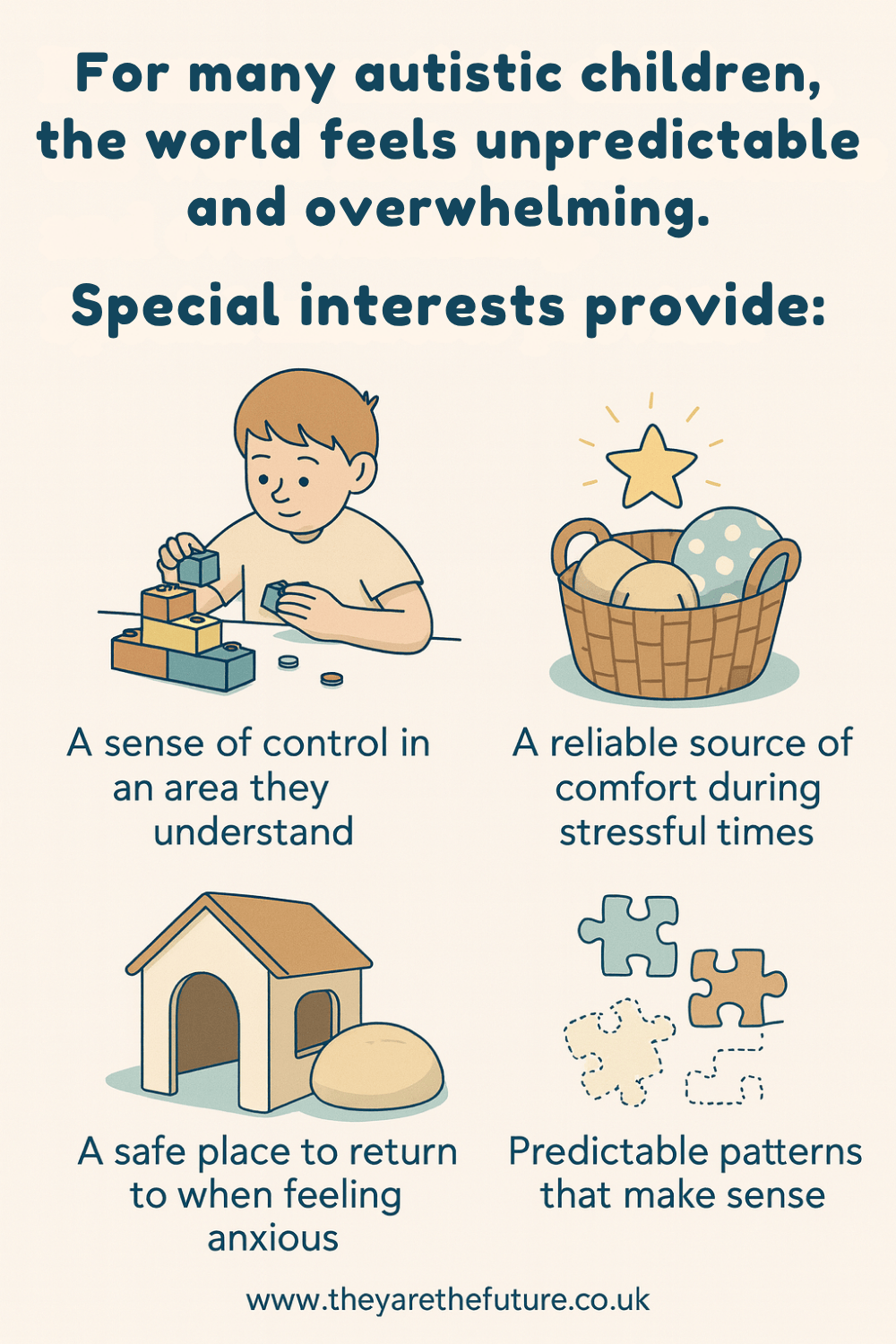
For many autistic children, the world feels unpredictable and overwhelming. Special interests provide:
- A sense of control in an area they understand
- A reliable source of comfort during stressful times
- A safe place to return to when feeling anxious
- Predictable patterns that make sense
Learning and Skill Development Through Special Interests
Special interests often speed up the development of important skills:
- Vocabulary growth through interest-related words
- Research skills as children look for more information
- Organization abilities as they sort and categorize information
- Memory techniques to store detailed knowledge

Building Social Skills and Connections
Special interests and passions can help build friendships and develop social skills:
- Shared interests form the foundation of many friendships
- Being an expert can earn respect from peers
- Interest-based clubs provide structured ways to socialise
- Online communities connect people with similar interests

Future Career Paths
Many successful autistic adults trace their careers directly to childhood special interests:
- The child fascinated by computers who becomes a software engineer
- The animal lover who studies veterinary medicine
- The pattern enthusiast who excels in data science
- The transport-focused child who finds fulfillment in urban planning
When Intense Interests Present Challenges
You might face real concerns when special interests or obsessions:
- Dominate conversations so much that they become one-sided
- Create resistance to necessary activities like homework or bedtime
- Lead to distress when your child must stop and do something else
- Limit exposure to a broader range of experiences
- Involve repetitive questions that exhaust family members
These challenges need thoughtful behaviour management rather than completely restricting the interest. Research shows that trying to eliminate restricted interests rarely works and often makes things worse.
Autism Parenting & Special Interests: Finding the Balance
The question isn’t whether to support special interests but how to support them in helpful ways.
1. Observe and Understand
Before making decisions about boundaries, take time to understand what role the interest plays for your child:
- Does it provide comfort during stress? You might notice more engagement during transitions or challenging situations.
- Does it serve as social connection? Some children use their interests to start conversations, even if they’re one-sided.
- Is it a sensory experience? The visual, sound, or touch aspects might meet important sensory needs.
- Does it offer predictability? The routine of engaging with the interest might create helpful structure and reduce anxiety around repetitive behaviour.
Understanding the purpose helps you make better decisions about supporting or setting boundaries.

2. Use the Motivational Power
Special interests create natural opportunities for learning when you incorporate them into:
- Academic learning: A child who loves dinosaurs might engage more with math problems featuring T-Rex or writing assignments about prehistoric times.
- Daily routines: Morning checklists with space-themed images can motivate the astronomy fan.
- New skill development: A transport interest can expand into map reading, understanding schedules, or learning geography.
- Reward systems: Time with special interests can motivate completion of less preferred activities.
3. Create Balanced Boundaries
Clear structure helps most autistic children thrive. Visual boundaries around intense interests work particularly well:
- Visual schedules showing specific times for the interest and other activities
- Timers that give concrete signals for transitions
- First/Then boards: “First homework, then 30 minutes of dinosaur videos”
- Interest tokens that can be earned and traded for interest time
The key is consistency, random or changing limits often create more problems than they solve.
4. Expand Restricted Interests Rather Than Eliminate Them
Instead of trying to redirect your child away from their obsession, think about how to broaden it:
- From trains to transportation systems to geography to travel
- From a specific movie to movie-making to storytelling to creative writing
- From dinosaurs to paleontology to geology to earth science
This approach respects the interest while gently widening your child’s experience.
5. Use Hyperfixations to Build Social Skills
Special interests and hyperfixations can become pathways to meaningful relationships:
- Find clubs or groups focused on the interest area
- Connect with other parents whose children share similar interests
- Create structured opportunities for your child to share their knowledge
- Teach social scripts for discussing interests (when to pause, how to ask questions)

Real Examples: Interest-Based Support in Action
These examples are based on some of the children I have worked in my clinic, but any names and identifying details have been changed.
Using Special Interests to Support Academic Development
Ten-year-old Aiden had an intense interest in weather systems.
Working with his teachers, I helped them incorporate weather data into maths lessons (calculating temperature differences, reading graphs), use cloud formations for science, and encourage weather journal writing for English.
His engagement improved dramatically, and skills developed through weather-related learning gradually transferred to other topics.
Managing Challenging Behaviour Through Special Interests
Six-year-old Maya’s space obsession led to meltdowns whenever she had to stop watching astronomy videos for bedtime.
Her parents created a visual schedule with clear “space time” periods, introduced a bedtime routine featuring her favourite space book, and developed a “space mission morning checklist” that rewarded completing tasks with brief planet facts.
This behaviour management approach reduced meltdowns dramatically as the boundaries became consistent and predictable.
Special Interests And Developing Social Skills
Fourteen-year-old Dev’s detailed knowledge of computer components came out as one-sided talks that overwhelmed peers.
Working together, his parents and I helped him find a coding club where this knowledge was valued, develop cue cards to help him recognise when others wanted to speak, and practice conversation starters beyond his special interest.
Over time, Dev formed meaningful connections with peers who shared his passion while learning to engage in broader conversations.
When to Seek Additional Support
Consider professional help if:
- Your child becomes extremely distressed when they can’t engage with their interest
- The interest significantly interferes with sleep, eating, or other essential activities
- You’re struggling to establish workable boundaries despite consistent efforts
- The content of the interest is inappropriate or potentially harmful
- Your family is experiencing significant stress related to managing the interest
Child psychologists, occupational therapists, and speech therapists with autism expertise can offer strategies tailored to your child’s specific situation.
A Final Thought About Your Autistic Child’s Special Interests
To summarize: Your child’s special interests and obsessions are not problems to fix. They’re windows into how your child experiences the world. Their intense interests can become ways to connect and learn about your child.
If you only see a child “obsessed with train timetables,” you miss the pattern recognition abilities, memory skills, and genuine joy this interest brings. By understanding, valuing, and gently guiding these special interests, you honour your child’s way of being while supporting their growth.
Recently I was chatting with an autistic adult who said: “When I was a kid, I was obsessed with classifying insects. That was my way of making sense of everything around me. The adults who actually got that and encouraged it instead of trying to shut it down were so important to me. They basically told me my way of seeing the world was okay.”
It’s a reminder that sometimes the best thing we can do for kids is simply make space for who they already are.
Dr Lucy Russell is a UK clinical psychologist and Clinical Director of Everlief Child Psychology. She qualified as a clinical psychologist from Oxford University in 2005 and worked in the National Health Service for many years before moving fully into her leadership and writing roles.
In 2019 Lucy launched They Are The Future, a support website for parents of school-aged children. Through TATF Lucy is passionate about giving practical, manageable strategies to parents and children who may otherwise struggle to find the support they need.
Lucy lives with her family, rescue cats and dog, and also fosters cats through a local animal welfare charity. She loves singing in a vocal harmony group and spending time in nature.
