
Is It Behaviour… Or Sensory Overload?

Your child explodes over brushing their teeth. Or they lash out in class. Maybe they refuse to put on their school shoes or scream when you wash their hair.
And you’re left wondering: Is this bad behaviour, or is something deeper going on?
These moments are hard. Really hard. As a clinical child psychologist, I’ve worked with thousands of families facing these exact scenarios. You want to help your child and you want things to be calmer. But you also need to understand what is really happening.
Often, the answer lies in a part of your child’s development that no one has explained to you before. Sensory processing.
In this article I’ll show you how to spot the difference between behaviour and sensory overload. And if what you read starts to ring true, I’ll point you to my practical eBook, What Is Sensory Processing?, which can help you understand and support your child in a whole new way.
Why Sensory Overload (or Under Stimulation) Can Look Like Behaviour Problems
Sensory overload happens when your child’s brain receives more input than it can handle. This might be noise, movement, light, temperature, smell or touch. It might even be internal sensations like hunger or needing the toilet.
Imagine being at a loud concert with flashing lights and someone poking you repeatedly. Now imagine being asked to sit still and do a maths worksheet in that state. That’s the reality for many children with sensory differences.
For some children, certain sensations feel too strong, too fast or too unpredictable. For others, the input is too low, and they are constantly seeking more.
Sensory under-stimulation – also known as sensory under-responsiveness – happens when your child’s brain isn’t receiving enough input to stay regulated. This could be a lack of movement, sound, touch or visual interest. It might also include internal sensations like low energy, boredom or feeling disconnected from their body. Some children experience a complex mix – under-stimulated in some senses and overwhelmed in others at the same time.
When a child is overwhelmed or under stimulated, they are not being naughty. They are doing the best they can with what they have at that moment. Their behaviour is often their nervous system’s way of saying “I’m not okay.”
Here’s a little video I made!
Signs It Might Be Sensory Processing, Not Defiance
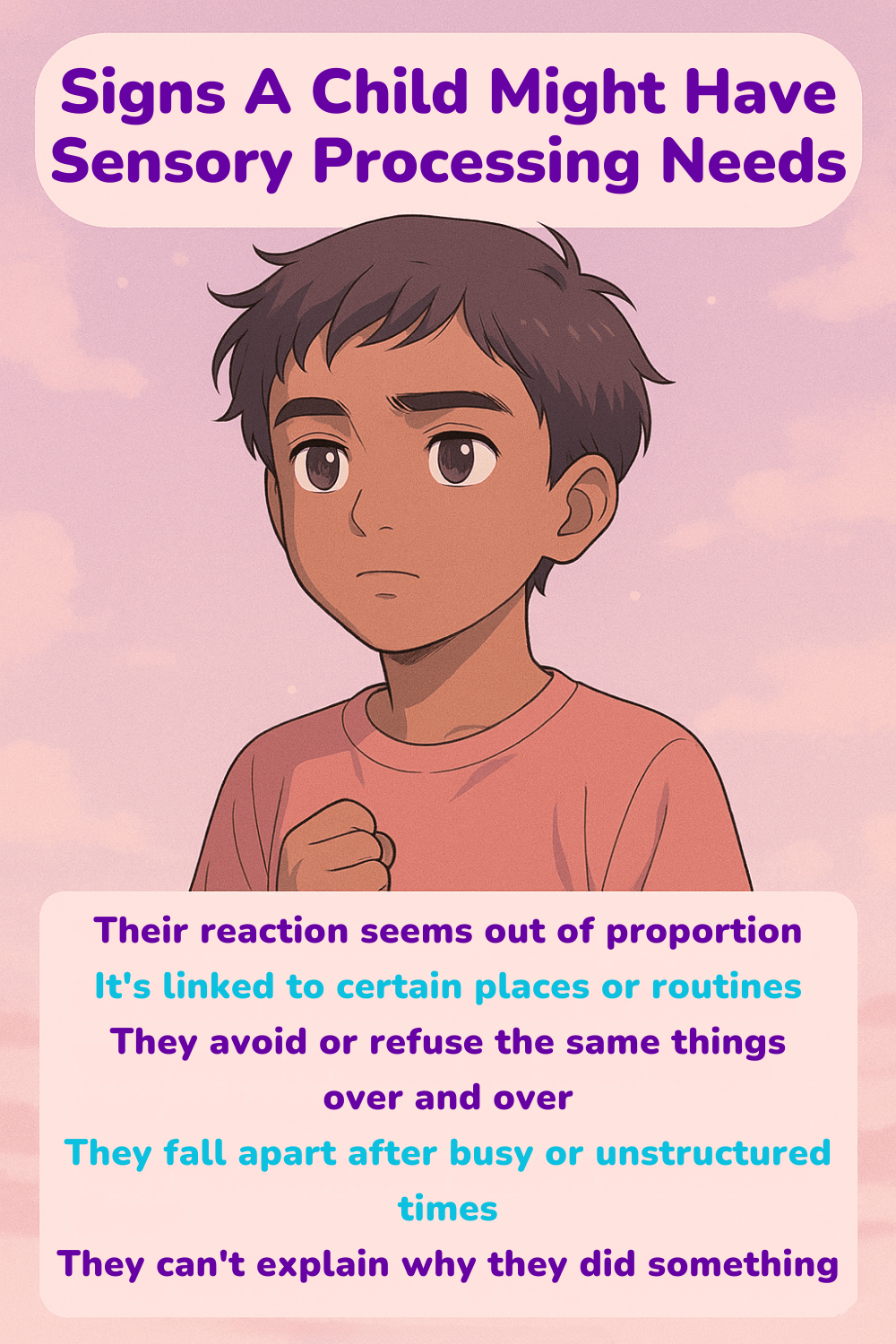
Here are some common signs that your child’s behaviour might have a sensory cause:
The reaction seems out of proportion
For example, your child has a full meltdown over putting on socks. This could be tactile sensitivity. The socks feel itchy, tight or “wrong” to them in a way that’s hard to explain.
It’s linked to certain places or routines
You notice the same behaviours happening in the school hall, at the supermarket, or at bedtime when it’s time to brush teeth.
They avoid or refuse the same things over and over
Hair washing, noisy hand dryers, being touched, crowded rooms, or certain clothing.
They fall apart after busy or unstructured times
After school. After playdates. After a busy birthday party. Their sensory system has reached its limit.
They can’t explain why they did something
Your child hits a classmate or slams a door and when you ask why, they say “I don’t know.” That’s often true. Their thinking brain was offline.
What You Can Do About Your Child’s Sensory Processing Differences
You don’t need a diagnosis to start making helpful changes. Here are some simple things you can try right away.
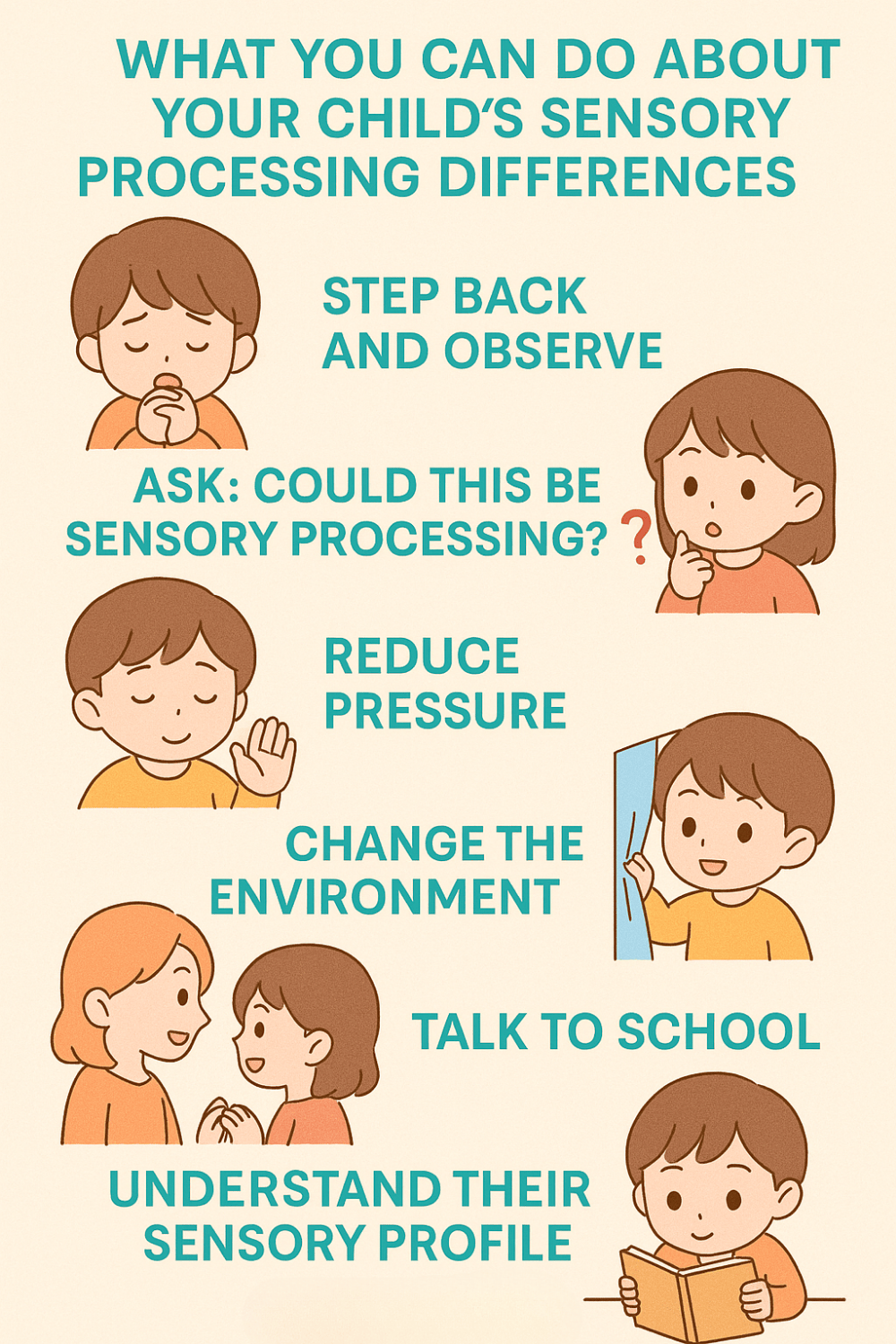
Step Back And Observe
Look for patterns. When does your child struggle most? What is happening around them? Is it loud? Crowded? Chaotic? Is there pressure to sit still, follow instructions or change activity quickly?
Ask: Could This Be Sensory Processing?
Instead of thinking “They’re being rude” try “Could they be overwhelmed?”
Instead of “They’re being silly again” try “Could they be under-stimulated and seeking movement?”
Reduce Pressure
If your child is heading into overload, pushing through will often make things worse. It’s okay to pause, slow down or adjust expectations.
Change The Environment
Try ear defenders in noisy places. Let them wear soft clothes. Offer a chewable necklace or fidget at school. Create a quiet space with cushions or blankets at home.
Talk To School
You do not need a formal diagnosis to ask for support. Teachers are often very open to practical suggestions. Share what you’ve noticed. Your child might benefit from movement breaks, alternative seating, or a quiet place to recover.
Understand Their Sensory Profile
This is where the What Is Sensory Processing? workbook comes in. It gives you a clear, parent-friendly way to figure out what’s really going on for your child, without getting lost in jargon.
Want to Learn More About Your Child’s Sensory Processing? This Resource Will Help
What Is Sensory Processing? is a printable, pdf eBook I created to help parents and teachers understand the connection between sensory needs and everyday struggles.
Inside, you’ll find:
- An explanation of all 8 senses, including proprioception and interoception
- Clear signs of sensory sensitivity and sensory seeking
- Real-life case studies and reflection prompts
- What helps, what doesn’t, and how to start making simple changes
- Practical strategies for home and school routines
- A space to build your child’s unique sensory profile
Whether you are new to the idea of sensory differences or already suspect it plays a part in your child’s challenges, this workbook is designed to help you take action.
You can find it the What is Sensory Processing eBook here.

A Final Word of Reassurance
If you’ve been blaming yourself, or feeling helpless, you just need a bit more support and information. And once you have that support and information, everything will start to make more sense.
Your child is reacting to a world that feels intense, confusing or uncomfortable to them.
Once you see their behaviour through a sensory lens, the way you support them can change completely.
Dr Lucy Russell is a UK clinical psychologist and Clinical Director of Everlief Child Psychology. She qualified as a clinical psychologist from Oxford University in 2005 and worked in the National Health Service for many years before moving fully into her leadership and writing roles.
In 2019 Lucy launched They Are The Future, a support website for parents of school-aged children. Through TATF Lucy is passionate about giving practical, manageable strategies to parents and children who may otherwise struggle to find the support they need.
Lucy lives with her family, rescue cats and dog, and also fosters cats through a local animal welfare charity. She loves singing in a vocal harmony group and spending time in nature.
