
The ADHD Brain vs a Regular Brain: How to Support Your Child

Your child can spend ages building, yet cannot start homework. You’ve explained the morning routine, but they’re still wandering around without socks. It’s understandable to feel frustrated.
ADHD means attention deficit hyperactivity disorder. This neurodevelopmental difference can affect how your child manages everyday tasks. Understanding what makes those tasks difficult helps you choose support that works for them.
Is the ADHD brain different from a neurotypical brain?
Yes, studies find differences in how brain regions develop and work together. However, there’s considerable overlap between children with and without ADHD.
I’m going to use the word “neurotypical” to describe children without ADHD or another neurodevelopmental condition. As you read, keep your own child in mind. Some findings will fit what you notice; others may not.
ADHD brain vs regular brain: five differences you might notice
You might recognise your mornings or homework sessions in the examples below.
Children without ADHD may also experience these difficulties. Every child’s support needs are different.
| Everyday skill | With ADHD | Without ADHD |
|---|---|---|
| Attention | Directing attention can be harder | Attention is often easier to direct |
| Planning and remembering | Organising steps can be harder | Organising steps is often easier |
| Motivation | Waiting for rewards can be harder | Waiting is often easier |
| Pausing | Pausing before responding can be harder | Stopping to think is often easier |
| Emotions | Some children need more help recovering from frustration | Recovery may be easier |
Attention and focus
Your child may concentrate on Lego but lose track during homework. Sustaining attention involves several brain networks, rather than a single concentration centre.
The default mode network is especially active during inward-focused thinking. This includes daydreaming, recalling memories and imagining the future. Its connected hubs include the medial prefrontal cortex and posterior cingulate cortex. These regions, towards the front and back, form part of that thinking network.
Other systems support attention to outside tasks, sometimes called a task positive network. Activity in these systems and the default network often follows opposing patterns. A large study found those opposing patterns were slightly less pronounced in ADHD.
These findings suggest internal thoughts may interrupt attention more easily in ADHD. Your child might lose their place during homework when a memory or idea appears. This is one possible explanation for distraction, rather than proof about your child.

Executive functions: planning, memory and getting started
Getting ready for school requires executive function: skills for organising and managing tasks. One skill, working memory, holds information briefly while your child uses it.
A 2025 review combined results from eight studies testing working memory. On average, children with ADHD performed less well than children without ADHD. The tasks tested holding and using information.
At home, your child might understand “get dressed, brush your teeth, then pack”. Remembering later steps while dressing puts demands on their working memory. If keeping track is difficult, they might finish dressing but forget what follows.
Try offering each instruction as they need it, reducing what they must remember.
Motivation, rewards and dopamine
Even when your child remembers their homework, Friday’s promised treat can seem distant. Children with ADHD often prefer smaller, immediate rewards over larger, delayed ones. So, a nearer reward may help your child feel more motivated today.
Scientists explore this preference by studying how the brain responds to rewards. Dopamine is one of the neurotransmitters, or chemical messengers, involved in that response. It helps us learn which actions lead to something rewarding.
You may hear this simplified to “children with ADHD have too little dopamine”. A 2024 review found limited evidence for that explanation. Staying with homework also requires attention, which involves other messengers. These include noradrenaline, also called norepinephrine.
We cannot explain your child’s motivation through one chemical alone. But you can respond to their difficulty waiting by acknowledging effort immediately. They experience something positive while they’re working, instead of waiting until Friday.
Impulse control
Your child might know they should wait, yet interrupt before you’ve finished speaking. Knowing the rule requires remembering it; waiting also requires holding back their response. Scientists call this inhibitory control.
The prefrontal cortex, towards the brain’s front, helps control responses. A 2025 review examined brain activity while children completed stopping tasks.
During these tasks, average activity was lower in the right inferior frontal gyrus. This is one area within the prefrontal cortex. Children with ADHD performed less well on stopping tasks, on average.
Those results don’t establish why your individual child interrupts. At home, notice whether they can pause more easily with a prompt such as an agreed hand signal. A prompt gives them a reminder at the moment they need to wait.
Emotional regulation
Your child may know what helps when they’re upset, such as taking a break. But remembering to do this can be much harder when disappointment hits. They need support to recognise their feelings and use those strategies in the moment.
In a 2025 study, children with ADHD showed greater emotional difficulties than children without ADHD. They also used less reappraisal: thinking about a situation differently to change their feelings.
For example, your child might interpret a low mark as “I always fail”. You could practise another interpretation together: “I need help with this topic.” Reappraisal means changing that interpretation, rather than simply telling them to stop being upset.
The study doesn’t prove why your child finds managing feelings difficult. If trying another interpretation helps them, practise when they’re ready to talk. When they’re overwhelmed, start by helping them settle, as described below.
For more ways to practise together, explore our emotion regulation activities for children.
Can a brain scan show ADHD?
No MRI brain scan can currently diagnose ADHD reliably in your child. Brain imaging can reveal group differences, but those groups’ results overlap.
MRI measures brain structure, including brain volume (size) and cortical thickness (outer-layer depth). Research includes the cerebellum, but findings vary across studies.
Functional MRI estimates activity through blood oxygenation changes linked to blood flow. Resting-state fMRI records those signals during rest.
Using these scans, a 2024 study found small ADHD-related differences in coordinated brain activity. These involved attention-related areas and the basal ganglia. Small average differences, however, do not provide a diagnostic test for your child.
Five practical ways to support your child’s ADHD brain
Break tasks and instructions into smaller steps
If your child forgets later instructions, give them less to remember. Say “Put your socks on”, then offer the next step. For homework, make starting smaller: “Let’s find the right page together.” This reduces the remembering and planning needed before your child can begin.
Use visual reminders and predictable routines
Show your child the steps using pictures, a checklist or phone reminders. If they lose their place, they can check what’s next without remembering everything. Keep the sequence familiar, so they have less to plan each morning.
Give immediate feedback and encouragement
Help your child notice their progress: “You’ve started your first question. That took effort.” Agree small milestones, such as two questions before a chosen break. This gives your child something closer to work towards than Friday’s treat.
Build movement breaks into the day
If your child finds sustained attention difficult, agree short work periods together. NICE includes movement breaks among recommended environmental adjustments. Try stretching between sections, or doing a silly dance. Agree when to return and notice what helps them restart.
Support emotional regulation before problem-solving
When your child is overwhelmed, they may find talking things through too much. Keep your words simple, and offer comfort or space, depending on what helps them. Once they’re ready, agree a way to show you they need a break.

NewA new tool from me, Dr Lucy Russell
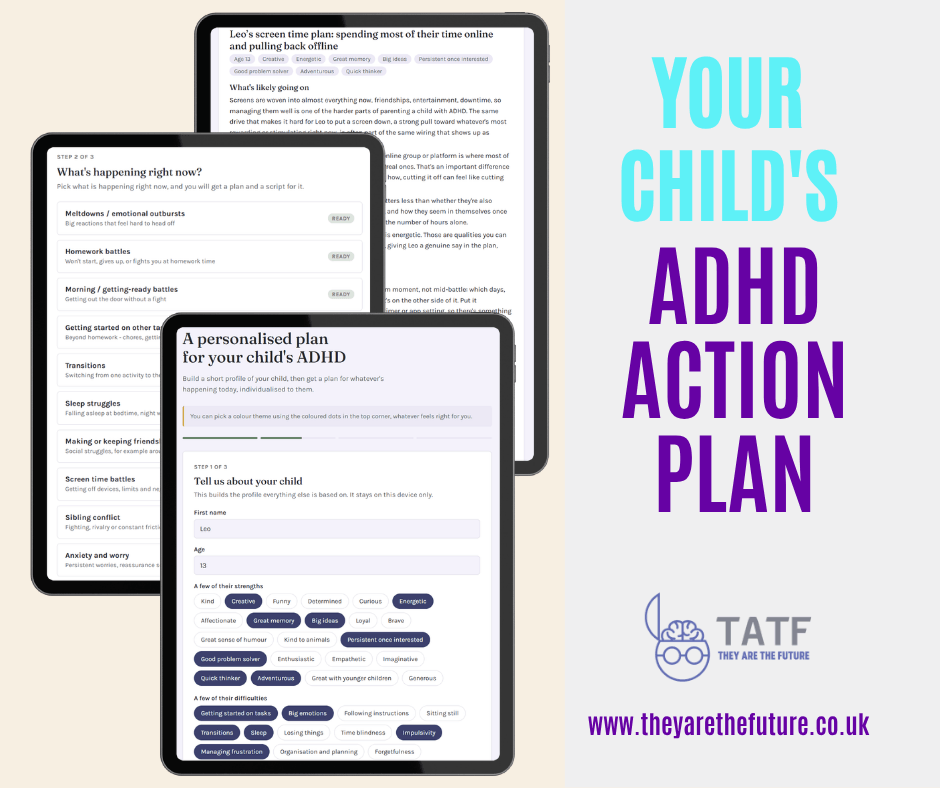
Your Child’s ADHD Action Plan
Tell my new online tool about your child and what’s happening today. In about two minutes you get a plan built around them: what’s likely going on, what to say in the moment and what to try next time.
Early access price: £17 ($21 USD). One payment, lifetime access.
The most important thing to remember
When you next find your child without socks, pause before repeating yourself. Have they forgotten the next step, become distracted, or found starting difficult? Noticing where they get stuck helps you decide how to help.
A checklist beside their clothes might help more than another reminder. I’d start with a small change and see what tomorrow brings. These adjustments can complement professional support, including stimulant medication when prescribed by a doctor.
Dr Lucy Russell is a UK clinical psychologist and Clinical Director of Everlief Child Psychology. She qualified as a clinical psychologist from Oxford University in 2005 and worked in the National Health Service for many years before moving fully into her leadership and writing roles.
In 2019 Lucy launched They Are The Future, a support website for parents of school-aged children. Through TATF Lucy is passionate about giving practical, manageable strategies to parents and children who may otherwise struggle to find the support they need.
Lucy lives with her family, rescue cats and dog, and also fosters cats through a local animal welfare charity. She loves singing in a vocal harmony group and spending time in nature.