
Why Your Teenager Is Exhausted After School (And How Recovery Time Helps)

If your teenager comes through the door after school snappy, withdrawn, or close to tears over something small, you are seeing something a lot of parents of this age group recognise. They have held it together all day, and now they have nothing left.
A teenager who’s exhausted after school is usually dealing with mental exhaustion rather than ordinary tiredness, and that after-school slump is one of the most common things parents ask me about.
It is worth remembering how much we ask of our young people in a day. School is a long stretch of demands, social pressure, and effort to meet other people’s expectations. For many teens, and especially those who are autistic or who work hard to mask how they are feeling, all of that takes a heavy toll.
A noisy, busy day can also bring sensory overload, which drains a child’s energy long before any homework begins.

This is where it helps to remember that behaviour is always communication. A short temper, slammed door, one-word answers – these are signs that their capacity to cope has run low, rather than signs that they have forgotten how to behave.
In my experience, the rudeness or the withdrawal is usually telling you that they are not feeling balanced or rested, rather than that they do not care. Understanding this does not mean excusing unkind behaviour, of course. It means we are far better placed to respond well, rather than react in the moment.
Why Extra Demands Backfire When a Teenager is Exhausted After School
The instinct, understandably, is to get the next thing moving. Homework, jobs around the house, unpacking their school bag. The trouble is that we are then adding more demands to a teen who has already given everything they have for the moment. Academic pressure and the intensity of school performance does not stop at the school gates, and a depleted brain has little left until it recovers.
It helps to think of your relationship with your teen as a kind of account. All day, life makes withdrawals: sit still, focus, get along with everyone, manage your feelings, organise yourself for the next lesson. If the first thing that happens at home is another “withdrawal” from the account, there is nothing left to draw on, and that is often when things flare up.
Build in recovery time
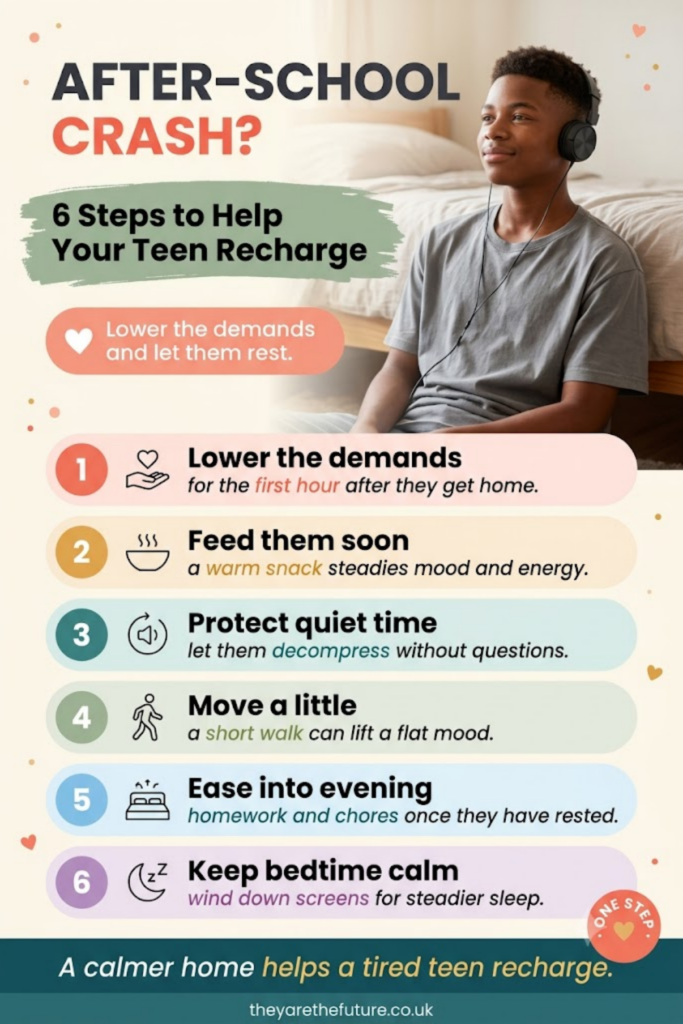
Plan recovery time before you load on any expectations.
When you know your teen has had a demanding day, say so out loud. Something like, “I know today has taken a lot out of you, so I want you to have some downtime first.” Then give them a stretch of low-expectation time: a snack and their room, time away from everyone, a programme they like, whatever helps them.
Short brain breaks like this are necessary for self-regulation – the ability to manage feelings – and protect your teen’s mental health over time.
For autistic teens especially, building a “sensory diet” into the day, a planned mix of calming and alerting activities, can ease their sensory overload and help head off burnout before it takes hold.
It also helps to give your teen a clear end point. Effort is so much easier to manage when they can see where it finishes. So if you know a family visit on a school night is going to be a stretch, you might agree that they come along for the first ten minutes, and then they can slip off to their room. The expectation still stands, but now it comes with a bit of built-in recovery time.
And you don’t have to choose between holding a boundary and being kind. You can do both at once. “Yes, the homework still needs doing, and you can have half an hour to yourself first” is firm and warm in the same breath.
Look after your own reserves too
None of this is easy when you are worn out yourself. When your teen is irritable and you are running on empty too, your patience wears thin. Sometimes it helps to picture yourself as something steady and grounded (like an anchor or a rock) while the weather moves around you.
When you can name what you are feeling, breathe, and stay calm, the whole house has a better chance of staying calm, and you model what managing a hard feeling looks like. Here’s my guide to staying calm as a parent.
Check the everyday basics
Emotional load lots of little things added up, but pay attention to the wellbeing basics:
- Sleep hygiene: Teenagers’ body clocks naturally shift later during adolescence, which can disrupt their sleep patterns and lead to insufficient sleep. Protect their circadian rhythm (their natural sleep-wake cycle) by limiting screens and blue light in the evening to combat sleep deprivation – which leads to daytime sleepiness, lack of focus at school, and can impact mood and mental health. If your teen has got into an unhealthy sleep pattern, consider my sleep course called Sleep for Success.
- Nutrition: Offer healthy snacks immediately after school to refuel their brain and body. Keep a careful eye on caffeine intake from energy drinks, which can interfere with rest.
- Movement: While it sounds counterintuitive, a short burst of physical activity after school can lift mood and improve energy levels compared to staying sedentary.
Steadier sleep patterns and consistent sleep hygiene help a great deal, and keeping up gentle physical activity through the week will lead to steadier energy and fewer mood swings. Ongoing poor sleep feeds chronic mental exhaustion and, over time, can affect both mental health and school performance.
TAKE THE QUIZ!
When to seek more help
If the tiredness is severe, constant, or feels like unexplained fatigue that does not get better with rest, speak to your doctor. They can rule out physical causes such as iron deficiency anaemia, consider conditions like delayed sleep phase syndrome or chronic fatigue syndrome, and refer you to a sleep specialist if needed.
A useful thing to watch for, and to mention to your GP, is post-exertional malaise, where a teen feels noticeably worse for a day or two after even ordinary activity. Where anxiety or low mood is adding to the exhaustion, talking therapies such as cognitive behavioural therapy can help.
Persistent unexplained fatigue is always important to take seriously, and conditions like chronic fatigue syndrome, though uncommon, are easier to manage when they are picked up early.
When the exhaustion becomes a daily pattern
If your teen is wiped out after school most days, it is worth understanding masking and burnout, where a young person spends so much energy hiding how they feel and keeping up with expectations that there is nothing left over.
Over time that effort catches up with them, and the after-school crash is often the first sign. In burnout, the body’s biological rhythms, including sleep, can be significantly affected, which is part of why the exhaustion deepens. Left unchecked, this kind of burnout can affect a young person’s mental health, not just their energy levels.
My short course, Masking and Burnout, explains what this looks like in neurodivergent children and teens, why it happens, and how to help them recover and protect their energy. It takes under an hour to work through.
Dr Lucy Russell is a UK clinical psychologist and Clinical Director of Everlief Child Psychology. She qualified as a clinical psychologist from Oxford University in 2005 and worked in the National Health Service for many years before moving fully into her leadership and writing roles.
In 2019 Lucy launched They Are The Future, a support website for parents of school-aged children. Through TATF Lucy is passionate about giving practical, manageable strategies to parents and children who may otherwise struggle to find the support they need.
Lucy lives with her family, rescue cats and dog, and also fosters cats through a local animal welfare charity. She loves singing in a vocal harmony group and spending time in nature.
