
Signs of ADHD in Kids: What to Look For at Home and at School

Signs of ADHD in kids fall into three groups: inattention (drifting off, losing things, forgetting instructions), hyperactivity (constant movement and restlessness) and impulsivity (interrupting and acting before thinking). What points towards ADHD is a pattern that has been there for a long time. It shows up in two or more settings, such as home and school, and makes everyday life noticeably harder for your child.
I’m a UK child clinical psychologist and I co-run a clinic in Buckinghamshire called Everlief Child Psychology, where we support families through assessments and follow-up support. Below I explain what the symptoms look like day to day, how they change with age and what to do with what you notice.
ADHD Symptoms in Kids at Home and at School
Childhood ADHD (attention deficit hyperactivity disorder) is a difference in how the brain manages attention, activity and self-control. Most children show these behaviours sometimes. They become significant when they happen often, last for months and are much stronger than in other children of the same age.
| Group of signs | What you might see at home | What teachers might see |
|---|---|---|
| Inattention | Forgets the second step of an instruction, loses jumpers, drifts off mid-conversation | Unfinished work, careless mistakes, gazing out of the window |
| Hyperactivity | Finds it very hard to stay at the table, talks almost non-stop | Fidgeting, tipping their chair, getting out of their seat |
| Impulsivity | Interrupts, finds waiting for a turn very hard, quick to flare up | Calls out answers, pushes in the line |
Most children have a combined presentation, with symptoms from more than one group, and some are mainly inattentive or mainly hyperactive-impulsive. The NHS (UK) guide to ADHD in children and young people notes that symptoms usually start before age 12. It also says that very young children are often distractible and impulsive for other reasons, such as tiredness, anxiety or stress.
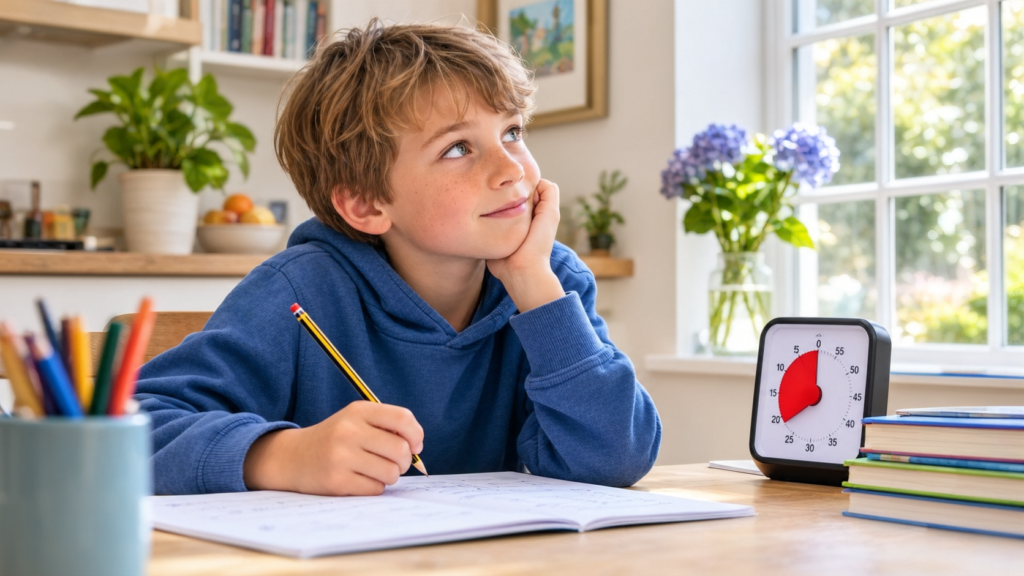
How ADHD Symptoms Change as Children Grow
ADHD symptoms in children look different at 6 than at 15, so they are easy to miss.
In the early primary years (around 5 to 7), you are more likely to see busy, physical symptoms and plenty of impulsivity. Your child might run everywhere, find carpet time in class hard and need many reminders for simple routines.
From about 8 to 11, lessons ask more of your child’s organisation and focus, so forgetfulness, unfinished work and homework battles often come to the fore.
In the teenage years, hyperactivity often becomes an inner restlessness. Impulsivity can lead to hasty choices and last-minute panics over deadlines. My article on ADHD symptoms in teens covers this age group in more detail.
The Quieter Symptoms of ADHD Parents Often Miss
Some children with ADHD are well behaved and calm in class, so their difficulties go unnoticed. This quieter presentation is often inattentive ADHD. The same NHS guide points out that professionals recognise ADHD less often in girls. Girls more commonly have inattentive symptoms, which are harder to spot.
Deya, age 11 (not a real child, but based on many children I’ve worked with), is polite and eager to please in class. Her teacher describes her as a lovely, quiet member of the class. At home, her parents see a different picture. Deya takes over an hour to get ready in the morning, starts three activities and finishes none. She often comes out of school exhausted and tearful. She has started to call herself stupid when homework feels hard.
If this sounds familiar, my guides to hidden ADHD in girls and ADHD without hyperactivity explain these quieter signs in more depth.
Is It ADHD or Something Else?
Several other things can look very like ADHD symptoms in kids. Poor sleep makes almost any child distracted and irritable. Anxiety can make a child fidgety, forgetful and quick to have an outburst. Sensory differences, such as finding noise, bright lights or scratchy clothes overwhelming, make concentrating in a busy classroom hard. A learning difficulty such as dyslexia can lead a child to switch off in lessons. This is why a thorough assessment needs to look at all of these before anyone draws a conclusion.
Autism and ADHD often occur together, which can be confusing. My article on ADHD vs autism sets out the main differences.
If you are already fairly sure your child has ADHD, or they have a diagnosis, I created a tool called Your Child’s ADHD Action Plan to help with whatever feels hardest right now. You choose what you most want help with (such as homework, mornings or meltdowns). You then get a plain-English explanation of what might be going on, words to use in the moment, ideas to try next time and a one-page summary for school. It is for parents of children aged 5 to 17.
Frequently Asked Questions
Parents usually notice a child who is far more active or distractible than other children their age, with noticeable impulsivity. This often starts in the first years of school. You might see a child who races from one activity to the next or needs every instruction repeated.
This is very common, especially for quieter children and girls. Many children work hard to hold things together in class and then show their tiredness at home, so share what you see with school.
In the UK, specialists usually assess ADHD from around the age of 6, because younger children are naturally very active and impulsive. The process starts with a referral through your doctor or your child’s school, followed by a specialist assessment. Some children only receive a diagnosis in their teens.
Boys more often show visible hyperactivity and impulsivity, while girls more often show inattentive symptoms, such as daydreaming, losing things and finding it hard to get started. Girls therefore often receive a diagnosis later.
What to Write Down Before You Speak to School or a Doctor
A short written record is the most useful thing you can bring to a teacher, the school’s SENCo (special educational needs coordinator) or your family doctor. In my clinic, notes like these help us understand a child faster.
Over two or three weeks, jot down:
- Three or four specific examples, each with the date and what happened (for example, “Left his sports kit behind for the third time this week”).
- Where it happens: home, classroom or clubs.
- How long you have noticed it, and whether anything changed when it started, such as a house move.
- How it affects your child: their friendships, schoolwork, sleep and how they talk about themselves.
- What already helps, even a little, such as a regular routine or physical exercise.
Ask the teacher to note what they see over the same weeks.
What Happens After You Ask for an Assessment
In the UK, the next step is usually a referral for an ADHD assessment through your doctor or the school. In England you may also be able to use Right to Choose, which I explain in my guide to Right to Choose ADHD assessments for children.
If ADHD is confirmed, treatment and support usually involve the whole family. ADHD treatment can include parent education programmes, practical changes at home and in the classroom, and other treatment options, including ADHD medication for some children, that the specialist team will talk through with you. Your child’s treatment plan is reviewed as they grow. ADHD often runs in families, as genetics play a big part.
In the US and other countries, your child’s paediatrician is usually the first person to ask.
Dr Lucy Russell is a UK clinical psychologist and Clinical Director of Everlief Child Psychology. She qualified as a clinical psychologist from Oxford University in 2005 and worked in the National Health Service for many years before moving fully into her leadership and writing roles.
In 2019 Lucy launched They Are The Future, a support website for parents of school-aged children. Through TATF Lucy is passionate about giving practical, manageable strategies to parents and children who may otherwise struggle to find the support they need.
Lucy lives with her family, rescue cats and dog, and also fosters cats through a local animal welfare charity. She loves singing in a vocal harmony group and spending time in nature.
