
Five Ways Teachers Can Support Autistic Girls in the Classroom

If you’ve got an autistic girl in your mainstream school class, she might be doing well academically and behaving appropriately. Or she might be visibly anxious, struggling with her behaviour, or falling behind. Regardless of how she presents, understanding the specific needs of autistic girls in the classroom can be harder than you’d expect.
I’m Dr Lucy Russell, a child clinical psychologist. I work with families and also deliver training to schools. What I’ve learnt from both is that in the classroom, autistic girls present across the full spectrum. Some mask their struggles behind quiet compliance. Others show visible distress. The presentation varies widely, which means the support she needs varies too. Many underdiagnosed girls never receive the support they deserve, which can lead to autistic burnout and poor emotional regulation.
Many teachers tell me they’re uncertain how to help an autistic girl in their class, even when they know about her diagnosis. Autism in girls often shows up in ways that don’t match the typical profile, so knowing what reasonable adjustments actually make a difference takes real awareness.
Every autistic girl is different. These five strategies are tools you can draw from. Pick the ones that fit your situation, your class, your resources, and the individual needs of each girl in front of you.

Key Takeaways
- Recognise hidden distress: Autistic girls often mask their challenges to blend in, and sensory overload may not look disruptive. It can show up as perfectionism, fatigue, or becoming quiet after school.
- Prioritise clear communication: Reduce mental load by providing short, concrete instructions and visual supports like checklists or timetables to improve social communication and help with transitions and daily expectations.
- Adjust the sensory environment: Conduct regular sensory audits to identify anxiety triggers such as harsh lighting or background noise, and provide reasonable adjustments including quiet zones or early access to classrooms to minimise stress.
- Support unstructured times: Break and lunch hours are often the most challenging parts of the school environment. Offer early entry, structured activities, or quiet alternatives to support peer relationships.
- Support executive function without shame: View organisational struggles as challenges with executive function rather than carelessness, and offer respectful, gender-specific support systems to help pupils with special educational needs stay on track.
1. Recognise Hidden Distress in Autistic Girls Beyond Behaviour
Sensory overload does not always look disruptive. It can show up as perfectionism, fatigue, stomach aches, freezing when asked, or tears after school. A girl may look calm and still be working flat out inside. It is vital to monitor their overall mental health, as internalised distress often goes unnoticed when a student is not acting out in class. Many underdiagnosed girls experience autistic burnout without proper support.
When a teacher says that something is not quite right, take it seriously. A child can be bright and high-achieving, yet still be anxious and overwhelmed. If you are struggling to spot these signs in complex social situations, an educational psychologist can provide valuable insight into peer relationships and social communication patterns.
If you want a clearer picture of how autistic girls mask at school, read more about autism and masking.
2. Prioritise Clear Communication That Reduces Mental Load
Clear communication reduces the mental load for autistic girls and can strengthen social communication skills. Many autistic girls in a mainstream school setting find that their social interaction improves when instructions are kept short, predictable, and direct. Short, concrete language removes the guesswork that adds to their anxiety, and therefore it builds their confidence.
One step at a time is often best. Using visual supports such as a checklist, a visual timetable, or a written prompt can help with memory, transitions, and confidence. Build in flexibility without drawing attention. Reasonable adjustments such as allowing a movement break, offering a different seat, or providing extra time to manage transitions can support a pupil without making her feel singled out.
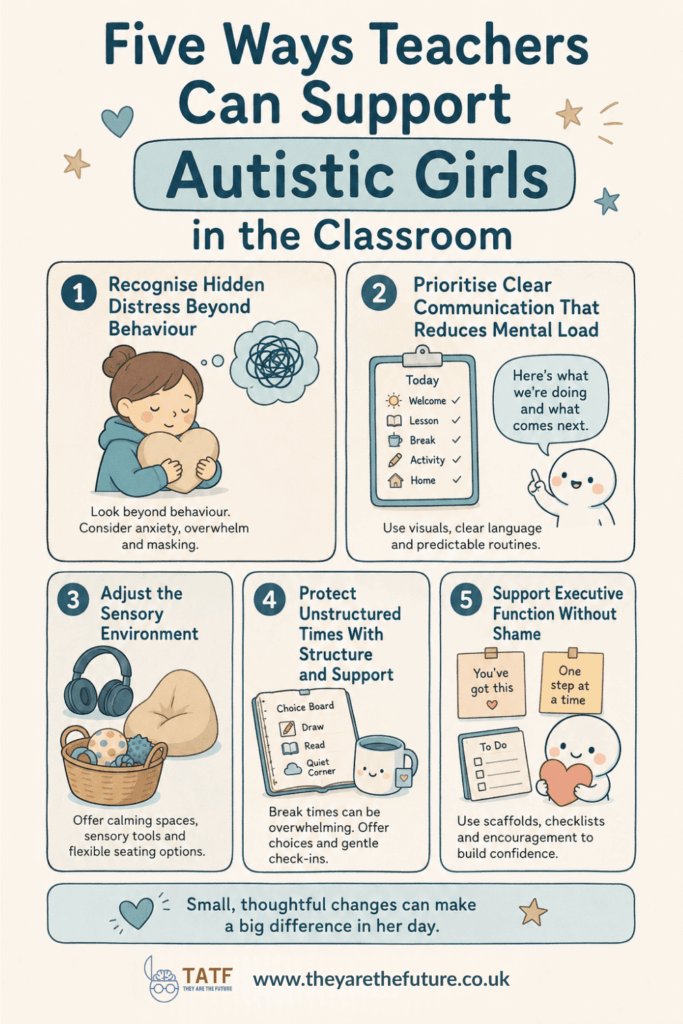
3. Adjust the Sensory Environment for Autistic Girls in the Classroom
The school environment and classroom atmosphere matter significantly for neurodivergent pupils with special educational needs. Constant background noise, harsh lighting, visual clutter and crowded spaces can lead to sensory overload, which drains a student’s energy before their learning has even begun. A sensory-friendly school environment is crucial for preventing autistic burnout.
Conduct a regular sensory audit of your teaching space to identify hidden anxiety triggers. Small changes such as providing a quieter seat, reducing visual clutter, and establishing dedicated quiet zones can lower stress levels quickly. Building in frequent movement breaks and offering a safe place to reset helps students manage their sensory needs throughout the day.
Many autistic girls report that specific anxiety triggers make it difficult to access learning. Movement breaks are simply part of providing reasonable adjustments and supporting neurodiversity in your mainstream school classroom. They help autistic girls manage their sensory needs so that learning can actually happen.
4. Protect Unstructured Times With Structure and Support
Transitions, lunch hours and busy corridors are often the most challenging aspects of the school environment for autistic girls. These unstructured periods involve complex social situations and peer relationships that can feel overwhelming. Unstructured time can amplify sensory and social demands at the exact moment when a student’s mental energy is depleted.
Some pupils may benefit from early entry to classrooms, a structured lunchtime activity, or a quick adult check-in before the bell rings. Support for unstructured times can transform a student’s day. Consider creating quiet, structured alternatives to lunch in the main hall, allowing early classroom access to avoid crowded corridors, and scheduling brief check-ins. These reasonable adjustments and flexible approaches prevent the overwhelm that often stems from girls having to navigate complex social situations without support.
5. Support Executive Function Without Shame
Forgotten books, lost letters and missed deadlines are usually caused by challenges with executive function rather than carelessness. For many neurodivergent pupils with special educational needs, these organisational difficulties are often exacerbated by the complex social interaction and demands required during unstructured times, which can leave them with little mental energy – especially for afternoon lessons.
Packing-up reminders, time warnings before a transition, and chunked homework are examples of helpful executive function support. Keep help flexible and respectful. Support should feel like a natural part of the school day.
When teachers implement reasonable adjustments and systems that help a student stay organised without drawing unwanted attention to them, they protect the student’s self-esteem and ensure they can focus on their academic progress. Gender-specific support that recognises the unique needs of autistic girls is essential in the mainstream school setting.

Frequently Asked Questions
Why do autistic girls in the classroom often go unrecognised in school?
Many autistic girls are highly skilled at masking or camouflaging their difficulties to fit in with their neurotypical peers. Because they may appear compliant or polite in class, teachers often miss the internal exhaustion and anxiety they experience beneath the surface. Understanding neurodiversity and gender-specific support is crucial, as underdiagnosed girls continue to struggle without proper intervention. Poor emotional regulation and autistic burnout often result from lack of understanding in the mainstream school setting.
Are movement breaks and flexible adjustments considered ‘special treatment’?
No. Reasonable adjustments such as movement breaks and flexible seating are designed to help a student regulate her nervous system. By offering subtle, inclusive options that support learning, you create a school environment where all students can manage their sensory needs effectively. These adjustments are particularly important for preventing autistic burnout.
What are the most difficult times of the school day for autistic girls?
Unstructured periods like lunch hours, busy corridors, and transitions between lessons are often the most taxing. These times combine sensory overwhelm with complex social situations and peer relationships that demand navigating peer interaction without adult support. Providing early entry to classrooms or a quiet, structured activity during lunch can help prevent the overwhelm that often leads to autistic burnout and mental health decline. Gender-specific support that recognises these challenges is essential in the mainstream school environment.
TAKE THE QUIZ!
Conclusion: Supporting Autistic Girls in the Classroom
Teachers do not need to get everything right the first time. What matters is your willingness to notice, stay curious, and adapt when something is not working. By implementing gender-specific support and adopting reasonable adjustments rooted in understanding neurodiversity, you can play a vital role in helping each girl in your mainstream school build a positive identity and thrive at school.
For a research-backed introduction to supporting neurodivergent students with special educational needs in mainstream schools, the Centre for Research in Autism and Education at UCL publishes evidence-based guidance for educators.
When a student feels understood and less overloaded, learning can finally become the priority.
Dr Lucy Russell is a UK clinical psychologist and Clinical Director of Everlief Child Psychology. She qualified as a clinical psychologist from Oxford University in 2005 and worked in the National Health Service for many years before moving fully into her leadership and writing roles.
In 2019 Lucy launched They Are The Future, a support website for parents of school-aged children. Through TATF Lucy is passionate about giving practical, manageable strategies to parents and children who may otherwise struggle to find the support they need.
Lucy lives with her family, rescue cats and dog, and also fosters cats through a local animal welfare charity. She loves singing in a vocal harmony group and spending time in nature.
