
Why Autism in Girls Looks Different – And Why That Matters

Autism in girls is a neurodevelopmental condition where the brain processes information, senses, and social communication differently. Because of social expectations and the pressure to fit in, many autistic girls work incredibly hard to “mask” their traits, making the signs easy to miss, even for professionals.
Is autism less common in girls?
You may have heard the statistic that the gender ratio shows autism is diagnosed in around 3 or 4 boys for every 1 girl. However, many researchers now agree that the gap is partly driven by how autism has been understood and measured.
A lot of early research focused on boys, and this has meant that the diagnostic criteria follow a male model. In other words, many well-known “classic” signs fit boys more neatly. That can delay support especially for autistic girls who have lower support needs (previously referred to as “high-functioning autism”, “mild autism”, or “level 1”, as defined in the DSM-5, which often involves more subtle presentations). It can also lead to misdiagnosis – for example with anxiety.
Autism affects how the brain processes information, senses, and social communication. Still, autism traits in girls can look different because of social expectations, early learning, and the pressure many girls feel to fit in.

An Example From My Clinic
Sophie’s parents sought my clinical advice. Their bright 10-year-old was struggling socially, but not in ways they associated with autism. She had friends, but this was mainly one intense friendship at a time, and often ended in conflict. She could “do” eye contact and spoke passionately about her interests. Previous professionals had suggested anxiety or perfectionism, yet beneath the surface, Sophie was working extremely hard to appear “normal”.
I’ve seen this pattern again and again in more than 20 years as a clinical psychologist. At my clinic, Everlief Child Psychology, around 50% of children diagnosed with autism (formally known as autism spectrum disorder) are girls. That doesn’t mean autism is new in girls, it means we are getting better at spotting it.
Signs of autism in teenage girls
Secondary school adds social pressure, sensory overload, and a bigger workload. Autism in girls often means masking ramps up for many, and so does exhaustion.
You might notice:
- A sudden spike in anxiety, school refusal, or panic symptoms
- Friendship stress that feels constant and intense
- A drop in mood, confidence, or self-esteem
- More shutdowns at home, especially after holding in emotions all day
- Rigid routines around food, study, clothing, or personal care in autistic girls
These signs of autism in teenage girls can be mislabelled as “just hormones” or “teenage attitude”.
Sometimes anxiety or low mood gets treated on its own, while the autism underneath stays hidden, which risks escalating poor mental health in teens. This is one reason diagnosing autism in girls needs a careful, whole-child approach.
Why autistic girls can look “social” but still struggle
Many parents tell me, “But she has friends.” Often, what you’re seeing is a small number of intense friendships, sometimes one close friend at a time. The connection can be strong, but it can also lead to friendship difficulties through conflict, misunderstanding, and big emotions.
Also, some girls can make eye contact, smile, and chat. That doesn’t always mean social interaction feels natural or safe, and they often have to work very hard to maintain these social niceties, which can lead to burnout.
Masking and social camouflaging
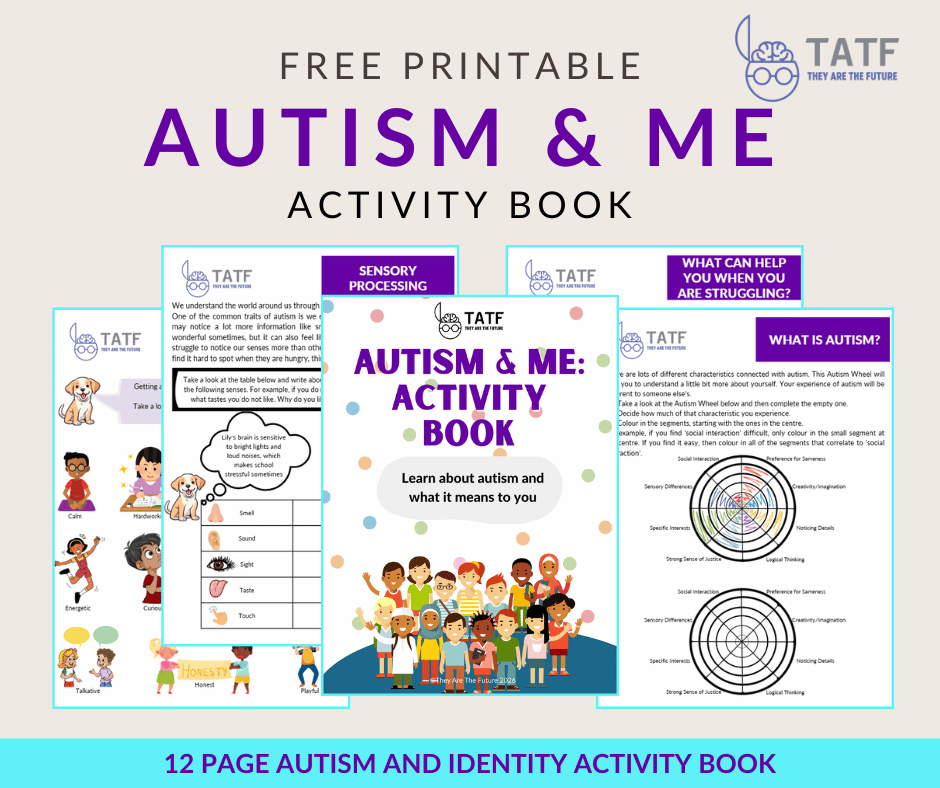
One of the common characteristics of autism in girls is masking (also called social camouflaging). This means your daughter learns to copy what seems to work socially, even when she feels confused or overwhelmed inside.
You might notice things like:
- Social scripting, using memorised phrases and “safe” topics to navigate social cues
- Mirroring, mimicking others by copying how other children speak, dress, or act
- Social echolalia, repeating the right-sounding words or phrases without fully grasping the meaning
- Hiding confusion, nodding, smiling, or changing the subject to avoid getting caught out
This can look like confidence. However, it often comes with a cost. Research from University College London links camouflaging with anxiety, exhaustion, and a shaky sense of identity. You may see that at home as tears, anger, or a complete crash after school.

Key Takeaways
- Autistic girls often mask their traits to fit in, appearing social and capable on the surface while experiencing exhaustion, anxiety, and friendship struggles underneath.
- Common signs include intense but unstable friendships, deep special interests that seem typical, sensory sensitivities, perfectionism, and meltdowns or shutdowns at home after holding it together at school.
- Missed diagnoses lead to mental health risks like anxiety and depression; early recognition unlocks tailored support at home and school for better wellbeing and achievement.
- Parents can help by believing her experiences, reducing sensory stress, providing predictability, and advocating for clear school adjustments like visual timetables and movement breaks.
- A diagnosis offers relief, self-understanding, and practical strategies, helping girls stop performing and feel safer in themselves.
Special interests can look “typical”, but the intensity stands out
You might picture autism interests as trains, maps, or systems. Some girls love those too, but many autistic girls develop passions that look more typical on the surface.
For example, you might see deep focus on:
- Books and reading
- Animals
- Drawing, art styles, or mythology
- Celebrities, singers, actors, or online creators
What’s different is often the depth of these intense interests. Your daughter might know an unusually large amount, spend hours researching, engage in repetitive behaviors around them, or struggle to switch topics when talking about them. In many cases, the interest also has a social element, like fan communities or creative groups.
This is one of the reasons traits of autism in girls are sometimes missed.
Imagination and play can be rich, detailed, and repetitive
There’s an old myth that autistic children lack imagination. In real life, many autistic girls show autism symptoms through vivid inner worlds.
You might notice:
- Detailed and intricate pretend play, with clear rules that must be followed
- Repeating the same storylines because they feel safe and predictable
- A love of fiction, sometimes used as a guide for real-life social situations
Reading can be a form of study for social interaction. Your daughter may learn phrases, tone, and social “scripts” from characters for mimicking social behavior. That can help her cope, but it can also hide the underlying effort.
Friendships can also look slightly different. Some autistic girls prefer younger children, older children, or adults, because those relationships feel simpler and less pressured.
Emotional and sensory patterns can be misunderstood
A lot of the signs of autism in girls show up through emotions and the senses, not through obvious behaviour at school.
Common patterns include:
- Sensory processing issues (such as reactions to noise, smells, bright lights, certain fabrics, or food textures) or subtle stimming behaviours, often dismissed by others as the person simply being “too sensitive.”
- Internalized symptoms, turning emotions inward with worry, withdrawal, or people-pleasing rather than outward anger
- Holding it together all day, then having meltdowns or shutdowns at home where it’s safe, often triggered by sensory overload
- Strong perfectionism, with panic or shame over small mistakes
If teachers describe a “quiet, high-achieving” child, while you see signs of autism like distress at home, that might be a clue that she’s using all her energy to cope at school.
What happens when autism is missed in girls
Undiagnosed autism in girls can lead to years of feeling different from their neurotypical peers without understanding why. Many girls become experts at coping on the outside, while feeling lost inside.
The late diagnosis of autism in girls is common. Girls are often misdiagnosed, for example with anxiety and depression. This means they are identified as autistic 2-3 years later than boys on average, according to this research. Many are not spotted until secondary school or adulthood. By this time, very often their mental health has already taken a hit. Here is a quick video I made about autism getting missed in anxious girls.
Mental health risks
Research suggests that when girls are missed, they face higher mental health risks, including anxiety, depression, eating difficulties, or hurting themselves. This review explores those links in more detail.
For many, a diagnosis brings relief. It helps you both make sense of long-standing patterns, and make a positive plan moving forwards.
What missed autism can mean at school
When a school doesn’t recognise autism, your child can slip through the cracks, especially if she behaves well and keeps up academically.
You may see:
- Support needs being overlooked, because she “seems fine”
- Underachievement, despite strong ability (often linked to stress, executive functioning issues, or sensory overload)
- Daily strain, like noise sensitivity, messy transitions, or organisational overwhelm
- Misread social difficulty, labelled as shyness, moodiness, or attitude rather than genuine confusion
When we move towards identifying autism in girls, it means the school can get a clearer map about how to support each child most effectively. That usually leads to happier children, who are more likely to achieve their academic potential.
Signs to look for (a parent-friendly checklist)
Every child is different, but these patterns often show up in girls with autism.
Social signs
- One or two intense friendships (a common autistic trait), rather than a wider group, OR feeling on the edge of friendship groups or difficulties with social interaction
- “Looking social” but struggling with social skills like the unwritten rules
- Feeling drained after school or parties
- Preferring adults, younger children, or older children
- Frequent fallouts, despite trying very hard to be kind
Communication signs
- Strong vocabulary, but difficulty with social communication (timing, tone, body language, back-and-forth)
- Taking words literally, or missing hints and implied meanings
- Talking at length about interests, or going very quiet in groups (situational mutism)
- Using prepared lines or “safe” conversation topics
- Subtle differences in tone, pitch, or volume
Emotional and sensory signs
- Big feelings that seem to come out of nowhere
- High sensitivity to noise, light, touch, taste, or smell
- A strong need for predictability and routines
- Shutdowns (going blank, quiet, or withdrawn) when overwhelmed
- Struggling with change, transitions, or surprises
These can be early signs of autism in girls, even in primary school where early intervention can make all the difference. They can also become more obvious later, especially during puberty and secondary school.

How you can support autistic girls (at home and school)
Whether you’re exploring an assessment or you already have a diagnosis, early intervention can support your child in practical ways. Small changes often make the biggest difference.
If you’re considering next steps, parents can request an autism assessment through their GP or school SENDCo. Screening tools like the AQ-10 or CAST can be helpful starting points for discussion.
What you can do as a parent
Let go of “normal”. Aim for safety, wellbeing, and confidence, not constant fitting in.ou can.
Believe her experience. If she says it hurts, it’s too loud, or it’s too much, treat that as real.
Keep life predictable where you can. Use simple routines, and give early warning when plans change.
Reduce sensory stress. Cut out scratchy labels, choose comfortable fabrics, use headphones, and soften harsh lighting. (These are just examples; it’s going to be different for each child.) An occupational therapist can help tailor these adjustments.
Protect recovery time. For example, quiet time after school could be essential for your daughter’s mental health and nervous system recovery.
Make the social rules clear. Explain things directly and kindly, rather than expecting her to “pick it up”.
Respect special interests. These interests help with emotional regulation, recharge her, and make her feel capable.
What you can ask of school
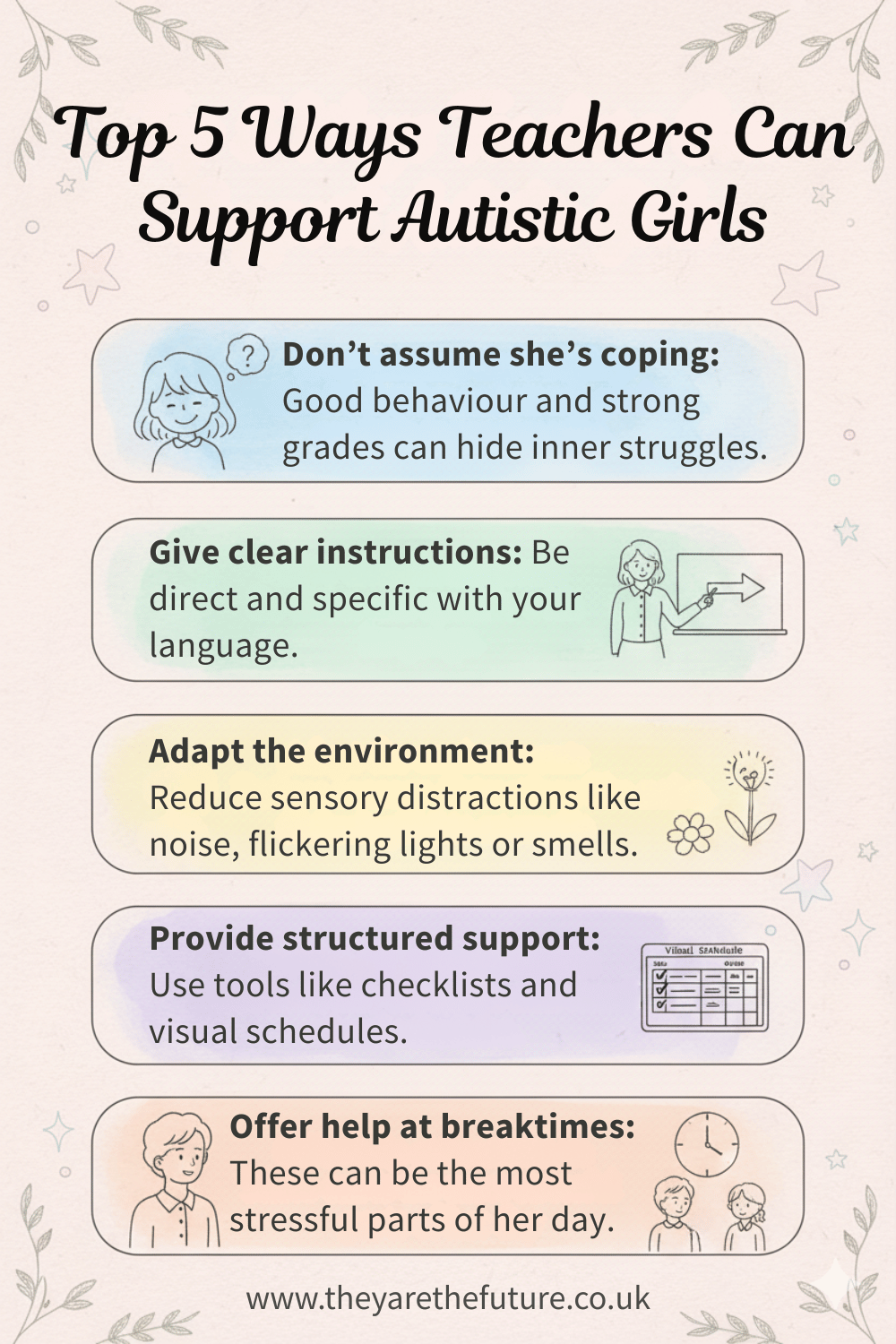
- Look beyond grades and behaviour. A calm, compliant child can still be struggling.
- Use clear, direct instructions. Short, concrete language reduces stress.
- Make sensory adjustments. Seating, noise levels, lighting, and movement breaks can help.
- Add structure. Checklists, visual timetables, and written steps reduce overload.
- Support unstructured times. Break and lunch can be the hardest part of the day.
- Consider executive functioning. If she loses things or forgets homework, she may need extra support in this area.
What you can look for in health professionals
- Keep up to date with the latest research and news on autism in girls and women, not only the “typical male” picture
- Listen closely to parents’ experiences
- Understand that anxiety, eating issues, perfectionism, or low mood can sit alongside autism
This is especially important for girls who have lower support needs, where masking and high ability can blur the clinical picture.
What a diagnosis can offer your daughter
A diagnosis is not about boxing your child in. It’s about making sense of her needs, her strengths, and her stress points.
When you move towards diagnosing autism in girls, you often unlock:
- Better support at school
- Clearer strategies at home
- Less shame and self-blame
- A stronger identity, built on self-understanding
Most importantly, your daughter can stop performing for the world and start feeling safer in herself. Even a late diagnosis can provide immense relief. That’s the real value of recognising autism in girls, and acting early when you can.
Frequently Asked Questions
Is autism less common in girls?
No, autism is not less common in girls, but it is often underdiagnosed due to male-biased criteria and girls’ tendency to mask traits. Research shows the gender gap narrows when accounting for camouflaging, with many girls identified later, especially those with lower support needs. At clinics like Everlief, around 50% of autism diagnoses are girls, reflecting better recognition.
Why do autistic girls seem social but still struggle with friendships?
Autistic girls often use masking techniques like scripting, mirroring, and hiding confusion to appear chatty and make eye contact, but this is exhausting and doesn’t mean interactions feel natural. They may have one intense friendship at a time that ends in conflict due to misunderstandings. This camouflaging leads to burnout, seen as tears or shutdowns at home.
What are key signs of autism in girls that parents should watch for?
Look for patterns like sensory sensitivities, big emotions internalized as worry or perfectionism, repetitive play with strict rules, and draining social efforts despite seeming ‘fine’ at school. Other clues include literal thinking, intense special interests with unusual depth, and preferring adults or younger peers. These can intensify in teenage years with school refusal or mood drops.
What happens if autism goes undiagnosed in girls?
Undiagnosed girls face higher risks of anxiety, depression, eating issues, and self-harm, often mislabelled as ‘quirky’ or anxious, leading to late diagnosis by 2-3 years compared to boys. They may underachieve at school despite ability due to overlooked needs like executive functioning or sensory overload. A diagnosis brings relief and enables targeted support to prevent mental health escalation.
How can parents support an autistic girl at home and school?
Believe her sensory and emotional experiences, create predictability with routines and warnings for change, and allow recovery time after school. Advocate for school adjustments like direct instructions, sensory tweaks, and social support during unstructured times. Respect special interests for emotional regulation and seek professionals updated on girls’ autism presentations.
Dr Lucy Russell is a UK clinical psychologist and Clinical Director of Everlief Child Psychology. She qualified as a clinical psychologist from Oxford University in 2005 and worked in the National Health Service for many years before moving fully into her leadership and writing roles.
In 2019 Lucy launched They Are The Future, a support website for parents of school-aged children. Through TATF Lucy is passionate about giving practical, manageable strategies to parents and children who may otherwise struggle to find the support they need.
Lucy lives with her family, rescue cats and dog, and also fosters cats through a local animal welfare charity. She loves singing in a vocal harmony group and spending time in nature.
