
Screen Time Battles: How to End the Daily Standoff

If screen time battles have become part of your daily routine, you are dealing with something most families in our digital age go through. The standoffs, the meltdowns when you call time, the child who says “one more minute” and means thirty.
Understanding why children find screen time so hard to put down changes everything about how you respond. Let me talk you through.
Why Your Child Struggles to Switch Off
Screens are designed to be hard to leave. Persuasive design (the deliberate engineering of apps, video games, and social media to keep users hooked) works by triggering dopamine responses in the brain. Each notification, reward, or new level is a small hit that keeps children coming back. This is not a failure of willpower, it’s just biology.
For children under 12 in particular, the part of the brain responsible for executive function and impulse control is still very much under construction. When you ask your child to stop, their brain can even perceive it as a threat. Their emotional, reactive brain fires up before their thinking brain has a chance to step in.
This does not mean anything goes, of course. It means understanding what is happening neurologically will help you respond in a way that actually works.

The Mistake Many Parents Make
When screen time ends and a child kicks off, the instinct is to reason, threaten, or repeat yourself until something gives. These power struggles are exhausting for everyone, and they rarely result in the cooperation you are looking for.
The problem is that in those moments of high emotion, the thinking brain is not fully available. Appealing to logic, issuing warnings, or trying to get them to acknowledge that the rules are fair will not land. Their “guard dog brain” is in charge, and it is not listening to negotiation.
Threatening to take tablets or smart phones away permanently, lecturing, or pleading are all ineffective in the heat of the moment. They tend to escalate things rather than settle them.
What Effective Limits Actually Look Like
Setting limits around screen time means doing something, not just saying something.
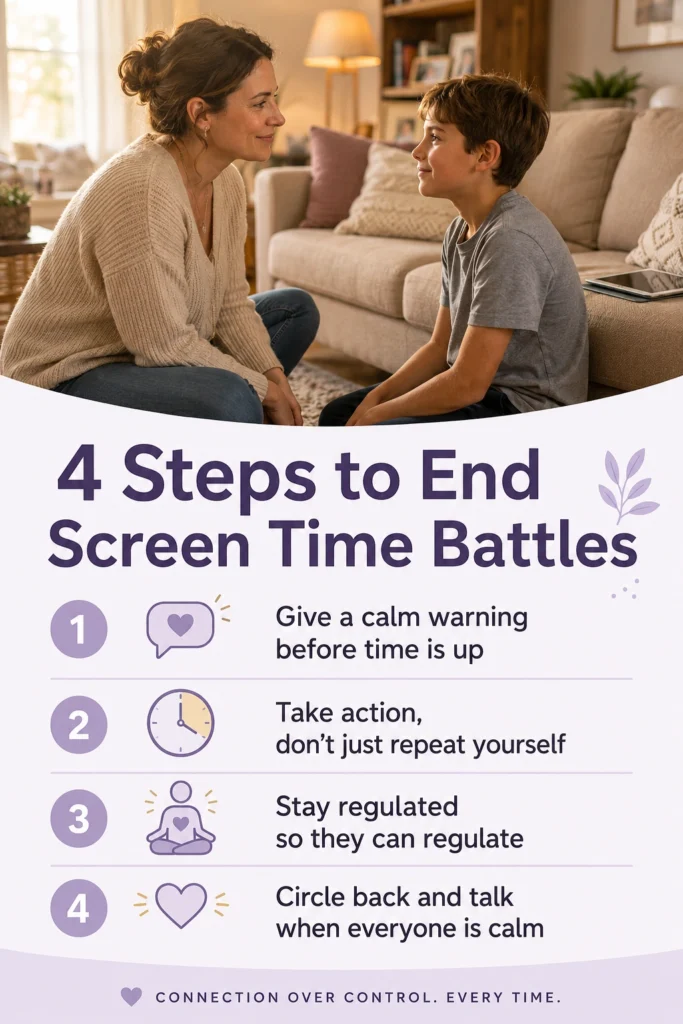
If you have asked five times and nothing has changed, asking a sixth time is not setting a limit. At that point, you need to act, kindly and calmly. That might look like:
- Walking over and offering a choice: “You can turn it off, or I will do it for you.”
- Removing the device yourself if they cannot manage it, while staying regulated and warm.
- Physically separating children if sibling arguments over screens are flaring up.
The goal is to step in before the situation escalates to a point where you are also dysregulated. The best parenting decisions rarely happen when your own frustration is at a nine out of ten.
Before You Set the Limit: Build In a Transition
Transitioning off devices is one of the hardest moments of the day for many children. Giving a five-minute warning helps, but how you give it matters. Get close, use a calm voice, and name what comes next: “In five minutes we are turning off, and then we are having dinner together.” This gives the brain a heads-up rather than a sudden jolt.
If your child has additional needs such as autism or ADHD, these transitions may be more pronounced. Predictable routines around screen time on and off can reduce daily friction significantly, and are far more effective than inconsistent rules that leave children unsure whether you mean it this time or not.
After the Outburst: The Step Parents Skip
Once the storm has passed and everyone has calmed down, there is a really important step that many families skip because it feels easier to move on.
Coming back to what happened, when everyone has calmed down, is where the actual learning takes place. A child’s thinking brain is back online an hour later, or the following day. That is the right time to talk.
It does not need to be a long conversation: “Earlier, when I said screen time was over, we ended up arguing again. Can we think together about how to make that easier next time?” This works because you are approaching it with curiosity, helping them link cause and effect (which young children genuinely struggle to do alone), and keeping the relationship intact.
“Connection before correction” is not just a nice idea. In the context of positive parenting, this principle is backed by a large body of research. Children are far more responsive to guidance from adults they feel safe and connected with, and mental health outcomes for children are consistently better in families with warm, responsive relationships alongside clear expectations.
TAKE THE QUIZ!
Problem-Solving Together: Building a Family Media Plan
For recurring battles, sit down at a calm moment and work through it together. Start by hearing their concerns first, then share your observations, then think together about solutions. This collaborative approach is the foundation of a workable “family media plan” that your child has actually had a hand in shaping.
Write all ideas down, even if theirs include “iPad whenever I want, forever.” The act of writing them down lets them know that their perspective matters. From there, you work towards solutions that feel workable for both of you. Children who feel heard are far more likely to cooperate with limits over time.
It is also worth thinking about how you use screens yourself. Modeling the “digital world behaviour” you want to see (putting your phone down at mealtimes, being unplugged for certain parts of the day) is one of the most powerful things you can do.
Co-viewing content together when you can, rather than screens always being a solo activity, helps build a tech-positive, connected family life rather than one where screens feel like the enemy.

When Reward Charts Are Not Working
Reward systems can work for some children in some situations. But I don’t advise negative actions such as removing stars or taking devices away unless the behaviour is very serious and you feel you have no other option.
Instead, examine your child’s the behaviour patterns more carefully and asking three questions:
- Why are they doing this? Are they tired, hungry, dysregulated, or struggling with a change in routine?
- What is the behaviour telling you? Do they need hands-on activities and more face-to-face connection to balance their digital world time? Is their attention span being affected by heavy device use?
- How can you teach what you want them to learn without damaging your relationship in the process?
A child sitting in their room after a screen time outburst is far more likely to be thinking about how unfair things are than reflecting on what they could do differently. If screen addiction or compulsive device use starts to seriously impact their health or family life rather than typical pushback, speak to your GP or a child psychologist.
A Practical Starting Point For Screen Time Battles
If screen time battles are a daily flashpoint, start here:
- Identify the specific moment when things tend to flare up (transitioning off devices? sibling conflict? after school?)
- Build one consistent routine around that moment
- Intervene earlier, with warmth and action rather than repeated requests
- Circle back calmly after the fact, with curiosity rather than a lecture
Progress will not be in a straight line. What you are building over time is a child who can manage transitions, regulate their emotions, and respond to limits, not because they fear the consequences, but because they understand them.
If you’re a parent experiencing regular emotional outbursts related to screen time, my short course, End Emotional Outbursts, goes deeper, giving you a practical, action-focused framework.

Dr Lucy Russell is a UK clinical psychologist and Clinical Director of Everlief Child Psychology. She qualified as a clinical psychologist from Oxford University in 2005 and worked in the National Health Service for many years before moving fully into her leadership and writing roles.
In 2019 Lucy launched They Are The Future, a support website for parents of school-aged children. Through TATF Lucy is passionate about giving practical, manageable strategies to parents and children who may otherwise struggle to find the support they need.
Lucy lives with her family, rescue cats and dog, and also fosters cats through a local animal welfare charity. She loves singing in a vocal harmony group and spending time in nature.
