
CBT Techniques for Anxiety You Can Use at Home With Your Child

When you hear cognitive behavioural therapy (CBT), you may picture formal therapy sessions in a clinic room. Yet CBT techniques for anxiety also include simple, practical skills you can gently use at home. You don’t need to be a therapist to help your child.
If you’re parenting a child or teenager with anxiety, this is for you. CBT is one of the most effective treatments for child and teen anxiety, and recent research still shows strong results across age groups. What matters most is steady practice, not doing it perfectly. In this article, I will talk you through a small number of CBT exercises in plain English, and how to match them to different anxiety patterns.
Start by understanding how CBT helps anxious children and teens
Let’s start by exploring how cognitive behavioural therapy helps with anxiety. CBT helps you and your child see the link between thoughts, feelings, body sensations, and actions.
If your child has automatic negative thoughts like “Something bad will happen”, these unhelpful thoughts can spark negative thought patterns. Then their body may tense, their feelings may surge, and they may avoid the situation.

That avoidance brings short-term relief. However, it also teaches the brain, “That danger must have been real.” Repeated reassurance can do something similar. It soothes your child for a moment, but it can stop them learning that they can cope, too.
That’s why CBT focuses on changing patterns, not just calming the moment. If you want a wider picture alongside these techniques, you can read more in my article on how to help your child with anxiety. A broader look at CBT outcomes for childhood anxiety may also be helpful for you.
The anxiety cycle: why scary thoughts grow when your child avoids things
Think of anxiety like a smoke alarm that goes off when you make toast. The alarm is real, but thinking traps make the brain overestimate the danger.
The cycle often looks like this: trigger, worried thought, anxious feeling, avoidance, relief, then stronger anxiety next time. Once you spot that pattern, CBT starts to make sense.
What your role looks like at home
Your job isn’t to remove every worry. Your role is to coach, practise, and stay calm.
So, aim to praise effort and bravery. Try not to judge progress by whether your child felt anxious. Instead, notice whether they took a step anyway.
Five CBT techniques for anxiety you can try step by step
These CBT exercises work best when you practise them in calm moments, not only during panic.

Use the ABC model to help your child make sense of anxious thoughts
ABC stands for Activating event, Belief, Consequence.
For example, A might be, “I have to go into school.” B might be, “Everyone will laugh at me.” C might be a sick feeling, tears, and refusing to go in.
You don’t need to argue with the thought. First, help your child spot it. That alone can reduce its power.
Next, you can use a strategy called cognitive restructuring through Socratic questioning to challenge and adapt the belief so it’s more helpful. In plain terms, this means asking non-judgmental, curious questions to help your child look at their worries more clearly, rather than just accepting them as fact. If your child is old enough, try my free ABC anxiety worksheet.
The goal is awareness first, not instant change. Over time, this helps uncover unhelpful core beliefs.
Teach thought challenging so worries feel less powerful
This next strategy is related to the ABC model, but it’s also a technique in itself. Once your child can name a worry, help them test it. Worries often stem from what we call “cognitive distortions” such as catastrophizing or overgeneralization, which fuel unhelpful thoughts and negative thought patterns.
Try saying:
- What’s the worry saying?
- What facts support it?
- What facts don’t support it?
- What would you say to a friend?
Then build a fairer thought. Not forced positivity, just balance. “I might feel awkward in class, but I’ve got through it before” is much more useful than “Everything will be fine”.
Try “worry time” when your child worries all day long
This works especially well for generalised anxiety disorder, where worry spreads into everything.
Set aside 10 to 15 minutes a day as “worry time”. When worries pop up earlier, write them down and say, “We’ll save that for worry time.” Then return to the present task. During worry time, your child can “worry” as much as they like, but at the end of their time, the idea is they agree to put the worry aside until the next day.
Nine-year-old Katie, for example, worried from breakfast to bedtime. Every worry felt urgent, and her parents spent most of the day fielding questions, offering reassurance, and talking her down from the next anxious thought. It was exhausting for everyone.
When they introduced worry time, they set aside 15 minutes at 6pm each day. When a worry came up at breakfast, they wrote it on a sticky note and said, “That one goes in the worry time pot.” At first Katie found this hard, and she needed reminding several times a day. But gradually, the pattern shifted. Worries still came, but they had somewhere to go. Mealtimes got calmer. Bedtime got shorter. And by the time worry time actually arrived, some of the things on her list didn’t feel so urgent after all. She was learning she had some control over her worries.
TAKE THE QUIZ!
Use graded exposure to build courage in small, manageable steps
Graded exposure is also sometimes called exposure therapy or systematic desensitization. It means facing fears in small, repeated steps – always at your child’s pace. You make a fear hierarchy – also known as a fear ladder – from the easier steps to the harder ones.
Katie, who hated separating from her Mum, started by sitting in another room for two minutes. Then she stayed with Grandma for ten minutes. After that, she managed a short playdate. Each step was repeated until it felt boring, not brave. In other words, she was training her brain to realise that being away from her mum was something she could manage.
Here’s another example: A teen with social anxiety might start by simply walking into a shop and standing at the counter, then progress to asking a shop assistant one question. From there, they might try saying hello to a classmate in the corridor, then joining a small group conversation. The trick is steady repetition, with the right balance of support and challenge. You can read more about finding the sweet spot between push and protect in my article.

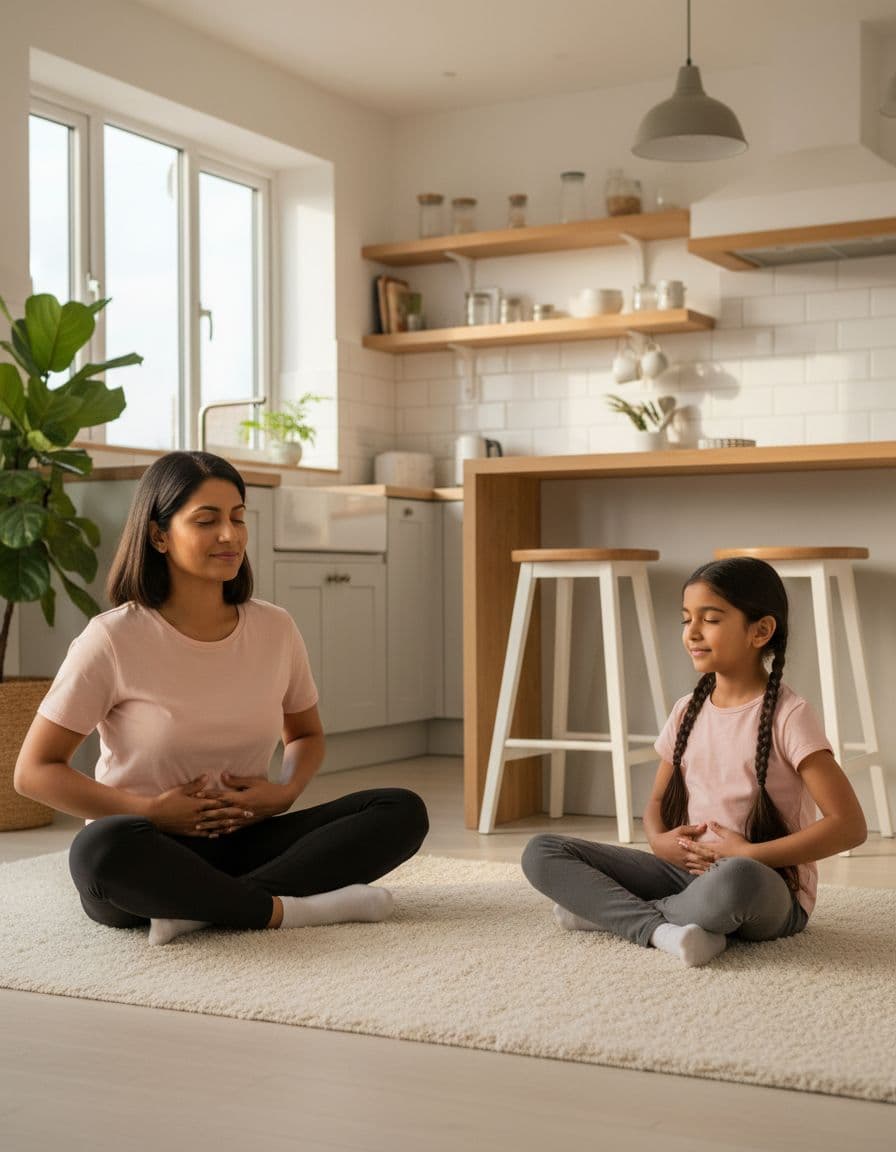
Use breathing to calm your child’s body before problem solving
When your child is anxious, their body is in alarm mode. Their heart beats faster, their breathing gets shallower, and their muscles tense up. At that point, their brain is focused on survival, not on thinking things through. Slow breathing is one of the simplest ways to interrupt that response.
The reason it works is physical. A long, slow out-breath activates the body’s calming system, which is the same system that gets switched off when anxiety takes hold. You don’t need to do much. You just need to breathe out for longer than you breathe in.
Try this with your child when they are calm, so it becomes familiar before they need it most. Place hands on the tummy. Breathe in slowly through the nose for a count of four, feeling the tummy rise. Then breathe out gently through the mouth for a count of six, feeling the tummy fall. Keep the shoulders relaxed. Repeat four or five times.
Younger children sometimes find it easier to imagine blowing up a balloon very slowly, or blowing a feather across the room without letting it drop. The image gives them something to focus on and slows the breath naturally.
Relaxation skills won’t stop anxiety altogether. The goal is to bring the body’s alarm down just enough so your child can think more clearly and engage with whatever comes next.
Match the right CBT technique to the kind of anxiety your child has
In my clinical work, I’ve found children usually need a mix of tools from cognitive behavioral therapy. Still, some CBT techniques fit certain anxiety patterns better than others.
What often works best for generalised, social, and separation anxiety
For generalised anxiety, start with worry time and thought challenging. These help when your child worries about everything and nothing. For panic disorder, breathing and grounding paired with thought challenging work well too.
For social anxiety disorder, graded exposure matters most, but never push your child too hard. Taking steps outside their comfort zone must be their decision and taken at their pace Pair it with balanced self-talk, such as, “I feel nervous, and I can still speak.”
For separation anxiety, graded exposure helps again, but routines matter too. Keep goodbyes calm, brief, and predictable. Add short coping phrases like, “This is hard, and I can handle it.”
If you want more structured support, my Outsmart Anxiety course gives you a step-by-step plan.
When to get extra support
Please get extra help if anxiety is stopping your child’s school attendance, sleep, friendships, family life, or daily functioning. Also seek support if panic, distress, or avoidance is getting stronger.
Cognitive behavioural therapy (sometimes combined with other forms of therapy) with a trained mental health professional may be needed for severe anxiety.
You don’t need to do every CBT technique at once. Choose one or two, practise them often, and let progress build up slowly. Start small, stay steady, and trust that your child can feel better with the right support.
Dr Lucy Russell is a UK clinical psychologist and Clinical Director of Everlief Child Psychology. She qualified as a clinical psychologist from Oxford University in 2005 and worked in the National Health Service for many years before moving fully into her leadership and writing roles.
In 2019 Lucy launched They Are The Future, a support website for parents of school-aged children. Through TATF Lucy is passionate about giving practical, manageable strategies to parents and children who may otherwise struggle to find the support they need.
Lucy lives with her family, rescue cats and dog, and also fosters cats through a local animal welfare charity. She loves singing in a vocal harmony group and spending time in nature.
