
Fear of Dogs in Children: A Step-by-Step Guide for Parents

Fear of dogs (or cynophobia), affects a significant number of children and is one of the most frequently seen specific phobias in my clinic. It’s common, and in most cases it can improve.
In fact, animal phobias in general are some of the most common phobias in children.
What helps is a calm, steady approach. You don’t need to push, persuade or spring surprises. A gradual exposure plan often works well, but only when your child is part of the plan and moves at a pace they can cope with.
Key Takeaways
- Cynophobia is a common fear of dogs in children that can improve with a calm, gradual approach rather than pushing or surprises.
- Look for avoidance behaviours interfering with daily life, like refusing walks or parks, to distinguish real fear from normal caution.
- The best help is gradual exposure using a hierarchy of fears (also known as a fear ladder), with your child involved, paired with breathing exercises to calm the nervous system, and praise for effort rather than achievement.
- Stay predictable, plan encounters at a manageable distance, and avoid too much reassurance or pressure, to build real confidence in your child.
- For severe cases, consult professionals, but home steps often lead to great progress as you’ll see in the examples below.
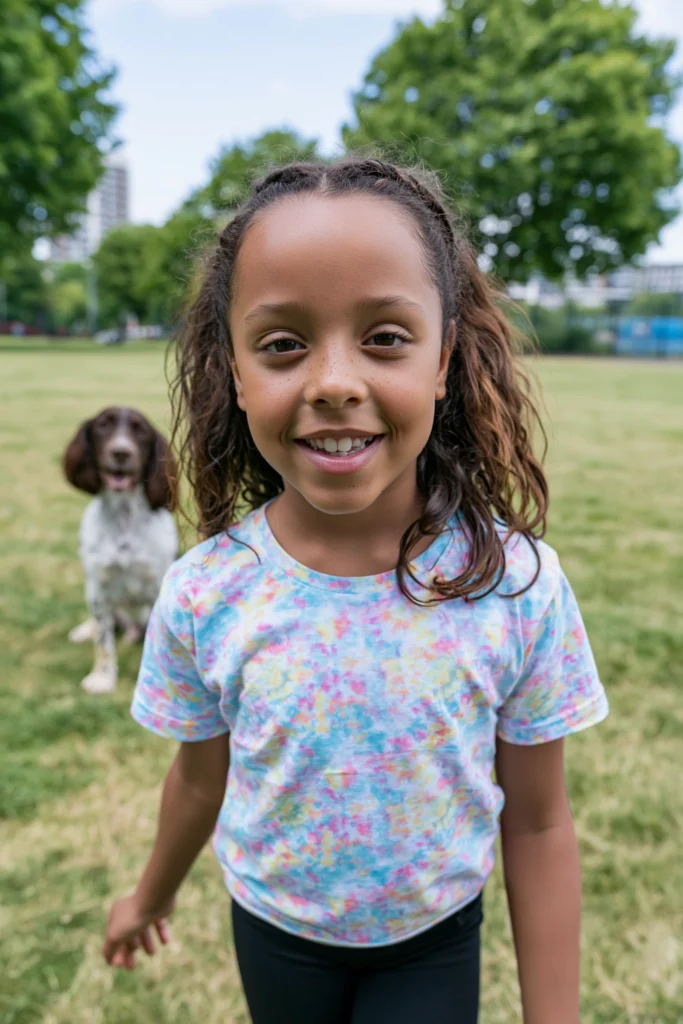
How to tell if your child has a real fear of dogs
Lots of children are cautious around dogs. That’s sensible. An excessive fear of dogs starts to interfere with daily activities.
You might notice avoidance behaviour such as refusing walks, crossing the road away from a dog, freezing when a dog appears, or crying and having panic attacks even when a dog is far away. Some children stop going to parks or worry before visits to friends’ houses.
If these symptoms meet diagnostic criteria (for example they have been present for at least six months) and lead to avoidance again and again, it’s probably a dog phobia rather than simple caution.
What may be driving the fear
Fear acquisition (what triggered the fear in the first place) often happens through direct personal experience, such as a dog barking threateningly, jumping up, or running towards your child. The age of onset is typically in early childhood. Sometimes there is no obvious trigger.
Your child may have seen a dog act unpredictably, heard an upsetting story, or picked up on someone else’s anxiety through modeling, such as observing a parent’s own fear. Try not to hunt for blame. What matters most is understanding that this can result in an unreasonable fear that feels real to your child and persists even when a dog is friendly.
What helps most, according to child psychology
The best-supported approach is gradual exposure therapy, a form of systematic desensitisation used within CBT frameworks, with calm coaching alongside it. In plain English, that means helping your child face the fear in tiny, manageable steps.
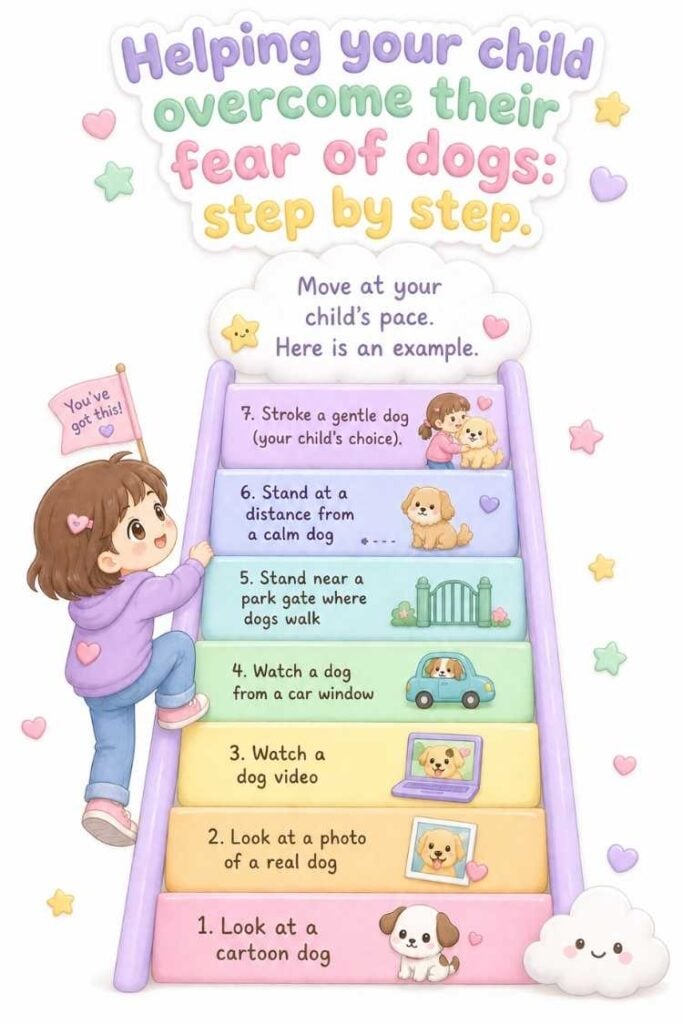
Start with small steps your child agrees to
Think of it like climbing a ladder, one rung at a time; this is known as a hierarchy of fear, or a fear ladder. Your child might begin by looking at dog pictures, then watching dogs from a car, then standing at a distance from a calm dog. The ladder will be different for every child. Pair these in vivo (real-life) exposures with calming breathing exercises and other grounding activities, as essential relaxation techniques.
Only later might they move closer, or briefly stroke a gentle dog. Let your child help choose the steps. If anxiety shoots up too far, slow down and avoid flooding (sudden intensity). A hierarchy of fear for overcoming anxiety can make this feel clearer.
Use praise, choice and repetition, not pressure
Children make better progress when they feel in control. Praise specific achievements: “You stood and watched for ten seconds”. But be sure to praise your child’s effort too, even if progress is slow.
Repeated practice is important, but only when the step feels doable. Bribing, teasing or forcing usually backfires. Fear shrinks when your child learns, “I can cope safely”, rather than when they’re pushed past their limit.

A simple plan for parents at home and out and about
Parent support and self-help treatment can be successful in dog phobias and it’s worth trying this before seeking professional support, unless the fear of dogs is very severe and significantly impacting your child’s life. The Child Mind Institute’s guide to specific phobia in children explains this well.
Keep your words predictable. You might say, “We’ll stand here, take three slow breaths, and leave if you need to.” That gives safety without reinforcing the anxiety response.
Plan dog encounters when you can. Stay at a distance your child can manage. Help them name the feeling, slow their breathing, and know where the exit is. Try not to give endless reassurance, because that can keep the alarm going.
While these home-based steps are effective, modern treatment of cynophobia can also include advanced options like virtual reality therapy if progress stalls.
Frequently Asked Questions
What is cynophobia?
Cynophobia is an excessive fear of dogs that goes beyond normal caution and interferes with a child’s daily activities. It often starts in early childhood from direct experiences like a dog jumping up, or through observing others’ anxiety. The fear feels very real to the child, even around friendly dogs.
How can I tell if my child’s fear of dogs is more than just caution?
Signs include avoidance like crossing roads, freezing, crying, or panic attacks when dogs appear, even from afar. This leads to missing parks or friends’ houses repeatedly. If it meets diagnostic criteria and persists, it’s likely cynophobia.
What is the best way to help my child with a fear of dogs?
Use gradual exposure therapy within a CBT framework, building a hierarchy of small, agreed steps from pictures to real dogs at a distance. Pair with slow breathing exercises, praise effort not progress, and let your child choose their pace. Avoid forcing or flooding, as when your child has a sense of control they will progress faster.
Can parents manage dog phobia at home?
Yes, in many cases. Build a fear ladder together: a list of small agreed steps starting with something very low-stakes, like looking at a picture of a dog, and working up gradually. Let your child help choose the steps and set the pace.
When you are out, keep your language predictable: “we’ll stand here, take three slow breaths, and go when you’re ready.” Stay at a distance your child can manage, and help them name what they are feeling rather than rushing to reassure them. Progress is often slow and uneven, and that is normal.
When should we see a professional?
If your child’s fear is stopping them from doing everyday things, such as going to school, visiting friends, or leaving the house, it is worth speaking to your doctor as a first step. The same applies if you have been working through the gradual steps at home for a few weeks with little progress. A referral to a child psychologist or CAMHS (if you’re in the UK) can open the door to structured support that goes beyond what is possible at home.
Two short real-life examples of progress with fear of dogs
Ryan, aged 6, had been frightened of dogs since a large one jumped up at him when he was three. He refused to walk on streets where dogs might appear and would freeze at the sound of barking. His parents started very small: a cartoon dog on screen for five seconds, then a photo, then a video. A week in, he watched a real dog from the safety of the car window. Progress was slow and uneven, but bit by bit he worked up to standing at the park gate without needing to leave.
Saffron, aged 10, had avoided the park for over a year after a dog ran towards her and knocked her over. She was bright and self-aware, but felt anxious whenever adults took charge of the plan. Once her parents shifted and let her choose each step herself, things moved more quickly. Within a few weeks she went from refusing to enter the park to standing calmly near a friend’s gentle spaniel for a full minute.
Want my support for your child’s anxiety?
If your child’s fear of dogs sits alongside broader anxiety, or if you find yourself unsure what to do when their worries flare up, my Outsmart Anxiety course was built for exactly this.
It is a self-paced online course developed from more than 20 years of clinical practice, and it gives you the same evidence-based approach I use in my work with children and families. Six short video modules cover why anxiety works the way it does, what to do in the moment, and how to build a plan that is specific to your child.
There are two versions: one for parents of children aged 12 and under, and one for parents of teenagers. You can find out more about the Outsmart Anxiety course here.

Conclusion
A fear of dogs can get better. The path is usually small steps, not giant leaps.
Some days will go well, and some won’t. That’s normal. If you stay calm, go gradually, and let your child have a real say, confidence often grows faster than you expect.
For severe cases of phobias, especially when combined with other mental health conditions, consult medical professionals (starting with your family doctor), who will use up-to-date clinical standards and guidelines such to assess the situation properly and develop an individualized treatment plan.
Dr Lucy Russell is a UK clinical psychologist and Clinical Director of Everlief Child Psychology. She qualified as a clinical psychologist from Oxford University in 2005 and worked in the National Health Service for many years before moving fully into her leadership and writing roles.
In 2019 Lucy launched They Are The Future, a support website for parents of school-aged children. Through TATF Lucy is passionate about giving practical, manageable strategies to parents and children who may otherwise struggle to find the support they need.
Lucy lives with her family, rescue cats and dog, and also fosters cats through a local animal welfare charity. She loves singing in a vocal harmony group and spending time in nature.
