
3 Study Tips Every Parent Should Know, They Really Do Work

You already know study matters. You see it in homework battles, exam nerves, and the way confidence (crucial for academic success) can dip when work feels hard. The tricky part is that “more hours” rarely fixes it.
What helps is studying in a way that suits your child’s brain. That’s why the best study tips, effective study skills, are often simple, flexible, and easy to repeat to build lasting study habits.
Below are three practical approaches you can try at home. They work well for many learners, and they can be especially helpful if you’re looking for study tips for kids who get overwhelmed, switch off quickly, or need more structure. You’ll also find study tips for ADHD students in this article.

Study tip 1: Use mind maps and visual cues to make ideas stick
A mind map helps your child see how information links together. Instead of holding lots of separate facts in their head from taking notes, they build a picture. This supports understanding and memory according to dual coding theory, as combining words and images strengthens recall. It can also reduce the “where do I even start?” feeling.
How you can do it at home
- Put the main topic in the centre of a blank page.
- Add branches for key themes, then smaller branches for details.
- Use colour, quick sketches, or symbols (it doesn’t have to be pretty).
- Keep words short, one or two per branch is plenty.
This is often a great fit for children who think in images, or who struggle to organise their notes. For older children who find it hard to organise their pages, Cornell Notes provide a structured alternative. Mind maps can particularly help some children with ADHD because they make the structure visible, not hidden in long paragraphs.
Other visual aids that help
Charts, timelines, diagrams, and simple tables can turn a dense page into something your child can scan and recall. Encourage them to create one “summary sheet” per topic to summarize information, then use it for quick review before tests.
Mini example:
Your 11-year-old has a science topic on habitats and keeps mixing up terms. You help them draw a simple mind map, then add tiny icons (a cactus for desert, a fish for ocean). A week later, they can explain the differences without checking their book, because the picture brings the facts back.
TAKE THE QUIZ!
Study tip 2: Improve focus with time plans, brain breaks, and active recall
Focus is not just about willpower. Many children need a clear start, a clear finish, and breaks that come before they’re exhausted. This is where my structured study tips for kids can make their homework feel lighter.
You might have heard of the Pomodoro Technique (25 minutes on, 5 minutes off). It works for some children, but it’s not the only option. Spaced practice shows that regular sessions are better than intense bursts. If your child has ADHD, shorter bursts and more movement often help, so it’s worth trying a few patterns.
Try one of these focus methods
- Time blocking: Time blocking is an essential time management skill. By chunking information and assigning each subject a set slot in a consistent study schedule, you help avoid cramming, reduce last-minute panic and stop one task swallowing the whole evening. Colour-coding can help some children stick to the plan.
- Brain breaks: Short breaks protect attention. Think 2 to 5 minutes to stretch, grab water, or pace around, then back to the task.
- Active retrieval: Swap re-reading for remembering. Your child closes the book and answers questions, writes what they know, or explains it out loud.
Active recall is one of the strongest study tips you can teach your child, because it turns studying into practice, not just exposure.
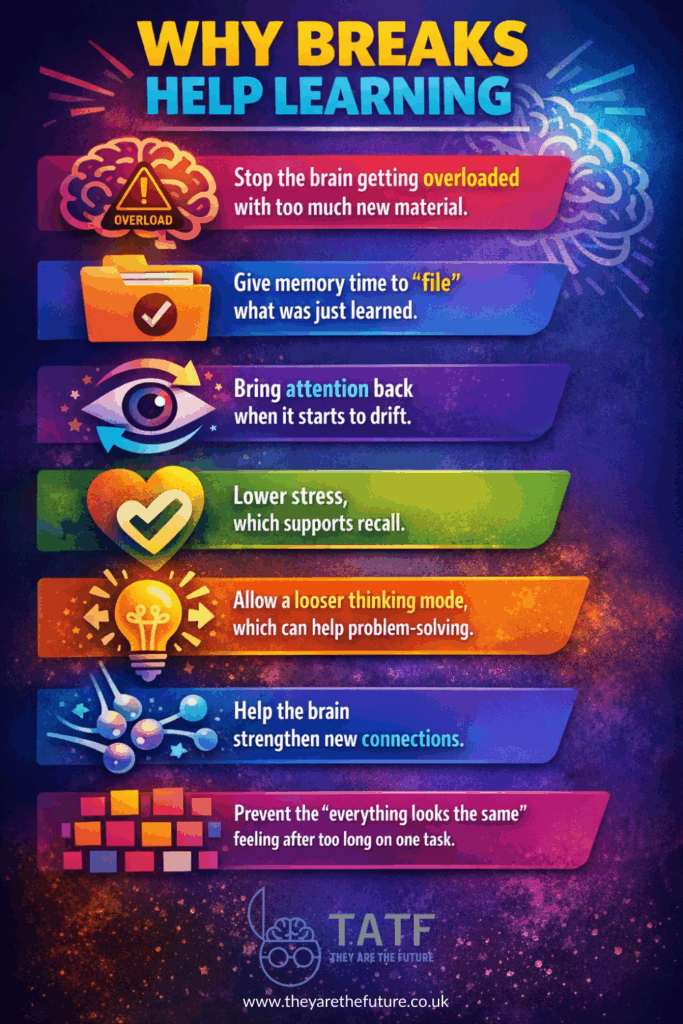
Why breaks help learning (in plain terms)
Regular breaks can:
- Stop the brain getting overloaded with too much new material.
- Give memory time to “file” what was just learned.
- Bring attention back when it starts to drift.
- Lower stress, which supports recall.
- Allow a looser thinking mode, which can help problem-solving.
- Help the brain strengthen new connections.
- Prevent the “everything looks the same” feeling after too long on one task.
Mini example (ADHD):
Your 15-year-old with ADHD can’t stay with revision for more than 10 minutes, and it ends in an argument. You agree on 12 minutes of work, then a 3-minute movement break, repeated four times. They also finish each block by answering three questions from memory.
After a week, they’re calmer, they start sessions more easily, and they can remember more in class. These are simple but effective study tips for ADHD students, because the plan matches how attention often works.
Study tip 3: Build a study set-up that fits your child, not a perfect one
A good study routine is helpful, but it only works if it fits real life. Your child’s age, energy, and learning style matter. A “perfect” desk and silent room might not be realistic, and it might not even be best.
Make the routine fit their learning style
- Auditory learners: Recorded notes, reading key points out loud, talking through ideas.
- Visual learners: Diagrams, colour-coded notes, tidy summary pages.
- Hands-on learners: Models, experiments, flash cards they can sort, walking while reciting facts.
Many children need a blend. This is also true for lots of young people with ADHD. Study tips for ADHD students often work best when you mix movement, clear structure, and active learning.
Add in a few high-impact study habits
- Mix methods, don’t stick to one. Use a mind map one day, flashcards the next, then practise questions.
- Use mnemonic devices for tricky lists. Your child can make up silly phrases, acronyms, or rhymes.
- Teach it back. Ask your child to explain one idea in their own words. Gaps show up fast, and that’s useful.
- Add movement. A short walk, quick football in the garden, or cycling can improve attention and mood.
- Protect sleep. Most teens do better with around 8 hours. Memory works best when sleep is steady.
Create a positive study space
- Pick one dedicated study space: It doesn’t need to be fancy, just consistent and low-distraction in their learning environment.
- Keep the start simple: Same time, same first step (for example, “open homework planner, choose one task”).
- Use gentle motivation: Small goals, a simple reward, or a visible checklist.
- Praise effort and strategy: Notice persistence, not just marks.

Two quick case stories you might recognise
Case story 1: Maya (9), anxious about spelling tests
Maya practised by copying words again and again, and still froze in tests. You switch to practice tests using active recall. She looks at the word, covers it, spells it, then checks. You also add a tiny drawing next to tricky words. After two weeks she feels calmer, and her scores improve, because she’s practising remembering, not just copying.
Case story 2: Ethan (16), bright but inconsistent
Ethan understands lessons but struggles to revise. He starts strong, then slides into cell phone distractions. You set up time blocks with short study bursts on practice problems, plus a “phone parking” spot in another room to remove distractions. He finishes each block by teaching you one key point. His grades lift, but the bigger win is that he feels in control.
Key takeaways: study tips you can use this week
These strategies drive academic success for you and your child.
- Use mind maps and visuals to organise and remember information.
- Build focus with time blocks, regular breaks, and active recall for long-term retention.
- Shape the routine around your child’s learning style, energy, and age.
- If you’re looking for ADHD study tips, my main advice is keep it structured, active, and movement-friendly.
- Small, repeatable changes to study habits beat long, stressful study sessions.
Frequently asked questions about effective study habits
How long should a study session be?
Encourage your child to pay attention in class as a foundational habit that makes studying at home easier. Many children do well with 25 to 50 minutes of focus after you remove distractions, then a 5 to 10-minute break. If attention is a challenge, start smaller, build up, and ask for help from a teacher if needed.
Do these study tips work for younger children?
Yes. You can shorten sessions, use more visuals, keep tasks bite-sized, and introduce basic test-taking strategies. These are practical study tips for kids across ages.
How can you help your child find their learning style?
Notice what helps them understand quickest, such as taking notes, diagrams, talking it through, practice questions, and hands-on methods, then test a few options. Keep what works, or ask for help from their teacher if you are unsure.
Are group study sessions helpful?
They can be, especially when your child explains ideas out loud. Group work is often best alongside some quiet solo revision time.
Dr Lucy Russell is a UK clinical psychologist and Clinical Director of Everlief Child Psychology. She qualified as a clinical psychologist from Oxford University in 2005 and worked in the National Health Service for many years before moving fully into her leadership and writing roles.
In 2019 Lucy launched They Are The Future, a support website for parents of school-aged children. Through TATF Lucy is passionate about giving practical, manageable strategies to parents and children who may otherwise struggle to find the support they need.
Lucy lives with her family, rescue cats and dog, and also fosters cats through a local animal welfare charity. She loves singing in a vocal harmony group and spending time in nature.
