
Why Year 3 Can Be Such A Tricky Transition for Your Seven Year-Old (And How to Help Your Child)

If your child sailed through reception to year 2 but has wobbled since September of Year 3, you are seeing something we hear about surprisingly often at my clinic, Everlief Child Psychology. Let’s talk about the year 3 transition, and how to ensure it’s as smooth as possible for your seven year-old.
The short answer: Why Year 3 Can Be Such A Tricky Transition
The move into key stage 2 brings a jump in academic expectations, more formal lessons, more independent learning and often a reshuffled social world, all at age seven. Yet this change can be easy to underestimate because it often happens within the same school. Like other school transitions, children benefit from gentle preparation, a predictable home routine and plenty of time to recharge as they settle into their new normal.

Why year 3 sometimes catches families out
The step from KS1 to KS2 changes much more than the classroom door. Learning becomes more formal and faster paced, sitting and listening replaces much of the play, and children are expected to organise themselves in new ways, remembering kit, recording homework and working through multi-step tasks. For some children, the transition also means moving to a different school or site. Education researchers have identified transitions like these as important milestones that deserve thoughtful support, even when they happen within a familiar school.
For some children the move from year 2 to year 3 also means a physical move to a junior school, with new staff, new buildings and new rules. Classes are often mixed at this point too, so a child can lose the friendship structure they relied on. And the sibling picture might change too: an older brother or sister may leave for secondary school at the same moment or a younger sibling may be “left behind” at infant school, changing the school run and the shape of home life. Any one of these would count as a change worth preparing for. Year 3 can deliver all of them in one week.
What the struggle can look like
Children this age rarely announce that a transition feels hard. Instead you may see after-school meltdowns, tears at bedtime, tummy aches on Sunday nights, clinginess at drop-off that looks like separation anxiety, or regression to younger behaviour.
School may report that everything is fine, because many children hold it together beautifully until they reach your car. That after-school release of emotions can be a sign of overload, and it usually means your child needs a lower-demand evenings rather than a talking-to.
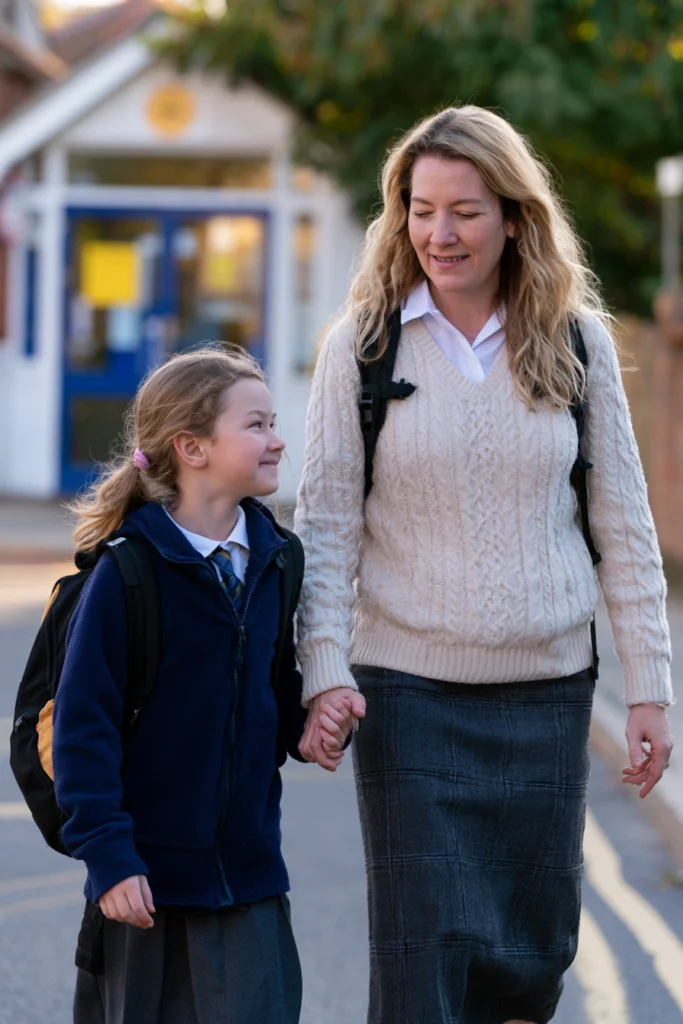
Transition to Year 3: How to prepare and support your child
Advance preparation works best when it matches your child’s personality and needs. Some children feel more confident with plenty of notice and lots of chances to ask questions. Others become more anxious if they have too long to think about what’s coming. Think about what has helped your child with past changes, and use that as your guide.
Children often cope better when they know what will stay the same as well as what will be different. Walk or drive past the building, look at photos of the new classroom, and talk through what stays the same (friends’ names, lunch, reading at bedtime) alongside what changes.
A simple visual timetable or wall planner can lower the daily load (cognitive and emotional) once term starts, because your child can see what is coming instead of holding it all in their head.
Then keep some things deliberately steady. Anchor points, the small routines and rituals that never change, tell your child’s nervous system that they are safe. The same snack after school, the same goodbye at the gate, a familiar object in the book bag, for example. A transitional object is a familiar item, such as a keyring, small toy or family photo, that reminds your child of home and can help them feel safe and reassured during times of change.
Finally, hand over control of the controllables. Your child cannot choose their teacher or class, but they can choose their water bottle, whether they wear the jumper or the cardigan, and which route you take to school (within reason). Sorting what they can and cannot control shrinks the helpless feeling that fuels worry. Try my circles of control exercise to make it more concrete for your child.
Work with the school
Most schools run transition days before September, but you can ask for more: an extra visit if your child is anxious, a photo of the teacher to keep at home, or a heads-up about which friends will be in the class.
Once term begins, a quick partnership with the teacher (“she’s finding the new expectations tiring, could we keep homework to a minimum for a few weeks?”) prevents small struggles becoming entrenched. Working with the school early is easier than trying to repair things at half term.
TAKE THE QUIZ!
When it’s more than an adjustment period
Give your child an adjustment period half a term or so of steady support. When to worry is when their distress is deepening or entrenched rather than easing: mounting back to school anxiety, regular refusal to go in, or misery that spills across the whole week.
If this happens, involve the teacher and consider more structured support. The skills your child builds now will help them cope with other big changes in the future, including the move to secondary school. I recommend my short course, Helping Your Child Cope With Change, designed with school transitions and other changes in mind.
Dr Lucy Russell is a UK clinical psychologist and Clinical Director of Everlief Child Psychology. She qualified as a clinical psychologist from Oxford University in 2005 and worked in the National Health Service for many years before moving fully into her leadership and writing roles.
In 2019 Lucy launched They Are The Future, a support website for parents of school-aged children. Through TATF Lucy is passionate about giving practical, manageable strategies to parents and children who may otherwise struggle to find the support they need.
Lucy lives with her family, rescue cats and dog, and also fosters cats through a local animal welfare charity. She loves singing in a vocal harmony group and spending time in nature.
