
Teen Anxiety Worksheets: Free CBT Strategies to Help Your Teenager

If your adolescent child is struggling with stress management, worry or anxiety, having some practical, structured tools to develop coping skills can make a real difference.
These free teen anxiety worksheets are grounded in cognitive behavioural therapy (CBT), one of the most well-researched approaches for anxiety in young people. They are designed to be used at home, either alongside professional support or as a starting point in their own right.
Get Your Teen Anxiety Worksheets Pack Here
Sign up here and I will send you the worksheets direct to your inbox.
Why Your Teen’s Brain Keeps Worrying
Anxiety is the most common mental health issue I see in my clinic, and it is understandable that so many teenagers are affected. The brain’s job is to keep us safe, and it does this by scanning constantly for threats and generating anxious thoughts of worst-case scenarios. In evolutionary terms, this made sense. In modern life, it often does not.
The brain cannot always distinguish between genuine danger and regular, everyday stress. That might be test anxiety from an upcoming exam, a difficult friendship, or social anxiety. It responds to all of them in the same way, activating the same fight-or-flight response with physical symptoms like a racing heart, as it would to real physical danger.
For some adolescents this happens more intensely than for others. Young people who are naturally sensitive, or who spend a lot of time consuming negative news and social media, can find those thoughts feel particularly powerful and hard to shake off.
The encouraging news is that anxiety is highly treatable. The strategies in these worksheets are the same evidence-based tools my team uses in our clinical work every day.

What’s Inside the Teen Anxiety Worksheets Pack
The five worksheets form a mini CBT workbook for teen anxiety, designed to support the mental health of adolescents. Each one builds on the last, moving from awareness through to active coping skills.
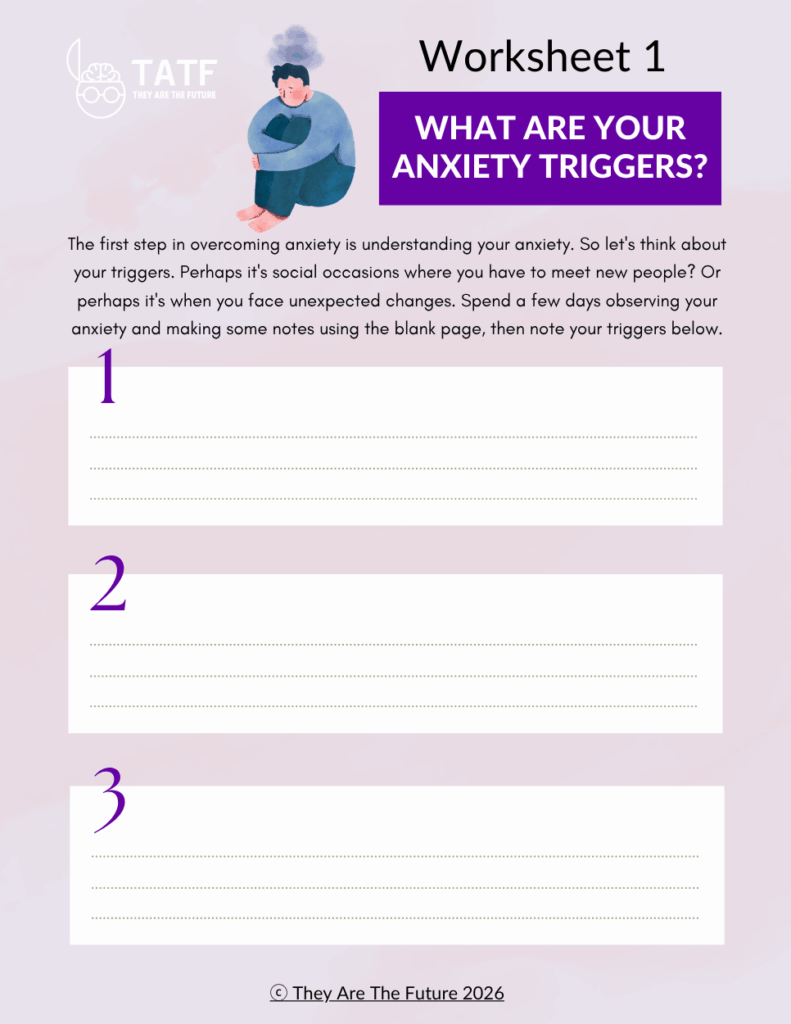
Worksheet 1: Understanding Anxiety Triggers
Before anything else, your teenager needs to understand their anxiety triggers. This first worksheet encourages them to observe their anxiety over several days, making notes as they go and then identifying their key anxiety triggers.
Building emotional awareness by simply naming what triggers anxious feelings, rather than being swept along by the feeling itself, is a surprisingly powerful starting point.
Worksheet 2: Using the Body to Calm the Nervous System
Anxiety is a physical experience as much as a mental one, often showing up through physical symptoms.
This worksheet introduces three body-based anxiety strategies that help to calm the nervous system directly: a body scan as a grounding exercise and form of meditation, a progressive muscle relaxation technique, and finger breathing as a deep breathing exercise.
These relaxation techniques and breathing exercises take a little practice before they feel natural, so encourage your teenager to try these grounding exercises, breathing exercises, and meditation practices during calm moments as well as anxious ones.

Worksheet 3: Challenging Unhelpful Thoughts
Cognitive restructuring is a core element of cognitive behavioural therapy for anxiety. In plain terms, it means learning to examine anxious thoughts more carefully and ask whether they are actually accurate.
The thought-challenging worksheet walks your teenager through this process step by step. They identify automatic negative thoughts, weigh up the evidence for and against them, and arrive at a more balanced, realistic version of the thought.
Starting with surface-level worries, rather than deep-seated fears, tends to work best. Small shifts in everyday thinking can build real confidence over time through positive self-talk and self-compassion.

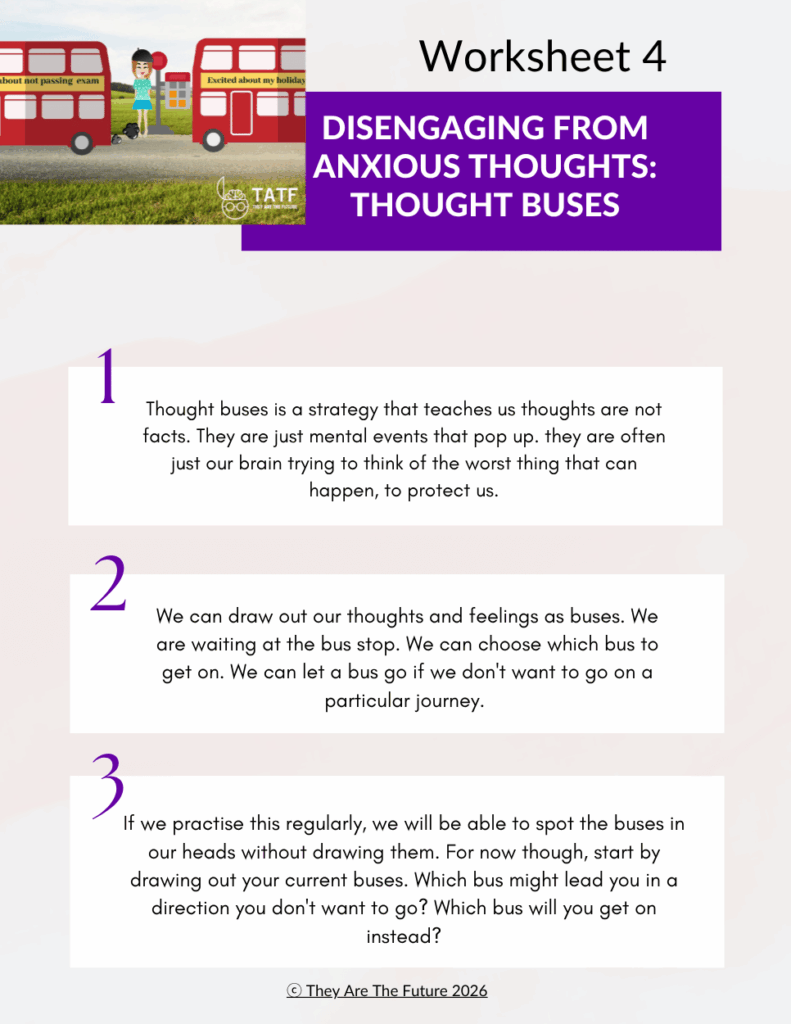
Worksheet 4: Learning to Let Thoughts Pass (Thought Buses)
One of the most useful shifts a teenager with anxiety can make is understanding that thoughts are mental events, not facts.
A frightening intrusive thought appearing in your mind does not make something more likely to happen.
The thought buses worksheet brings this idea to life through visualization. Your teenager draws their current intrusive thoughts and racing thoughts as buses at a bus stop and then considers which buses they want to get on and which they can let pass using mindfulness.
This technique, drawing from mindfulness in both CBT and acceptance and commitment therapy (ACT), can genuinely change how your teenager relates to anxious thoughts.
As an alternative visual tool, they might try a worry jar. With regular mindfulness practice, it can transform their relationship with thoughts.
Worksheet 5: Facing Fears Step by Step (Graded Exposure)
If your teenager is avoiding something because of anxiety, whether that is a social situation, a specific place such as school, or a particular experience, this worksheet gives them a structured way to face it gradually. This is one of the most effective coping strategies for overcoming anxiety.
Graded exposure works by breaking a feared situation down into small, manageable steps in an anxiety hierarchy, starting with the least anxiety-provoking and working upwards slowly over time.
Each step is repeated until the anxiety associated with it reduces, building essential coping skills along the way, and only then does your teenager move on to the next one.
There is a worked example in the worksheet to get them started, followed by space to build their own personal exposure ladder. Mastering these coping skills is vital for your teen’s mental health.

When to Seek Further Support
Self-help tools, distinct from therapeutic treatment, work best when anxiety is mild to moderate. Beyond this free worksheet pack, a book called Think Good Feel Good is a brilliant cognitive behavioural therapy anxiety workbook for teens and older children. It was written by a psychologist and I recommend it to many families in my clinic.
If your teenager’s anxiety is more severe, or is significantly affecting their mental health, daily life, school attendance, or sleep, please speak to your GP in the first instance.
In the UK, NHS CAMHS services are under pressure and waiting times can be long. If you are self-funding or have private health insurance, ACHiPPP (the Association for Child Psychologists in Private Practice) is a good way to find qualified specialist support for adolescents.
My online parent course, Outsmart Anxiety, can also help you build your own knowledge and confidence in supporting your teen’s mental wellbeing while you wait for, or alongside, professional input. In summary, these teen anxiety worksheets are ideal for addressing mild to moderate anxiety.
TAKE THE QUIZ!
Dr Lucy Russell is a UK clinical psychologist and Clinical Director of Everlief Child Psychology. She qualified as a clinical psychologist from Oxford University in 2005 and worked in the National Health Service for many years before moving fully into her leadership and writing roles.
In 2019 Lucy launched They Are The Future, a support website for parents of school-aged children. Through TATF Lucy is passionate about giving practical, manageable strategies to parents and children who may otherwise struggle to find the support they need.
Lucy lives with her family, rescue cats and dog, and also fosters cats through a local animal welfare charity. She loves singing in a vocal harmony group and spending time in nature.
