
Screen Free Kids’ Activities Your Child Will Actually Want to Do

Ideas for screen free kids’ activities are everywhere online, but most lists leave parents more overwhelmed than when they started. This article gives you something more useful: a practical shortlist of screen-free ideas that actually work, for younger children and for teens.
The aim isn’t to eliminate screen time entirely. It’s to create a healthy balance, with a few reliable screen-free activities in your back pocket for when you need them.
Before we get into the list, it’s worth saying this: the reason screens are so hard to compete with isn’t laziness or bad parenting. Screens are designed by teams of very clever people to hold attention. The activities below work in a different way entirely. They draw children in through mastery, sensory input, and the satisfaction of making something real.
It also helps to keep a tub of Lego, some puzzles, and a few books somewhere visible and easy to reach. Having those things out rather than tucked away in a cupboard makes it much easier for children to find their own motivation without any prompting from you. Swap things around every couple of weeks and they’re much more likely to actually get used.
Screen free kids activities for ages 5 to 12
These four screen free kids activities can all be set up with things you already have at home.
1. Junk modelling with a challenge stick
Keep a junk modelling box stocked with cardboard tubes, shoeboxes, tape, string, and any clean packaging you’d otherwise recycle. The secret ingredient is a jar of lolly sticks, each one with a specific challenge written on it in advance. Your child picks one at random and that’s their brief.
Good ones to write:
- Build a vehicle that could survive a flood
- Make a home for an invisible creature
- Design a machine that sorts socks
- Create a bridge strong enough to hold a book
- Build a fort for your toys using only what’s in the box
They can raid the Lego too if they want to incorporate it into their build. These ideas are specific enough to spark something, yet open enough that they take it wherever they want.
From a developmental perspective, this kind of open-ended imaginative play is genuinely educational. When children direct their own play, they practise planning, flexible thinking, and emotional regulation. These are exactly the skills that get squeezed when screen time fills every gap.
2. A nature walk treasure hunt
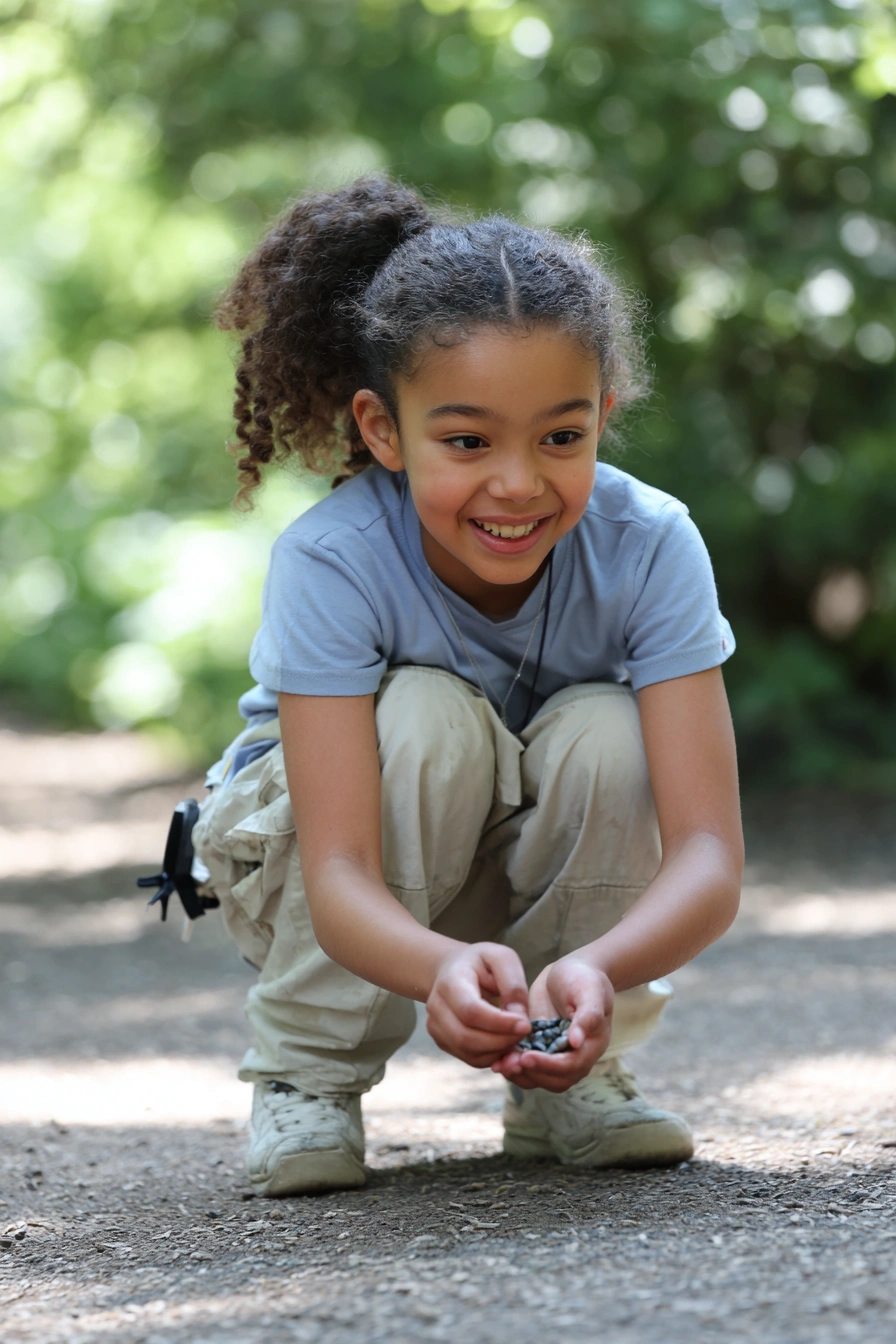
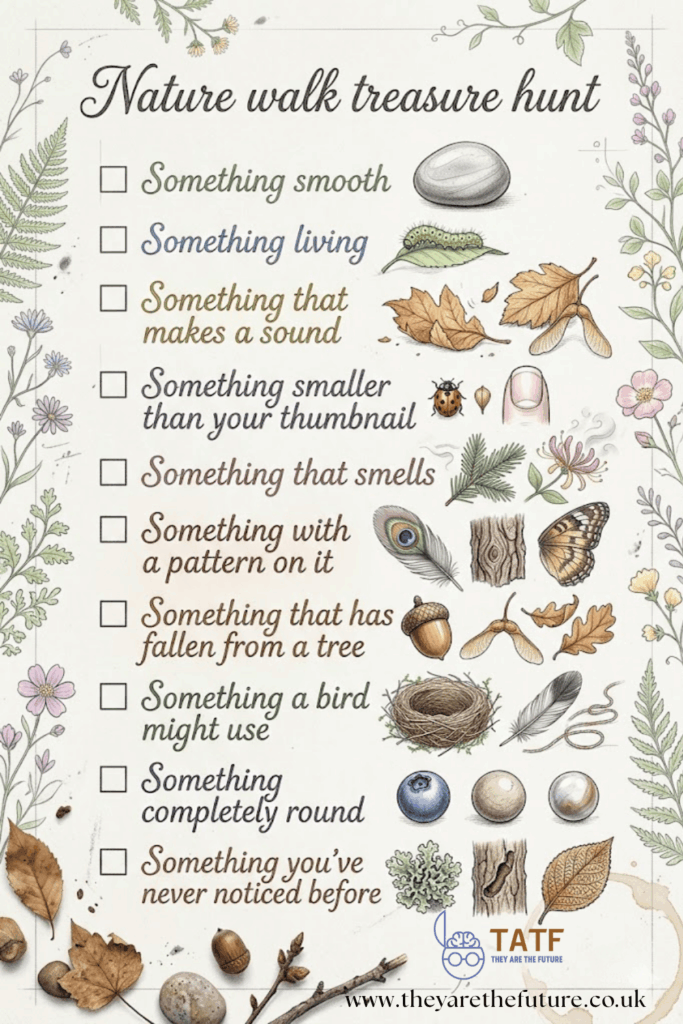
Before you leave the house, write a simple treasure hunt list together. Having a shared mission turns outdoor play into something absorbing rather than something they need to be persuaded into, and children develop fine motor skills naturally as they handle and sort their finds.
☐ Something smooth
☐ Something living
☐ Something that makes a sound
☐ Something smaller than your thumbnail
☐ Something that smells
☐ Something with a pattern on it
☐ Something that has fallen from a tree
☐ Something a bird might use
☐ Something completely round
☐ Something you’ve never noticed before
Tick things off as you go, and let your child be the judge of whether something counts.
Back home, the finds can feed straight back into the junk modelling box or spark a drawing. The Wetland Wildlife Trust has various free printable activity sheets worth bookmarking for nature walk days.
There’s also something regulating about being outside that’s easy to underestimate. Natural environments lower cortisol levels and support attention in children who find it hard to settle. If your child is dysregulated before you head out, a nature walk is often more effective than anything you could set up indoors.
3. Design a creature from the arts and crafts box
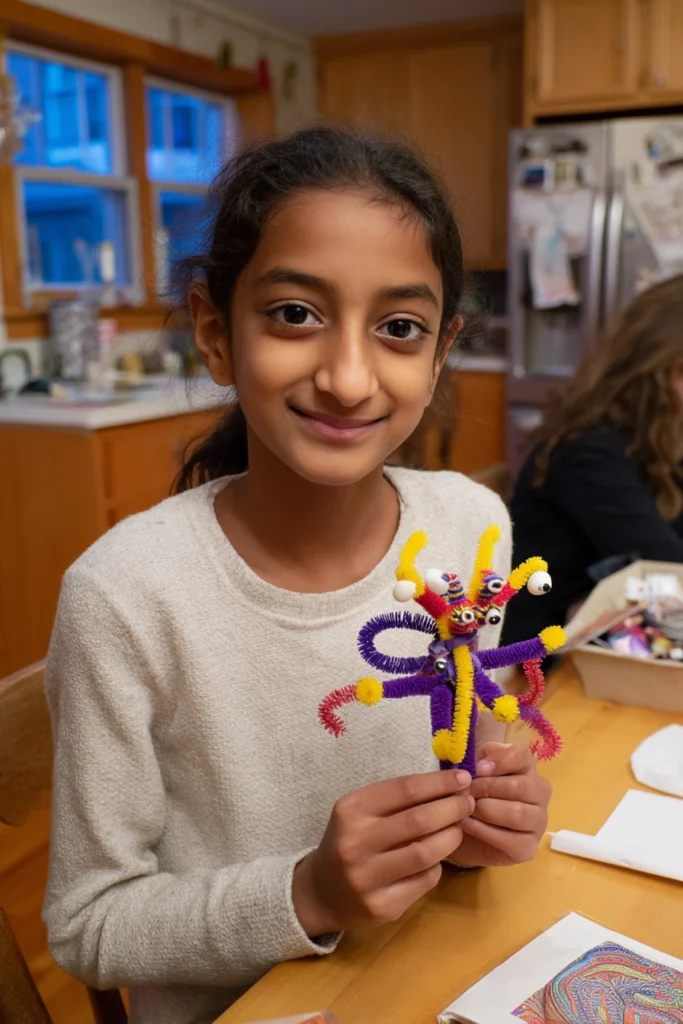
Arts and crafts works best when you give it a single, specific brief rather than just pointing at a box of materials. A good one: design and build a creature nobody has ever seen before, complete with a name, a habitat, and at least one piece of furniture for its home. It gives just enough direction without taking over.
The box itself doesn’t need to be expensive or carefully curated. The aim is variety of texture and possibility.
Good things to keep in it:
- Cardboard tubes
- Cereal boxes
- Egg cartons
- Foil
- Tissue paper
- Old magazines
- Fabric scraps
- Lolly sticks
- String
- Rubber bands
- Pipe cleaners
- Googly eyes
- A solid roll of masking tape
Masking tape is worth having in bulk because unlike sellotape it sticks to almost anything, tears easily, and can be drawn on.
A small pair of child-safe scissors, some PVA glue, and a few felt tips round it out. Replenish it whenever you’d otherwise throw something away, and rotate a few items every couple of weeks so it feels fresh.
Children who resist screen-free time often settle quickly once their hands are busy. This isn’t coincidence. Repetitive, tactile activity engages the nervous system in a way that naturally reduces anxiety. It’s part of why occupational therapists lean on craft-based tasks so heavily.
4. Bake banana muffins
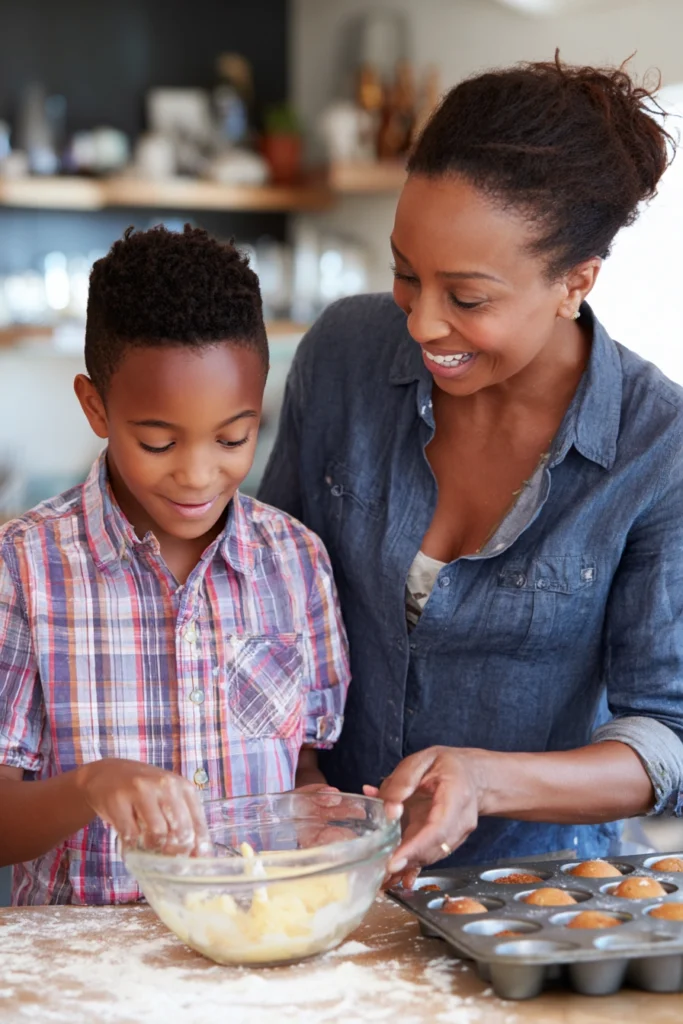
Cooking and baking is one of the most underrated screen-free activities for children. Banana muffins are a brilliant starting point because the ingredients are simple, the steps are manageable, and children can do most of it themselves.
Your child can measure, mash, pour, and mix with minimal adult input, and the whole thing takes under 30 minutes. Tidying up afterwards folds chores into the process without making a thing of it. It builds problem-solving skills, and of course produces something they can actually eat.
Simple banana muffins (makes 12)
| Ingredient | UK | US |
|---|---|---|
| Overripe bananas | 3 medium | 3 medium |
| Self-raising flour | 250g | 2 cups |
| Caster sugar | 100g | ½ cup |
| Unsalted butter, melted | 85g | 6 tbsp |
| Egg | 1 large | 1 large |
| Milk | 3 tbsp | 3 tbsp |
| Pinch of salt |
✓ Preheat the oven to 180°C / 350°F
✓ Mash the bananas in a large bowl until smooth
✓ Add the melted butter, sugar, egg, and milk and stir together
✓ Fold in the flour and salt until just combined, don’t overmix
✓ Spoon into a lined muffin tin
✓ Bake for 20 to 22 minutes until golden on top
From a psychological perspective, baking is one of the few activities that naturally rewards patience and effort in a way children can feel immediately. That’s a valuable experience at any age, but especially for children who’ve grown used to instant gratification from screens.
Screen-free activities for teens
Teens switch off fast if something feels managed or childish. The screen-free activities that work best give them real choice, a bit of challenge, and something they can own. I’m speaking from experience as a parent of an older teen and a young adult.
Develop mentally, teenagers are in a period where autonomy, identity, and peer connection matter enormously. If a teen feels like something is being done to them rather than offered to them, they’ll resist it almost on instinct. Hand them the same idea as a loose suggestion, something they can shape and own, and you’ll often get a completely different response.
1. A timed garden obstacle course
A simple obstacle course in the garden works surprisingly well with teens. A line of plant pots to weave through, a low washing line to crawl under, a bucket to throw a ball into. Add a stopwatch and a points system and it stops feeling like something their parent organised and starts feeling like something worth winning. Let your teen redesign the course for the next round and they’ll barely notice how long they’ve been outside.
The physical side matters too. Exercise is one of the most reliable tools we have for supporting adolescent mood and focus, and a bit of friendly competition tends to take care of the motivation without you having to say a word.

2. Fold an origami jumping frog
Origami surprises most teens. It’s harder than it looks, completely absorbing, and gives them something to show for their time.
The jumping frog is a great starting point: one sheet of paper, achievable in a single sitting, and immediately playable once it’s done. Jo Nakashima’s YouTube channel is one of the clearest and most beginner-friendly out there.
What makes origami particularly valuable is that it requires sustained, focused attention without any external reward structure. For teenagers who’ve spent a lot of time in the fast-paced feedback loop of social media, that’s a genuinely different cognitive experience, and one worth offering.
3. Grow a windowsill herb garden
Give your teen their own pot or raised bed section and let them choose what to grow.
A windowsill herb garden makes a brilliant starting project. All it takes is three small pots, a bag of compost, and seeds for basil, mint, and coriander. Within a couple of weeks there’s something growing, it costs very little, and they end up with something they’ll actually use in the kitchen.
In my clinical experience, gardening is particularly helpful for anxious teenagers. There’s something grounding about working with soil and watching something grow slowly. It’s the opposite of the pace most teens are used to, and many find that genuinely calming.
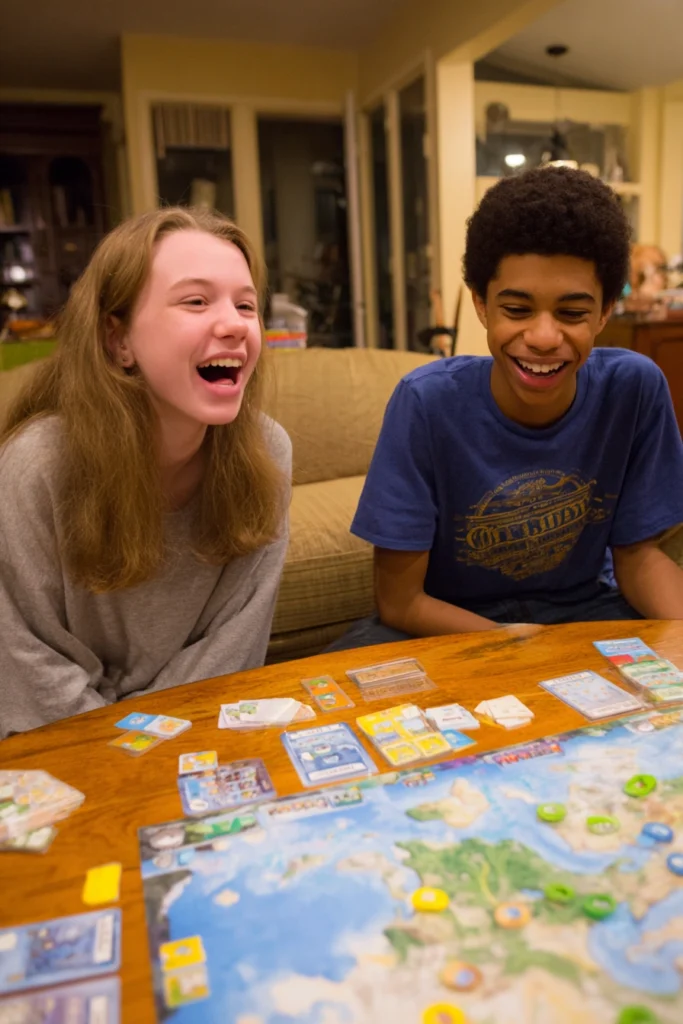
4. An evening of Dobble or Ticket to Ride
Card games and board games work better with teens than most parents expect. They lower the stakes, get everyone talking, and build family connections almost by accident.
Dobble is a fast-paced card game where everyone races to spot the one matching symbol between two cards, it’s chaotic, funny, and works for mixed ages.
Ticket to Ride is a strategy board game where players collect cards to claim railway routes across a map, simple enough to pick up quickly but with enough depth to keep teens genuinely engaged.
Catan is similar in feel, a resource-trading game where players build settlements and negotiate with each other, and it’s particularly good for teens who like a bit of competition and deal-making.
Keep a few games like this accessible and easy to grab, especially on evenings when screen time has been a source of friction.
From a family therapy perspective, shared activities that don’t require anyone to be vulnerable often open up more honest conversation than a direct check-in ever would. Teens talk when their hands are busy and the pressure is off.
One last thought
If transitions are hard in your house, screen-free time tends to go better when it’s predictable. A short screen-free window before bed helps you create a calmer bedtime routine, and having a book or activity already set out takes the friction out of winding down.
Screen free kids activities don’t need to be elaborate to work. A small, reliable shortlist beats a long list of ideas you never get round to trying.
Dr Lucy Russell is a UK clinical psychologist and Clinical Director of Everlief Child Psychology. She qualified as a clinical psychologist from Oxford University in 2005 and worked in the National Health Service for many years before moving fully into her leadership and writing roles.
In 2019 Lucy launched They Are The Future, a support website for parents of school-aged children. Through TATF Lucy is passionate about giving practical, manageable strategies to parents and children who may otherwise struggle to find the support they need.
Lucy lives with her family, rescue cats and dog, and also fosters cats through a local animal welfare charity. She loves singing in a vocal harmony group and spending time in nature.
