
Core Beliefs: Examples For Your Child’s Wellbeing

Core beliefs in children form earlier than most parents realise, and you have more influence over them than you might think.
Your child’s core beliefs act as a lens through which they see themselves and the world. A child who believes “I am not good enough,” for instance, may give up on new challenges before they’ve even started. Understanding how these beliefs form during the formative years, and their profound impact on your child’s mental health is crucial.
This article explores the world of core beliefs in children, giving you insights and practical advice to help you nurture a positive emotional well-being for your child.

Defining Core Beliefs and Their Formation
Core beliefs in children are deep-seated perceptions about oneself, others, and the world. They shape how children view themselves and their surroundings.
These beliefs start forming early in life, influenced by family dynamics, school, and early life experiences. Childhood trauma, difficult relationships, or repeated criticism during the formative years can all drive the development of unhelpful beliefs.
The Spectrum of Core Beliefs: From Positive to Negative
Positive core beliefs such as “I am capable” encourage resilience and confidence, building security in children.
Negative core beliefs can limit personal growth, leading to self-esteem difficulties and anxiety. Common negative themes include feelings of unlovability, helplessness, or worthlessness; beliefs that often take root in childhood and persist without support.
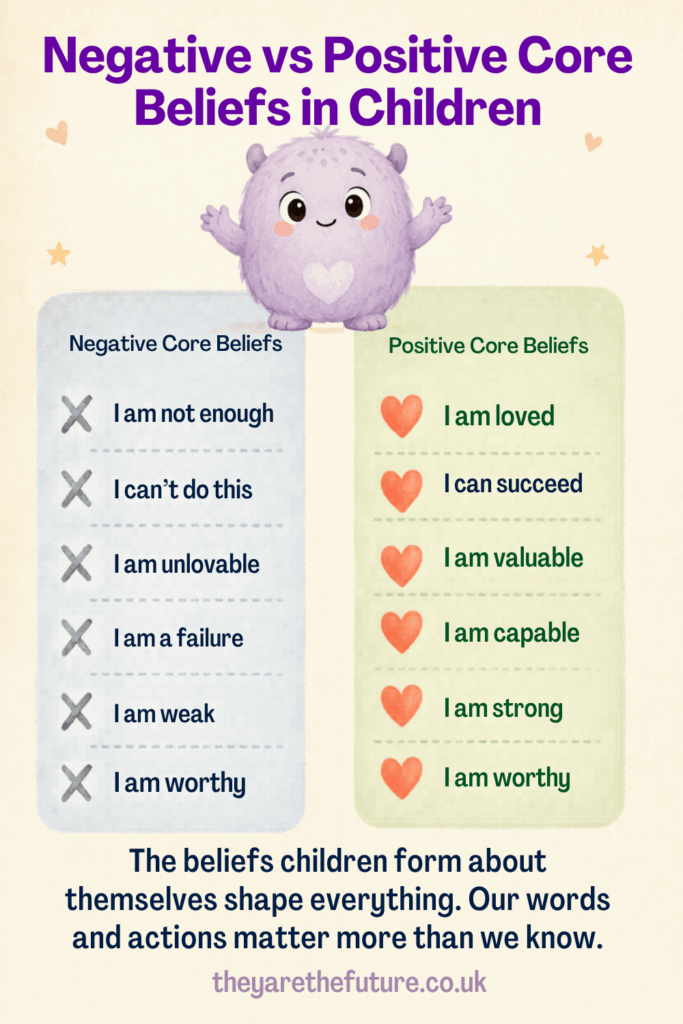
Core Beliefs Examples and Their Day-to-Day Impact on Children
Core beliefs, formed from early life experiences, significantly influence a child’s daily life. Whether positive or negative, they shape how children perceive themselves and interact with the world.
Understanding these beliefs (and their impact) is an important step in guiding children towards a healthier mindset. A negative belief such as “I am not smart enough” can lead to reluctance to try new activities, affecting learning and socialising. It often stems from childhood trauma or repeated setbacks during the formative years.
Cognitive Behavioural Therapy (CBT) is particularly effective here. It helps children understand how automatic negative thoughts are driven by their core beliefs, and guides them toward developing more adaptive beliefs that are realistic and supportive.
On the other hand, a positive core belief like “I am valued” boosts a child’s confidence across a wide range of situations, from academic performance to social interactions. This kind of belief is reinforced by new evidence from positive experiences. It’s a process supported by brain plasticity, which means children’s minds remain genuinely open to change.
In some cases, negative core beliefs contribute to more serious issues such as depression or social anxiety. Here, the role of a child psychologist or cognitive behavioural therapist is crucial. They can identify the roots of these beliefs and support the child in developing healthier patterns.
The process involves cognitive restructuring, where a child’s existing beliefs are challenged by new information or experiences. Even when a young person wants to accept a new belief such as “I am intelligent,” deep down they may still feel uncertain. It takes time. That’s entirely normal.
A child who believes they are a “bad person” might be encouraged to look at evidence of their good actions and qualities, eventually shifting their self-talk and self-perception.
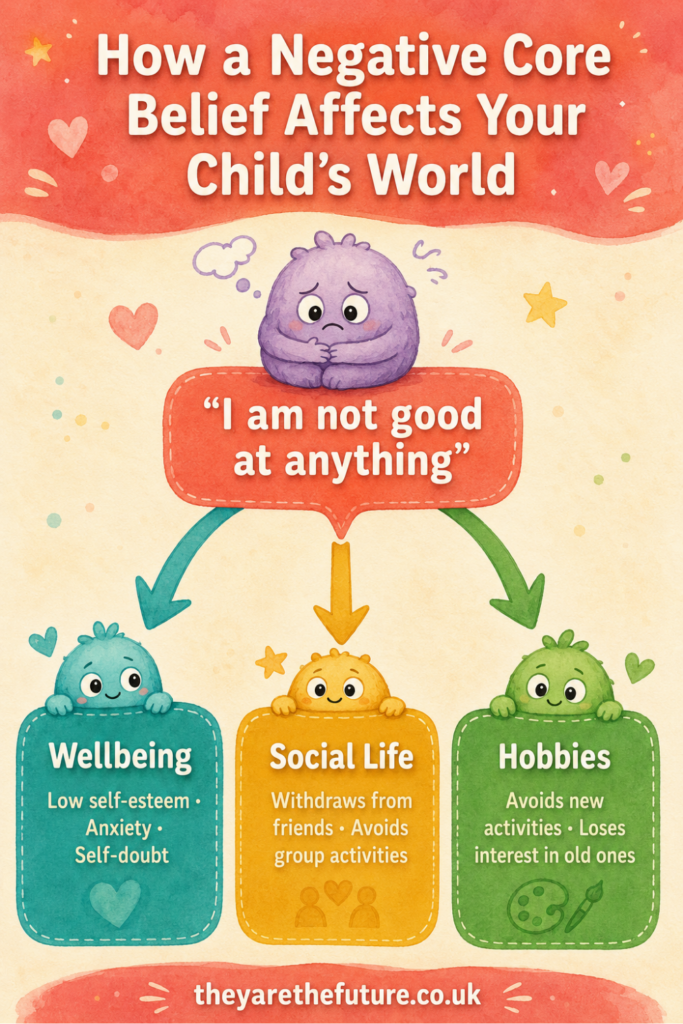
Cognitive Behavioural Therapy: A Tool for Transformation
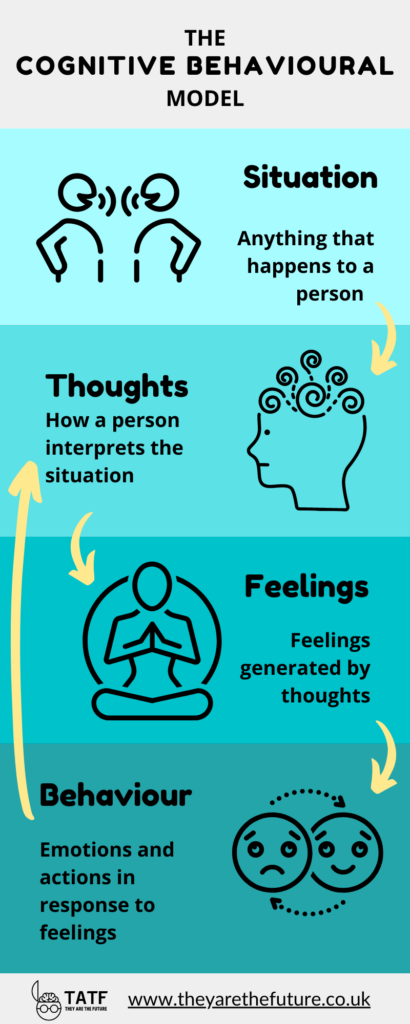
Cognitive Behavioural Therapy (CBT) helps us identify core beliefs and reshape harmful ones into adaptive beliefs that work in our favour. It reveals how thoughts, feelings, and behaviours are interconnected.
Through CBT, children can learn to replace a negative core belief with more positive, realistic ones. Cognitive distortions – the mental shortcuts that twist thinking – are gently brought to light and examined.
Practical Steps: Identifying and Changing Core Beliefs
Identifying core beliefs is the first step. Once you have both spotted them, you can help your child begin to challenge them.
Here is how to identify and gently adapt problematic core beliefs:
- Identify the Core Beliefs: Listen to your child’s language and observe behaviour.
- Understand the Impact: Recognise how these beliefs affect your child’s emotions and actions.
- Use Conversation Starters: Use open-ended questions to explore beliefs, like “How did that make you feel?”
- Introduce Worksheets: Guide your child through core beliefs worksheets.
- Challenge Beliefs: Encourage your child to regularly question and gently challenge negative core beliefs.
- Reinforce Positive Beliefs: Praise and support positive core beliefs and behaviours consistently.
- Regular Check-ins: Keep the conversation going and monitor progress. Stay patient — it can take many months to adapt a core belief.
Empowering Children to Challenge Negative Thoughts
Nurturing a child’s ability to recognise and challenge automatic negative thoughts is essential for their emotional well-being. Here are effective strategies:
- Active Monitoring: Encourage your child to observe their thoughts and feelings throughout the day. Help them differentiate between automatic thoughts and rational thoughts, and notice patterns when they feel anxious or upset.
- Gently Questioning Negative Thoughts: Guide your child to question the validity of their negative core beliefs. Ask them to gather evidence for and against a belief, and consider alternative perspectives.
- Reframing Negative Self-Talk: Assist your child in rephrasing negative self-talk into more positive and realistic statements. Encourage positive affirmations and self-reflection as daily habits. Help them focus on strengths rather than perceived flaws.
- Cognitive Restructuring: Introduce cognitive restructuring techniques, including Socratic questioning and the downward arrow technique, to help your child uncover and challenge distorted thought patterns.

A bit more on some of these terms:
- Socratic questioning: Asking focused questions to challenge assumptions and deepen understanding. If your child says “Exercise is boring,” you might ask “Why do you think so?” or “What kinds have you tried?” This prompts self-reflection and opens up new perspectives.
- Downward arrow technique: A CBT method where you gently ask questions such as “And what would that mean?” after each negative thought, to uncover the deeper core belief driving it.
- Cognitive distortions are mental shortcuts that twist thinking into unhelpful patterns. Common examples include:
- All-or-nothing thinking: Seeing the world in black and white. One bad test doesn’t mean your child is “terrible” at everything.
- Overgeneralisation: One mistake doesn’t define a pattern. Forgetting homework once doesn’t mean they’ll “always” forget it.
- Filtering: Only noticing the bad and ignoring the good. Help your child celebrate small wins.
TAKE THE QUIZ!
Case Studies: Adapting Core Beliefs
These stories highlight the impact of challenging negative core beliefs on reducing anxiety, improving self-esteem, and building resilience.
Core Beliefs Examples: Overcoming Social Anxiety
Sixteen year-old Sarah had always struggled with social anxiety. She believed her peers judged her harshly and that she would never be accepted. This was a negative core belief rooted in her early life experiences that led to avoidance and social isolation.
Sarah’s parents sought help from a child psychologist who specialised in Cognitive Behavioural Therapy. Through CBT, Sarah learned to use socratic questioning and cognitive restructuring to challenge her beliefs, gather evidence for more positive alternatives, and reframe social situations as opportunities rather than threats.
As Sarah progressed, her self-talk shifted. She developed positive core beliefs about herself and her social abilities, made new friends, and experienced a greater sense of belonging.

Targeting Core Beliefs to Enhance Self-Esteem
Michael, a talented young athlete, struggled with low self-esteem. He constantly felt inadequate; a belief that threatened his performance and personal growth.
His parents used techniques to tackle his negative core beliefs directly. They encouraged positive affirmations and self-reflection, praised even small victories, and helped him practise more supportive self-talk. Slowly, Michael started to see challenges as opportunities to learn and grow. His adaptive beliefs began to replace the self-doubt.

Building Resilience Through Core Beliefs
Emily used to be full of joy and energy, but a series of setbacks (school struggles, friendship difficulties, and family issues) chipped away at her confidence. She began to feel helpless, pessimistic, and convinced she would always fail. These are classic signs of entrenched negative core beliefs.
Her parents and teachers worked together on building resilience, tackling her helplessness and worthlessness beliefs directly. They introduced self-reflection and helped Emily reframe setbacks as learning opportunities. Emily’s parents celebrated small victories, reinforced her positive core beliefs, and modelled emotional well-being themselves.
Over time, Emily’s self-talk shifted. She faced challenges with more confidence, and her sense of personal growth returned.
The Role of Cognitive Behavioural Therapy in Adapting Core Beliefs
Some children need external help from a professional to work on their core beliefs in children, particularly if they are deeply entrenched. A child psychologist or cognitive behavioural therapist can provide this support.
These therapists assess and identify core beliefs through observation and interviews, then develop individualised intervention plans. They use Cognitive Behavioural Therapy techniques, including cognitive restructuring, socratic questioning, and the downward arrow technique, to help children develop more adaptive thinking patterns and build emotional well-being over time.
Beyond the Individual: Family and Community Role
Building resilience and positive core beliefs in children extends beyond individual therapy. Family dynamics and community support both play a vital role.
Family values around openness, empathy, and unconditional love reinforce positive core beliefs and strengthen your child’s sense of security. Create a nurturing home environment that models positive thinking, encourages self-reflection, and celebrates children’s personal growth. Thanks to brain plasticity, even deeply held negative core beliefs can shift with consistent, compassionate support.
Dr Lucy Russell is a UK clinical psychologist and Clinical Director of Everlief Child Psychology. She qualified as a clinical psychologist from Oxford University in 2005 and worked in the National Health Service for many years before moving fully into her leadership and writing roles.
In 2019 Lucy launched They Are The Future, a support website for parents of school-aged children. Through TATF Lucy is passionate about giving practical, manageable strategies to parents and children who may otherwise struggle to find the support they need.
Lucy lives with her family, rescue cats and dog, and also fosters cats through a local animal welfare charity. She loves singing in a vocal harmony group and spending time in nature.
