
Finding Out Your Child is Autistic: What To Do Next

Finding out your child is autistic can bring a mixture of emotions. You may feel relieved to finally have answers. You may also feel worried, uncertain or overwhelmed. Many parents experience several emotions at once.
Whatever you’re feeling, your child is still the same person they were before their diagnosis. Autism doesn’t change who they are. It simply helps explain how they experience the world and what support may help them thrive.
The weeks after a diagnosis can feel confusing. You may wonder what to tell your child, whether they need therapy, how school should respond, or where to find trustworthy advice. With so much information available, knowing where to start can be difficult.
This guide explains the practical steps to take after an autism diagnosis. You’ll learn how to support your child emotionally, work with school, decide whether professional support is needed, and help your child develop a positive understanding of their autistic identity.

What Autism Means
As a parent, you don’t need to become an autism expert overnight. However, understanding the basics will help you make sense of your child’s strengths, differences and support needs.
Autism is a lifelong neurodevelopmental difference. It affects how a person experiences and responds to the world around them. Differences often involve social communication, flexible thinking, sensory processing and emotional regulation. Every autistic child has their own unique profile, so no two autistic children are exactly alike.
Your child may find some situations exhausting while coping well in others. They may love routine, become overwhelmed by certain sounds, communicate differently, or develop deep interests in favourite topics. Equally, they may have many strengths, such as creativity, honesty, attention to detail or excellent memory.
An autism diagnosis is not a measure of your child’s potential. Many autistic people lead happy, fulfilling lives, build successful careers and enjoy meaningful relationships. The diagnosis simply gives you, your child and the people around them a better understanding of how to provide the right support.
Read next: Autism Assessments: Information For Parents and Your Child Has Been Diagnosed With Autism: What Next?
Your First Steps After an Autism Diagnosis
Receiving an autism diagnosis often brings relief alongside uncertainty. Many parents say they finally understand why their child has struggled. Others worry about what the future might hold. Both reactions are completely normal.
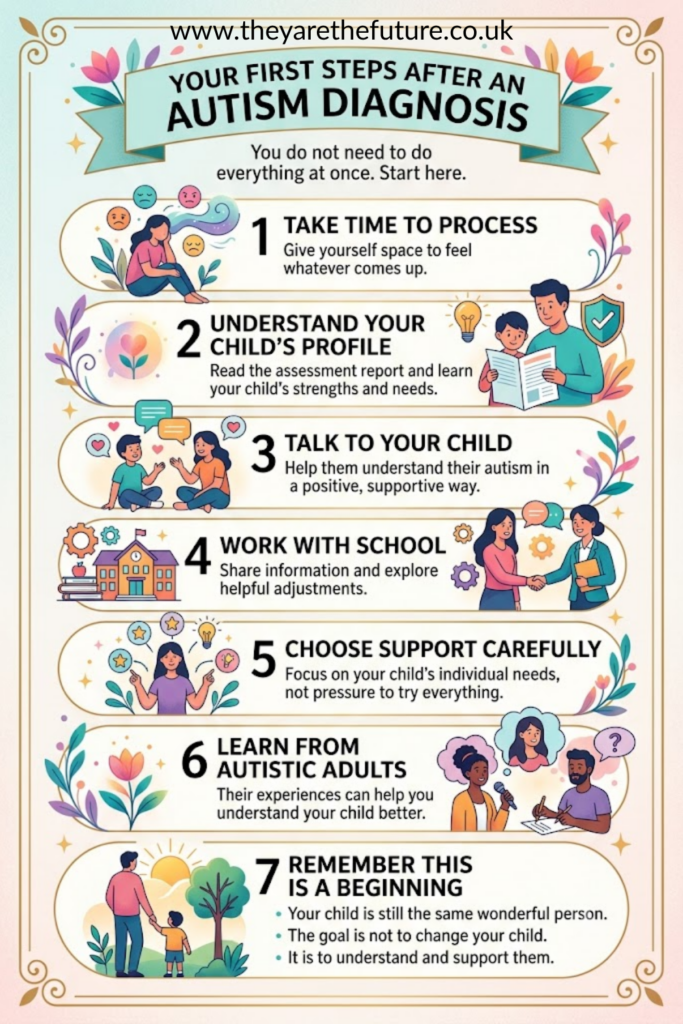
Rather than trying to do everything at once, focus on a few important first steps.
1. Give yourself time to process the diagnosis
There is no “right” way to feel. You may experience relief, sadness, hope, guilt or anxiety, sometimes all in the same day.
Try not to make major decisions immediately. Give yourself time to absorb the information and discuss it with people you trust.
2. Read your child’s assessment report carefully
Your child’s report should explain their individual strengths, differences and support needs. Every autistic child is different, so avoid comparing your child with others.
Make a note of anything you don’t understand and ask the assessment team to explain it. Understanding your child’s unique profile is much more helpful than reading general information about autism.
3. Think about telling your child
If your child doesn’t already know about their diagnosis, consider how and when you will explain it.
Many autistic children feel relieved when they understand why some things feel harder for them than for other people. Learning about their autism can help them build confidence and self-understanding, especially when the conversation focuses on both strengths and challenges.
I’ll explain how to approach this later in the article.
4. Talk with your child’s school
Arrange a meeting with your child’s school or nursery to discuss the assessment findings and any adjustments that could help.
Simple changes can sometimes make a significant difference. These might include sensory breaks, clearer routines, movement opportunities, visual supports or a quieter space when your child feels overwhelmed.
5. Don’t feel pressured to try every therapy
After a diagnosis, families are often offered lots of advice. Some suggestions are evidence-based, while others have very little research behind them.
Ask yourself one question before pursuing any intervention:
What specific difficulty is this support designed to help with?
Autism itself does not need treating. However, your child may benefit from support with areas such as anxiety, emotional regulation, communication, sensory processing or everyday skills.
The best support is always tailored to your child’s individual needs.
6. Learn from autistic people
Professionals can explain autism from a clinical perspective, but autistic adults offer something equally valuable: lived experience.
Reading books, watching videos or following autistic advocates can deepen your understanding of how your child may experience the world. Many parents find this helps them better understand their child’s behaviour and respond with greater confidence and empathy.
7. Remember that this is the beginning, not the end
Your child’s diagnosis doesn’t change who they are. It simply gives your family a clearer roadmap.
Over time, you’ll learn what helps your child feel safe, understood and able to thrive. You don’t need to have all the answers today.
Explaining Autism to Your Child
Talking to your child about autism can feel daunting. However, for most children, understanding their diagnosis helps them make sense of experiences that may previously have felt confusing.
There isn’t one perfect conversation. Instead, think of it as an ongoing discussion that develops as your child grows.
Keep your explanation simple and appropriate for your child’s age. For example, you might say:
“Autism means your brain works differently. Some things may feel more difficult for you, while other things may come more naturally. Everyone’s brain is different, and this is part of what makes you who you are.”
Use examples from your child’s own life. You could talk about sensory sensitivities, needing extra time to adjust to change, finding friendships confusing or becoming deeply interested in favourite topics. Personal examples make the explanation much more meaningful.
Encourage your child to ask questions whenever they want. Some children are curious immediately. Others need time before they want to talk.
Most importantly, help your child understand that autism is only one part of who they are. Their diagnosis doesn’t limit what they can achieve. It helps explain how they experience the world and what allows them to flourish.
Recommended Books and Resources for Families
You don’t need to learn everything about autism immediately. Start with a few trusted resources rather than trying to read everything you can find.
These are some of the books I recommend most often to families following a new diagnosis.
For children and teenagers
- The Superhero Brain: Explaining Autism to Empower Kids by Christel Land
- Different Like Me: My Book of Autism Heroes by Jennifer Elder
- My Awesome Autism: Helping Children Learn About Their Autism Diagnosis by Nikki Saunders
- The Awesome Autistic Go-To Guide: A Practical Handbook for Autistic Teens and Tweens by Yenn Purkis, Tanya Masterman & Emma Goodall
- All Cats Are on the Autism Spectrum by Kathy Hoopman
- The ASD Workbook: Understanding Your Autism Spectrum Disorder by Penny Kershaw
- The Spectrum Girl’s Survival Guide: How to Grow Up Awesome and Autistic by Siena Castellon
For parents and older teenagers
- Neurotribes by Steve Silberman
I also highly recommend this 13 page illustrated resource from NeuroWild, which explains autism in a clear, accessible and neurodiversity-affirming way.
If you’re looking for more structured guidance, my team’s Embracing Autism online course supports parents through the months following a diagnosis. Together with four colleagues, I’ve created practical lessons on understanding autism, supporting wellbeing, working with school and helping your child thrive.
Choosing the Right Support
An autism diagnosis doesn’t automatically mean your child needs therapy. Many autistic children thrive with the right understanding, supportive relationships and appropriate adjustments at home and school.
The most helpful support depends on your child’s individual strengths, challenges and goals. Rather than asking, “What support do autistic children need?”, ask, “What support does my child need?”
Some children benefit from support with anxiety, emotional regulation or self-esteem. Others need help developing communication skills, managing sensory differences or becoming more independent in everyday life.
If professional support would help your child, look for practitioners who understand autism and adapt their approach to suit autistic children. A good therapist works with your child’s differences, not against them.
Support may include:
- Clinical psychology or talking therapy, to help with anxiety, low mood, emotional regulation or confidence.
- Speech and language therapy, if your child would benefit from support with communication or social understanding.
- Occupational therapy, particularly for sensory processing differences or everyday practical skills.
- Parent support sessions, which can help you better understand your child’s behaviour, reduce family stress and feel more confident responding to challenges.
Research consistently shows that children achieve the best outcomes when support is individualised and started as soon as a genuine need is identified. However, more support isn’t always better. The aim isn’t to change who your child is. It’s to reduce unnecessary barriers and help them flourish.
Remember that your child’s needs will change over time. Review what is helping regularly, and don’t be afraid to stop approaches that aren’t making a meaningful difference.
Helping Your Child Build a Positive Autistic Identity
One of the greatest gifts you can give your child is helping them understand and accept who they are.
Your child’s autism is only one part of them. They are also a son or daughter, a friend, a football fan, an artist, a gamer, a musician or whatever else makes them uniquely themselves. The goal isn’t for autism to define their identity, but for it to become one part of a healthy, positive sense of self.
As your child grows, help them understand both their strengths and the areas they find more challenging. When children can explain their own needs, they’re better equipped to ask for support and advocate for themselves.
Celebrate your child’s strengths just as much as you support their challenges. They may have exceptional creativity, honesty, curiosity, determination, problem-solving skills or attention to detail. Recognising these qualities helps build confidence and resilience.
Your child may sometimes meet people who don’t understand autism or who make inaccurate assumptions. These experiences can be upsetting, but they also create opportunities to build confidence and self-advocacy. Help your child understand that they never need to apologise for being autistic. Instead, encourage them to communicate their needs in ways that feel comfortable and appropriate for them.
You can also make a big difference by helping the people around your child understand autism. Work closely with your child’s school to identify any reasonable adjustments that will help them learn and feel included. Encourage family members to learn about your child’s individual strengths, differences and support needs too. When the adults around your child understand autism, your child is much more likely to feel accepted, respected and supported.
Above all, remind your child that they never need to hide who they are to make other people feel comfortable. The right support isn’t about changing your child’s personality. It’s about reducing unnecessary barriers so they can flourish as the unique person they already are.
What has changed is your understanding of how they experience the world. That understanding will help you make decisions that allow them to thrive.talents, and help them find activities and opportunities that allow them to shine.
Above all, remind your child that they never need to hide who they are to make other people feel comfortable. The right support isn’t about changing your child’s personality. It’s about reducing unnecessary barriers so they can flourish as the unique person they already are.
What has changed is your understanding of how they experience the world. That understanding will help you make decisions that allow them to thrive.
Remember
Your child hasn’t changed because of their diagnosis. What has changed is your understanding of how they experience the world. That understanding will help you make decisions that allow them to thrive.
Finding Out Your Child Is Autistic: Summary
An autism diagnosis doesn’t change who your child is. It gives you a better understanding of how they experience the world and what helps them thrive.
You don’t need to have all the answers straight away. Start by learning about your child’s unique strengths and support needs, working closely with school, and helping them develop a positive understanding of their autistic identity.
Remember that every autistic child is different. The support that works best will always be tailored to your child’s individual needs.
With understanding, acceptance and the right support, autistic children can build happy, fulfilling lives. Your child’s diagnosis is not the end of their story. For many families, it’s the beginning of understanding them more deeply than ever before.
Finding Out Your Child is Autistic: FAQs
Many parents worry about telling their child they are autistic. They may fear it will affect their confidence or make them feel different. However, most autistic children find it helpful to understand their diagnosis. It can help them make sense of their experiences, including their strengths and the things they find difficult. Try to talk about autism as part of who your child is, rather than something that needs to be changed. The goal is to help your child understand themselves, feel accepted and recognise their own strengths.
An autism diagnosis does not mean your child automatically needs therapy. Autistic children do not need to be fixed. However, some children benefit from support with specific challenges, such as anxiety, emotional regulation, communication or sensory differences. The most helpful support often focuses on making life easier for your child. This may involve changes to their environment, routines or the way other people understand their needs.
Sharing your child’s diagnosis with school is often helpful. It allows teachers to understand your child better and recognise the support they may need.
A diagnosis can help school staff make reasonable adjustments. These might include changes to the classroom environment, communication style or daily routines.
You do not have to share everything at once. Start with the information that will help your child feel understood and supported.
Yes. Autistic children can grow into happy, fulfilled adults. Every autistic person is different. Some will need ongoing support, while others will become very independent. A child’s future is not defined by their diagnosis. Acceptance, supportive relationships and environments that understand their needs can make a huge difference. Success also looks different for everyone. The most important thing is helping your child feel valued and able to be themselves.
An autism diagnosis can bring many different emotions for parents. Some feel relieved, while others feel worried, confused or overwhelmed. You do not need to have all the answers straight away. Start by learning more about your child’s individual strengths, needs and experiences. Notice what helps your child feel safe, confident and understood. Building this understanding is one of the most important first steps.
Finding reliable autism information can feel overwhelming. There is a lot of advice online, and some of it is outdated or unhelpful. Look for sources that respect autistic identity and focus on supporting children to thrive. NHS services, autism charities and experienced professionals can all be useful places to start. It can also be valuable to listen to autistic adults sharing their experiences. This can help you understand autism from a wider perspective. Most importantly, remember that you know your child best. The right support will always be shaped around their individual needs, personality and strengths.
Dr Lucy Russell is a UK clinical psychologist and Clinical Director of Everlief Child Psychology. She qualified as a clinical psychologist from Oxford University in 2005 and worked in the National Health Service for many years before moving fully into her leadership and writing roles.
In 2019 Lucy launched They Are The Future, a support website for parents of school-aged children. Through TATF Lucy is passionate about giving practical, manageable strategies to parents and children who may otherwise struggle to find the support they need.
Lucy lives with her family, rescue cats and dog, and also fosters cats through a local animal welfare charity. She loves singing in a vocal harmony group and spending time in nature.
