
How to Help Your Child With Separation Anxiety at School Drop-Off

In this article, I will cover separation anxiety at school drop in younger children at elementary school or primary school.
As a child psychologist, I advise parents on this common challenge regularly in my clinic. I will talk you through my 7 key strategies to help your family manage these mornings more calmly.
You do not need to attempt all of these at once. Simply choose one or two strategies to focus on, and you are likely to see a positive improvement.
Key Takeaways
- Empathy is crucial: Remember that your child’s brain is not yet developed enough to rationalise their fears; stay close, listen to their worries, and help them feel contained rather than trying to fix or distract them immediately.
- Prioritise a calm routine: Children look to their parents to gauge how to feel, so plan a structured, predictable morning routine the night before to reduce stress for both you and your child.
- Collaborate with the school: Ensure your child has a nurturing point of contact at school and work with staff to adapt the environment, such as assigning your child a special role or creating a consistent goodbye ritual.
- Use transitional objects: Providing a small, comforting item from home can serve as a bridge to your child’s ‘safe base’, helping them feel connected to you throughout the school day.
- Manage your own wellbeing: You cannot support your child’s fears effectively if you are dysregulated; practice self-care and maintain your own calm to ensure you have the emotional capacity to handle school drop-offs.
Summary: Quick Tips for Success
If you are in a rush, here is the essential roadmap to managing school drop-off anxiety:
- Stay calm: Your child co-regulates with you; keep your own nervous system steady.
- Listen, don’t fix: Validate their feelings of fear rather than trying to rationalise them away.
- Establish a predictable routine: Prep the night before to eliminate morning chaos when they go back to school.
- Collaborate with school: Assign a ‘special role’ or create a consistent goodbye ritual with the teacher.
- Bridge the gap: Use a transitional object to maintain your emotional connection throughout the day.
What is Separation Anxiety?
Separation anxiety occurs when your child becomes distressed at being separated from you.
It is normal for children to show separation anxiety in early childhood; in fact, your child’s fears are often developmentally normal as they navigate new milestones. You are their “safe base”, and naturally they will feel a bit unsure about leaving you at times.
Older children may also typically have symptoms of separation anxiety in new environments.
Usually, within a short while of leaving you, if your child feels safe in their new environment, such as the classroom, they will not be distressed any more and will be able to enjoy their day.
We are going to look at what to do when this does not happen. We will also look at what you can do when your child’s distress at leaving you is very severe or prolonged.

How to Help a Child With Separation Anxiety at School
Here are my top 7 key strategies from more than 20 years as a child psychologist, and 20 years of being a mother! Please note that during early learning years, anxiety often manifests as tummy aches or crying. Having the right coping strategies can make the difference between feeling in control and feeling out of control when it comes to separation anxiety at school drop-off, and ongoing separation anxiety at school.
It is so important that you can contain the situation for your child and help them feel safe, especially if you are concerned about potential school refusal.
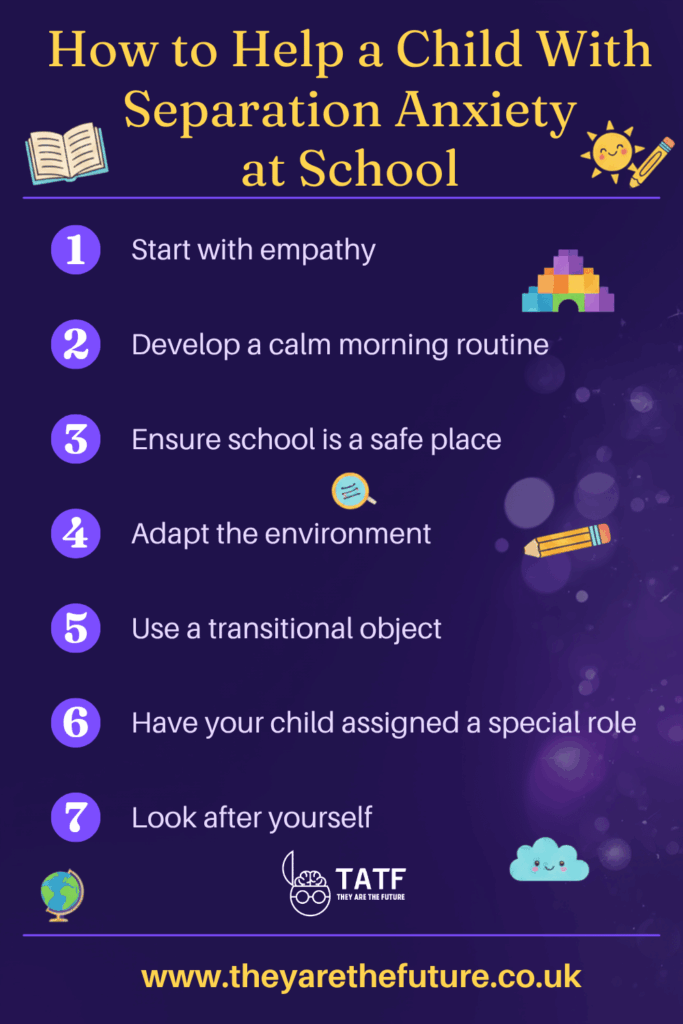
1. Separation Anxiety at School Drop Off: Start With Empathy
It can be mystifying, frustrating, and stressful when your child experiences separation anxiety at school drop-off.
You know they will be safe. You tell them a hundred times. You take extra time to give them cuddles and reassurance.

But it’s important to understand that your child cannot rationalise. Their brain has not yet developed enough that the rational part can take control of the emotion centre of the brain.
Deep in their core, they do not feel safe, and they need an adult to contain their fear.
Your child’s separation anxiety might occur despite having a nurturing teacher. School is simply more challenging than home. It is a new place with new situations to cope with every day, and new classmates or social situations to navigate.
So my top tip here is to empathise with your child’s fears. Listen carefully to your child as they express their big feelings, without trying to fix or distract them immediately. This helps them process their emotions.
Perhaps you feel like your child should be able to go in without distress because all the other children can, or because they went in the other day without any problems. Forget all of that. Focus on meeting your child in the here and now. Your child is scared and needs help.
Keep your goodbye brief, consistent, and warm, avoiding long, drawn-out explanations that can increase your child’s anxiety. Validating their feelings with a short, calm phrase like, ‘I know it’s hard to say goodbye, but you are safe and I will be here to pick you up at 3pm,’ is much more effective than trying to reason with them. Always follow through with your promise to return, as this consistency builds the security they need to let go.
TAKE THE QUIZ!
2. Develop a Calm Morning Routine
Mornings and calm do not often go together when it comes to children and school. But you can buck this trend by carefully planning a new morning routine.
However, if you are stressed, your child will be stressed. They look to you to, their trusted adult, to judge how they should feel.

So the first step is: plan plan plan! Even if you are not a natural planner, make a simple structure. Prepare what you can the night before, such as laying out school clothes and packing lunch.
A visual schedule, such as a colourful poster on the wall, will help both you and your child understand the sequence of the morning. You will not have to think on your feet, and everyone will be clear about expectations.
Take a look at this video from Mrs. D’s Corner.
3. Ensure School Is A Safe Place
You need to feel confident that your child’s school is a safe place where they are nurtured. There must be a nurturing adult within the setting who can tune in to your child’s specific emotional needs and provide support during moments of separation anxiety at school drop off.
4. Adapt the Environment
Talk to your child’s school about what can be adapted in the school environment to help your child feel safe. Examples include arriving a few minutes early to avoid crowds, sitting closer to the teacher, or visiting a quiet nurture room at the start of the day.
5. Use a “Transitional Object” to Reduce Separation Anxiety
Young children do not have a good concept of time. The school day can feel like forever, and they may worry that you will not come back.
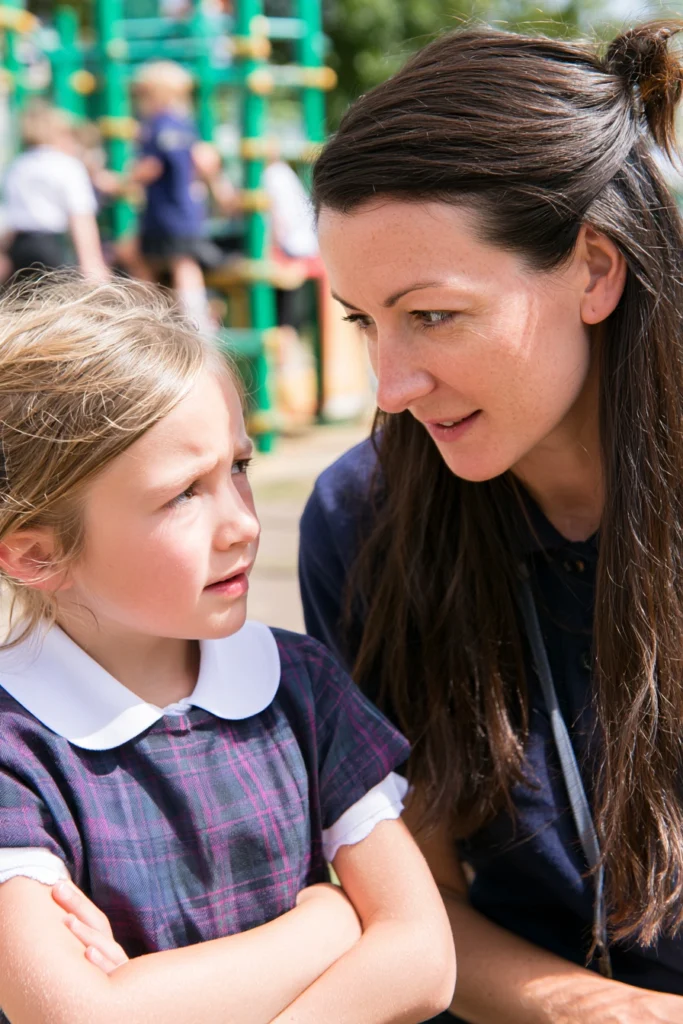
As part of your goodbye routine at the school gates, you can share a transitional object with your child. This item, such as a special scarf or small photo, serves as a bridge to your home and acts as a safe base for them to hold onto throughout the day.
Ensure the teacher is aware of this object so they can support your child if they feel wobbly.

6. Have Your Child Assigned a Special Role
There is nothing like having a special job to re-focus anxious kids. Speak to the teacher about whether your child could become a lunch box organiser, a register monitor, or a helper for the class pet. A role like this will give your child a sense of belonging and purpose, and help them look forward to coming to school.
7. Look After Yourself
You cannot support your child if you do not feel regulated yourself. In the moment, you may feel desperate, but try to take a long, slow, deep breath. Focus on making the outbreath just as long as the in-breath.
From a wider perspective, if your child is having a hard time, ensure you are practicing self-care so you have the emotional capacity to support them. Focus on basics such as getting enough sleep, eating regular nutritious meals, and maintaining social contact.
From a wider perspective, if your child is having a hard time you need to make sure you are looking after yourself with good self-care so that you can best support them.
If you want to deepen your understanding about anxiety so you feel clear on exactly which steps will help for your child, consider our mini-course, Knowledge is Power!

Separation Anxiety at School Drop-Off: What If Your Child Refuses to Go In?
If your child cannot or will not go into school because of their anxiety, know that you are not alone.
There are 3 crucial principles to follow to help your child:
- Build close, positive communication with the school.
- Increase nurture at school and home.
- Increase flexibility at school and home.

You will find more detailed information about these principles in my article on what to do if your child is too anxious to go to school. You will also find lots of practical support and advice there.
School Separation Anxiety: Frequently Asked Questions
How Much Should I Be Concerned About My Child’s Separation Anxiety?
The timing of separation anxiety and recent events are important in considering how concerned you should be.
For example, if your child has experienced a recent house move, divorce or separation, bereavement or any other traumatic event, separation anxiety is to be expected.
In fact, it would be unusual for your child not to experience separation anxiety. Their world has been shaken up and they need extra comfort and security. Because you are their secure attachment figure, it is natural that they want to stay near you.
The good news is that normally this passes within a few days or weeks. Your child’s feelings settle and they begin to feel more secure.

Should I Force My Anxious Child to Attend School?
If your child develops longstanding anxiety about attending school, forcing them may affect your relationship negatively.
More importantly, their anxiety may go unsupported and become more severe. The goal is to support your child as they head back to school so they can gradually build their confidence and independence.
It is a delicate balance, because avoiding school can also make the anxiety worse.
The best thing to do is develop positive communication with your child’s school and follow the advice in this article to help your child gradually feel safer attending.
Also, take a look at my article: When Your Child Feels Too Anxious To Go To School.

If My 5 Year Old is Crying at School Drop Off, Should I Be Concerned?
Separation anxiety in young children is normal and often occurs during school or kindergarten drop-off. If your child is crying and their distress is severe, persists for many days, and they do not recover quickly, you may need additional support.
Traumatic events can trigger these feelings, but typically they should settle within a few days or weeks.
Talk to your child’s teacher and ensure they have a thorough understanding of what is going on for your child.
If severe anxiety continues, seek support from an educational or clinical psychologist.
What Are the Signs That a Child Has Severe Separation Anxiety?
Some separation anxiety is very typical for preschool and kindergarten drop-off, and for young children up to the age of 5 or 6.
If your child is crying and is severely distressed for many days or weeks and does not recover after a few minutes once in school, it is a sign that your child may need some additional support.
Try the strategies above first. If nothing changes you may need support from an educational psychologist or clinical psychologist.
If your child still has separation anxiety aged 8, this might be a sign that you need to get some professional support.
Most children have largely overcome separation anxiety by this age.
Remember though, that every child is different, and there may be good reasons, like traumatic events or neurodevelopmental differences, why your child does not feel secure without you yet.
Chat with your child’s doctor. They may refer you to a paediatrician or therapist for further support.
Should I Be Worried About My 8 year Old Child’s Separation Anxiety at School Drop Off?
While some degree of separation anxiety in 8 year olds is common, heightened and persistent distress in a child this age might warrant increased concern. If your child is frequently crying during drop-off, it is worth looking at the bigger picture.
Factors like the severity of the anxiety, its impact on your child’s daily life and learning, and any recent significant events such as a move, divorce, or loss should be taken into account.
Open communication with your child’s teacher and seeking guidance from educational or clinical psychologists can be valuable steps in addressing and managing the situation effectively.

What is Separation Anxiety Disorder?
Separation anxiety disorder is a name given to separation anxiety that is considered more intense or prolonged than would be expected at the child’s age.
In particular, separation anxiety disorder may be diagnosed if it is interfering significantly with school or home life. Read more about the symptoms of separation anxiety disorder in this article.
If you are concerned, speaking with a clinical psychologist can help determine if this is the correct diagnosis, and guide you towards the best treatment plan for your child.
Your child may have an anxious attachment. To find out more about anxious attachment styles and how to support your child, read my colleague Hayley Vaughan-Smith’s article: How to Deal With Anxious Attachment.
How to Help Your Child With Separation Anxiety at School Drop-Off: My Final Thoughts and Summary
I hope you have found these recommended strategies and the case example helpful.
Don’t forget that experiencing separation anxiety at school drop-off is a normal part of development for many children. To avoid becoming overwhelmed, try reviewing the techniques I have suggested and simply focus on one at a time. The primary goal of these strategies is to gradually foster independence and improve your child’s emotional regulation as they become more confident in the classroom.
The key to success is to maintain regular and positive communication with your child’s nurturing teacher. By working closely with them, you can create a consistent support system that helps your child feel secure and less anxious during the transition.
Good luck!
Books About Separation Anxiety (For You and Your Child)
Reading together is a wonderful way to open up conversations about feelings and provide comfort during challenging transitions. Here are some of our top recommendations for families navigating these emotions.
For Children:
The Invisible String by Patrice Karst
The Kissing Hand (The Kissing Hand Series) by Audrey Penn & Ruth Harper
Meet Me at the Moon by Gianna Marino
For Parents:
Helping Your Child Overcome Separation Anxiety or School Refusal by Linda Engler
The Highly Sensitive Parent by Elaine N Aron
Dr Lucy Russell is a UK clinical psychologist and Clinical Director of Everlief Child Psychology. She qualified as a clinical psychologist from Oxford University in 2005 and worked in the National Health Service for many years before moving fully into her leadership and writing roles.
In 2019 Lucy launched They Are The Future, a support website for parents of school-aged children. Through TATF Lucy is passionate about giving practical, manageable strategies to parents and children who may otherwise struggle to find the support they need.
Lucy lives with her family, rescue cats and dog, and also fosters cats through a local animal welfare charity. She loves singing in a vocal harmony group and spending time in nature.
