
Autistic Teenagers and Relationships: A Parent’s Guide

For autistic teenagers, friendships and romantic relationships can sometimes feel complicated, confusing or exhausting. Your teenager might desperately want friends but struggle to make them, have a group of friends but crave something deeper, or have several good friends yet find socialising draining.
There is no single autistic experience of relationships. Your teenager’s strengths, communication style, sensory needs and previous experiences will all shape their relationships. The aim is not to make them behave more like everyone else. It is to help them build relationships that feel safe, enjoyable and authentic.
If your child is approaching adolescence, you may also find my guide to thriving in the teenage years for autistic teens helpful. The teenage years bring significant changes to friendships, independence and identity.

Why can relationships be difficult for autistic teenagers?
Autistic teenagers may communicate and process social information differently. They may find implied meanings, fast conversations or subtle changes in someone’s behaviour difficult to interpret. Sensory differences can add another layer, because busy groups, loud environments, unexpected touch or crowded spaces can make socialising exhausting.
Some autistic teenagers also prefer predictability, which can make changing friendships particularly difficult. A best friend suddenly playing with somebody else can feel like rejection. A friendship group changing at school can leave your teenager unsure where they fit. On top of this, there is the big issue that social interactions are not predictable. Not knowing how a conversation or an interaction might go can cause an autistic teen to feel anxious, stressed, or overwhelmed.
These difficulties do not mean autistic people lack interest in relationships. Most autistic people want friendship, connection and belonging, although the type and amount they want varies. Autistic teenagers can also bring considerable strengths to relationships, including loyalty, honesty, humour, shared interests and deep knowledge.
Autistic teenagers and friendships
Friendships can change significantly during the teenage years. Friends may move between groups, develop new interests or become interested in dating. These changes can be particularly difficult for an autistic teenager who prefers predictable relationships. For more support with this, see my guide to when an autistic teenager doesn’t understand friendship.
A teenager may interpret a friend spending time with somebody else as rejection. They may struggle to understand the unwritten rules of friendship that seem obvious to everyone else, and they may struggle to understand that someone can have several friendships at once. They might also hold onto a friendship that has naturally changed because they are unsure how to develop new connections.
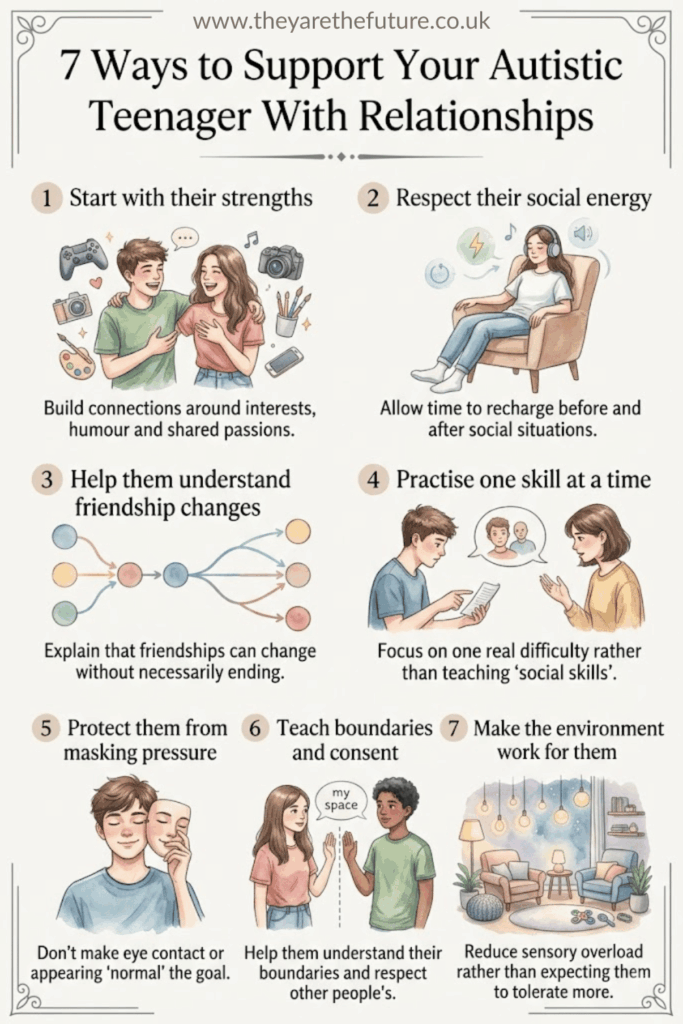
You can help by making these changes concrete. Talk through different friendship scenarios and explore what your teenager could do next. What happens if their friend is busy? Who else could they spend time with? Could they join another group or contact somebody outside school?
Visual mapping can be particularly useful. Draw the different people in your teenager’s social world and explore how their relationships connect. This can make complicated friendship dynamics easier to understand.
Help your autistic teenager find people who share their interests
If your teenager is struggling socially, think carefully about where they are trying to connect. A noisy school environment may be a poor setting for an autistic teenager, while a small club based around a strong interest could feel completely different.
Shared interests provide a natural starting point for conversation. Gaming, animals, sport, music, books, crafts and particular areas of knowledge can all create opportunities for connection.
Some teenagers prefer one-to-one friendships, while others enjoy groups but need regular breaks. Try not to measure success by the number of friends your teenager has. One safe, reciprocal friendship can be incredibly valuable.
Online friendships can also be meaningful for autistic teenagers. However, they still need clear guidance around privacy, boundaries, manipulation and online safety.
Alone time is not automatically a problem for autistic teens
Some autistic teenagers need considerable time alone after social interaction. They may need quiet time after school before talking to anyone. They may also need to rest before a social event and decompress afterwards.
That does not automatically mean they are avoiding people. Ask whether your teenager is content with their level of social connection. If they enjoy their own company and have meaningful relationships, there may be little to change.
The situation is different if your teenager wants friends but feels unable to make them. In that case, work out what is getting in the way. It could be anxiety, sensory overload, previous rejection or difficulty finding compatible people.
Understanding the barrier gives you a much better starting point than simply saying, “They need better social skills.”
Understanding emotions and social communication
Some autistic teenagers find facial expressions, tone of voice and body language difficult to interpret. Others understand these signals but become overwhelmed when too much information arrives at once. Some communicate their own emotions differently from their peers.
It is also important to remember that communication works both ways. Autistic and non-autistic people can misunderstand each other. This is sometimes described as the double empathy problem, recognising that differences between autistic and non-autistic people can create misunderstandings on both sides. Your teenager does not need to communicate in exactly the same way as everyone else.
Don’t make eye contact the goal for autistic teens
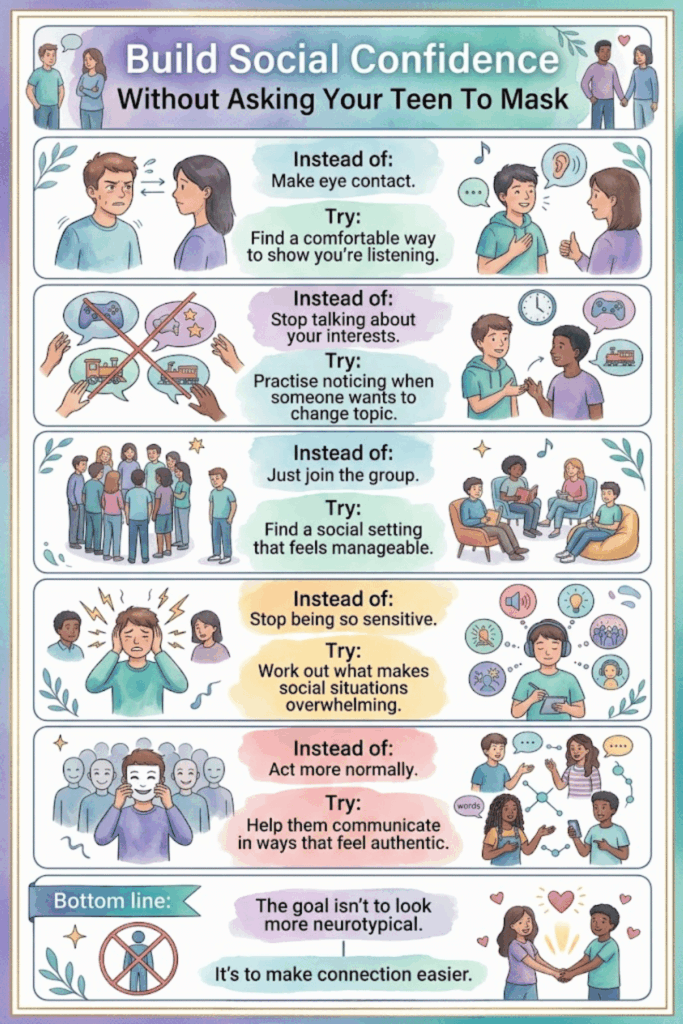
Older autism advice often focused heavily on eye contact. Eye contact can feel uncomfortable, distracting or overwhelming for some autistic people. For some, forcing eye contact makes listening and processing harder.
There is no need to make eye contact a target. If your teenager naturally uses eye contact, that’s fine. If they do not, their communication can still be effective.
The same principle applies to other behaviours designed to make someone appear more neurotypical. The aim should be successful communication, not performance.
Be careful about masking
Some autistic teenagers work extremely hard to appear non-autistic or neurotypical. They may copy other people’s behaviour, rehearse conversations or constantly monitor their facial expressions. They may force eye contact or suppress movements that help them regulate themselves.
This is often called masking or camouflaging. It can help someone navigate difficult situations, but maintaining a mask long-term can also be exhausting.
Masking can be particularly relevant to friendships. A teenager may look socially confident at school while using enormous amounts of energy to maintain that appearance. They may then come home exhausted, irritable or unable to manage anything else.
Ask yourself whether your teenager needs to change, or whether their environment needs changing. Developing a skill they want can be helpful. Teaching them that their natural communication is wrong is very different.
Helping your autistic teenager develop social confidence
If your teenager wants more friendships, choose one specific difficulty to work on. Perhaps starting conversations feels impossible, so practise a few natural conversation openers together.
Perhaps they talk enthusiastically about their favourite subject without noticing that the other person wants to change the topic. You could practise noticing when a conversation is winding down.
If disagreements regularly lead to friendships ending, practise repairing relationships afterwards. Your teenager might say, “Sorry, I think I upset you”, “I didn’t mean it that way”, or “Can we start again?”
Keep practice low-pressure. Your teenager should not feel that every social interaction is an assessment.
Social communication should not mean losing yourself
There is an important distinction between developing a skill and hiding who you are. Sometimes a small change in communication genuinely helps another person understand your teenager. Your teenager should not have to constantly monitor themselves to earn acceptance.
I once worked with a sixteen-year-old who loved Greek mythology. He had two close friends outside school but felt isolated in his class. He had learned that eye contact and small talk were important, so he tried intense eye contact with classmates and asked people about their favourite Greek myths.
Neither strategy was helping. We explored what felt natural for him, and he decided he did not need to force eye contact. He also worked on broadening his conversation topics beyond Greek mythology.
Over time, he became more comfortable approaching classmates and developed a small friendship group at school. The goal was not to make him more “normal”. It was to help him understand what worked for him.
Friendships need reciprocity
Friendships involve two people’s needs. Your teenager may need support understanding that friends can have different interests, opinions and boundaries.
That does not mean your teenager should always compromise. It means both people’s needs deserve consideration. You can explore everyday situations together by asking, “What do you think your friend wants?” or “What would feel fair to both of you?”
This can be especially useful when strong interests or opinions dominate interactions. A teenager can learn to notice another person’s perspective without being taught that their own perspective is wrong.
Autistic teenagers, dating and romantic relationships
As children become teenagers, they may start to show an interest in romantic relationships. Your teenager may experience romantic attraction but feel unsure what it means. Dating, flirting and physical intimacy can also be difficult to interpret.
Do not assume your teenager will simply learn these things from peers. Talk about relationships before they need the information. Explain that attraction, friendship, affection and sexual intimacy can overlap, but they are not the same thing.
Keep explanations concrete and age-appropriate, and discuss consent explicitly. Your teenager needs to know that they can say no, and that another person can say no. Consent applies to hugging, kissing, sexual contact and sharing intimate images. It needs to be freely given without pressure, manipulation or coercion.
Autism Central’s guidance on sex and relationships provides further information. Social stories and comic-strip conversations can also help with boundaries and appropriate behaviour.
The National Autistic Society’s guidance on sex education provides further information for parents and carers.
You can also use television programmes, films or real-life examples to start conversations. Ask, “Was that respectful?”, “Did both people seem comfortable?” or “Was anyone being pressured?”
These conversations can help your teenager recognise healthy and unhealthy relationships.

Boundaries and physical contact
Sensory differences can significantly affect relationships. Some autistic teenagers dislike hugs or unexpected touch. Others seek frequent physical contact and may not notice when somebody else has had enough.
Both experiences need respect. Teach your teenager that everyone has personal boundaries, and their boundaries deserve respect alongside other people’s boundaries.
A simple phrase can help: “I can say no, and other people can say no.”
Your teenager does not need to accept unwanted physical contact to be polite. Equally, they need to understand that somebody else’s refusal must be respected.
If physical boundaries are confusing, use concrete examples. Talk about different relationships and what kinds of touch are appropriate. Being in a romantic relationship does not give someone automatic permission to touch another person.
Sensory differences and relationships
An autistic teenager may really want to spend time with friends but struggle with busy environments. Perhaps the cinema is too loud, parties are overwhelming or a busy restaurant makes conversation almost impossible.
You can problem-solve the environment rather than assuming your teenager needs to tolerate more. Could they watch a film at home? Could they meet one friend instead of six? Could they choose a quieter venue or attend for an hour?
Sensory activities can also help some autistic teenagers recognise and manage their sensory needs. You may find these sensory activities for autistic teenagers useful if sensory overload regularly affects social situations.
The aim is to make connection possible without pushing your teenager beyond their capacity.
When relationships end
The end of a friendship can be devastating. The end of a romantic relationship can feel even more significant. Some autistic teenagers need additional time to process what has happened.
Clear explanations can be more helpful than vague reassurance. Instead of saying, “You’ll get over it”, acknowledge the loss and help your teenager work out what happens next.
They may need support with school, social media or contact with the other person. They may need help deciding whether to mute or unfollow someone online.
Give them time to process the change while continuing to offer connection if they need it. Keep routines going where possible. Your teenager may need more space for a while, but they do not need to manage the loss alone.
Help your teenager recognise healthy relationships
Young people need to know what healthy relationships look like. Talk about respect, honesty, boundaries, trust and mutual choice. Both people should be able to have other friendships and interests.
Also talk about warning signs. These can include controlling behaviour, humiliation, threats, pressure, manipulation or demands for secrecy.
For teenagers, online relationships need attention too. Talk about requests for private information, intimate images, money or secrecy. Make sure your teenager knows they can tell you about something uncomfortable.
Try not to respond with immediate shock or punishment. If your teenager expects anger, they may be less likely to seek help next time.
Supporting relationships at school
If your teenager is struggling socially at school, talk to staff. Ask what they are noticing and when difficulties happen. Unstructured times such as lunch and break may be much harder than lessons.
Your teenager may benefit from a trusted adult, a quieter lunchtime option or a club based around their interests. If bullying or exclusion is involved, this needs addressing directly.
Your teenager should not be expected to develop better social skills to solve bullying. School support should also consider sensory load, fatigue and the demands of masking.
Speech, language and communication support
Some autistic teenagers have significant differences in spoken language. Others speak fluently but struggle with conversation, inference, sarcasm or implied meanings. If communication difficulties are affecting your teenager’s relationships, ask whether speech and language therapy could help. Your GP or child’s school can advise about local pathways.
Your teenager’s communication profile should guide the support they receive. The aim should be to reduce communication barriers and increase participation, rather than making them communicate in a more neurotypical way.
Work out where your teenager is thriving
It can help to look at your teenager’s relationships separately rather than treating “social skills” as one problem. Think about school friendships, friendships outside school, family relationships, online friendships, relationships with adults, clubs and romantic relationships.
For each area, ask yourself what is going well and what is difficult. Then consider whether the difficulty involves skill, confidence, anxiety, sensory overload or the environment.
Your teenager might communicate brilliantly with one close friend but struggle in a noisy group. They might feel more confident online than face-to-face, or enjoy socialising but need a whole evening alone afterwards.
Looking at these differences can help you identify the support your teenager actually needs.
Autistic teenagers and relationships: what can you do now?
Start with one relationship that your teenager cares about. Find out what is going well and where they are getting stuck. Then choose one small, practical change.
Perhaps they need help understanding a friendship change. Perhaps they need a quieter way to meet people. Maybe anxiety is getting in the way, or they need to learn how to communicate a boundary.
You do not need to fix everything at once.
Your teenager does not need lots of friends or conventional social skills. They need opportunities to connect with people who respect them, alongside support to understand their own boundaries and other people’s boundaries.
Over time, these skills can help them build friendships, family relationships and romantic relationships that feel safe, respectful and mutual.
Dr Lucy Russell is a UK clinical psychologist and Clinical Director of Everlief Child Psychology. She qualified as a clinical psychologist from Oxford University in 2005 and worked in the National Health Service for many years before moving fully into her leadership and writing roles.
In 2019 Lucy launched They Are The Future, a support website for parents of school-aged children. Through TATF Lucy is passionate about giving practical, manageable strategies to parents and children who may otherwise struggle to find the support they need.
Lucy lives with her family, rescue cats and dog, and also fosters cats through a local animal welfare charity. She loves singing in a vocal harmony group and spending time in nature.
