
Your Child Has Been Diagnosed With Autism: What Next?

When your child receives a formal diagnosis of autism spectrum disorder, you can feel relief and grief at the same time. Validation, confusion, worry, and hope can all show up together, and that is normal.
You may finally have an explanation for things that have felt hard, puzzling or intense. You may also feel sad for the times your child was misunderstood, or for the support they should have had sooner. You might even feel pressure to act fast, as if there is one perfect next step and you must find it now.
There isn’t. Your child hasn’t changed. You simply understand them better now. The diagnosis gives you a better map, and that helps you decide what to do next.
I’m Dr Lucy Russell, a child clinical psychologist with more than 20 years of experience working with children and families. Autism is central to my clinical work and to my personal life too. Several members of my family are neurodivergent, and I am a carer for an autistic family member. I bring both perspectives to everything I write.
What should I do first after my child’s autism diagnosis?
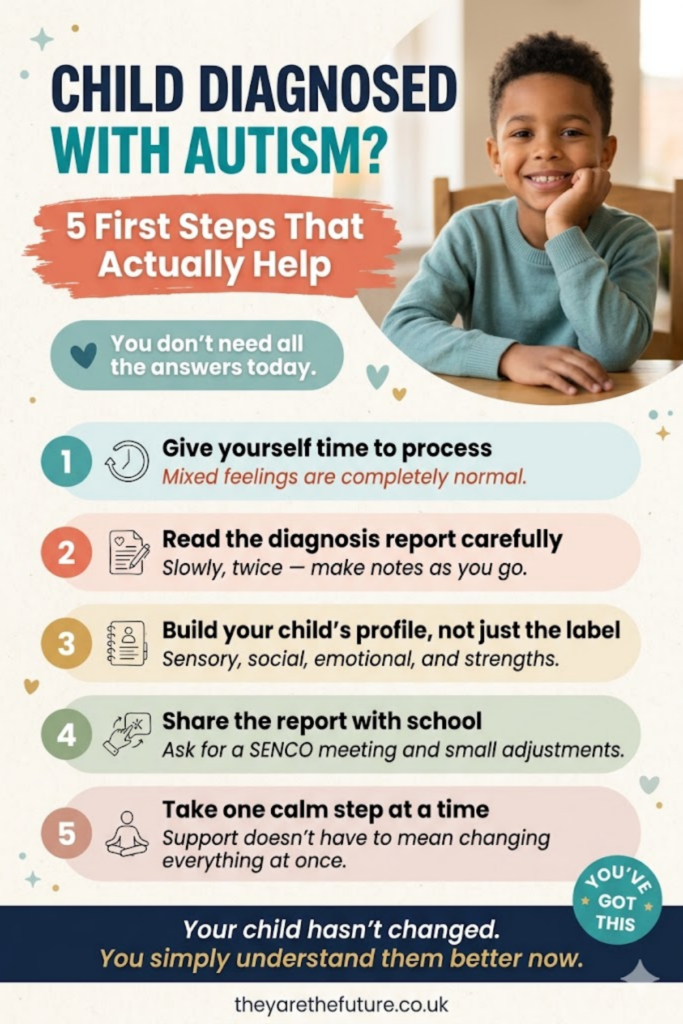
There is no single right order, but in my professional experience these five steps make the biggest difference for most families early on:
- Give yourself time to process the diagnosis before making big decisions.
- Read your child’s assessment report slowly and start noticing their individual profile.
- Learn about autism from trusted, neuroaffirming sources rather than random searches at 11pm.
- Share the diagnosis with school and start building practical support at home.
- Get structured professional support, for example a course like Embracing Autism, so you’re not piecing this together alone.
The rest of this article walks through each of these in more detail.
Do I need to act on everything straight away after the diagnosis?
The diagnosis report arrives, advice pours in, school questions begin, and everyone seems to want a plan straight away. But this is a big moment for your whole family, and you don’t need all the answers this week.
Mixed feelings don’t mean you’re coping badly. They mean something important has happened. Pause before making big decisions and talk things through with someone you trust.
Support doesn’t have to mean signing up to every possible intervention. It doesn’t mean changing your whole family life overnight.

What does my child’s autism assessment report actually mean?
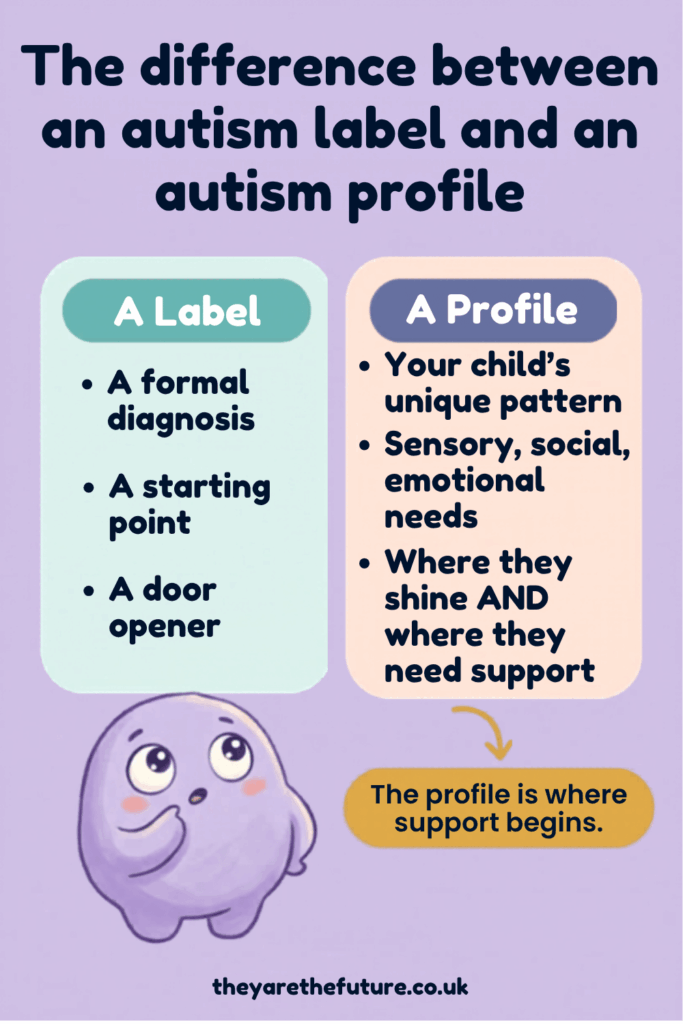
Your child has now met the diagnostic criteria set out in the DSM-5, and the autism assessment process is complete. A diagnosis is a starting point, not a full picture: the report should give you a real sense of your child’s individual profile, their specific strengths, and where they need support.
Read it slowly, make notes, and look for patterns rather than just the label itself: sensory needs, communication style, emotional regulation, routines, sleep, energy, and friendships. Look for strengths as well as challenges too, many autistic children are creative, funny, deeply knowledgeable about their interests, or able to focus intensely on what matters to them.
If anything feels unclear, ask questions or request follow-up. The NHS information on autism assessments can help you check what usually happens next. Keep a simple note of what helps and what makes things harder. That note becomes the basis for getting the right support.
Where can I find reliable, trustworthy information about autism?
The internet can help, but it can also leave you more confused than when you started. One page says one thing, another says the opposite, and some advice relies on outdated stereotypes that don’t fit your child at all.
Start with reliable, neuroaffirming sources: read what autistic people say about their own lives alongside what trusted healthcare professionals write. That combination tends to give you the clearest picture.
You don’t need to become an expert overnight, just to understand your child better with less fear and more accuracy. A good place to start is my autism and ADHD support articles and resources. Further down this article I cover Embracing Autism, the course I run with four fellow specialists, which many parents describe as the point things started to click into place.

How do I get support for my child at school and at home?
Once you understand your child’s profile better, you can start building support around them. Keep it practical, you’re not trying to rebuild family life in a weekend.
At school, share the report with the SENCO and ask for a meeting. Useful adjustments to discuss include a quieter space or movement breaks for sensory needs, clearer and more direct instructions, and extra warning before moving between tasks. You don’t need a perfect plan at the first meeting, just a conversation that leads to action. The National Autistic Society’s guide to formal support is a useful reference for what schools and services may offer.
At home, small changes often help most: reducing sensory overload, giving your child more processing time, using clear and unambiguous language, and preparing for changes in advance. If you’re wondering how to talk to your child about their diagnosis, a simple, positive, age-appropriate conversation usually works best: autism means their brain works in its own way, with strengths and struggles, and it isn’t something to hide.
Financial and legal support can feel overwhelming to navigate, but the National Autistic Society and Citizens Advice both have guidance on benefits and legal protections, and your local authority may have its own specific pathways too.
Where can I get professional support after my child’s autism diagnosis?
If family life feels very stressful right now, if school has become hard for your child to bear, if their behaviour is putting real strain on you and the rest of the family, or if emotional regulation is the hardest part of most days, working all of this out from scattered articles and forum threads isn’t realistic. This is often the exact point where parents tell me they most want a clear, guided plan rather than more information to sift through alone.
Embracing Autism gives you exactly that: direct access to five specialists, now in its fifth year. Between us we are two clinical psychologists, a consultant paediatrician, a senior speech and language therapist, and a specialist paediatric occupational therapist: Dr Lucy Russell, Dr Cassie Coleman, Dr Marcelina Watkinson, Nicci Paine, and Aimee Laming. It’s the kind of multi-disciplinary team that’s hard to access anywhere else as a parent, and each team member works directly with autistic children and families as part of their day-to-day clinical work.
It covers the areas that come up most after diagnosis: sensory differences, social interaction and friendships, behaviour, school, anxiety, and sleep, plus a live group 90-minute Zoom Q&A with the team so you can ask about your own child directly. It runs four to five times a year. Find out more about Embracing Autism.
This is just the beginning
After your child has been diagnosed with autism, it can feel as though you should instantly know how to parent differently. You won’t, and no one gets a perfect roadmap.
Autism is lifelong, but everyone’s understanding grows. The more you notice patterns, listen to your child, and adjust what isn’t working, the more confident you all become. Many families start out overwhelmed and later say the diagnosis helped things click into place as their understanding grew.
Some families get post-diagnostic support through the NHS, but in many areas wait times are long and provision is inconsistent. If your child needs additional support, for example for mental health or anxiety, a GP referral can open doors to further help, and it’s worth asking what’s available in your area. If you want extra support making sense of this next stage, the section above walks through the Embracing Autism course in more detail.
Your child is exactly who they were before the diagnosis. What’s different now is how clearly you can see what they need, and that clarity is what helps you know where to focus first.
Frequently Asked Questions
Give yourself time to process the diagnosis before making any big decisions. Read the assessment report to understand your child’s individual profile, share it with school, and look for trustworthy, neuroaffirming information rather than random search results. Many parents also find it helpful to get structured professional support early on, for example through the Embracing Autism course, rather than trying to work everything out alone.
Both are common, and they can show up together. Allow space for good days and harder ones alike. Pausing before big decisions and talking things through with someone you trust tends to help more than rushing into action.
Keep the explanation simple and age-appropriate: autism means their brain works in its own way, with both strengths and struggles, and it is not something to hide. Most children respond well to a calm, honest, positive conversation. Follow your child’s lead on how much detail they want and revisit the topic as questions come up.
Support can come from your child’s school, your GP, local council services, and national charities such as the National Autistic Society. NHS post-diagnostic support varies significantly by area, which is why many families also look for professional support alongside it, like the Embracing Autism course.
Embracing Autism gives parents direct access to five specialists across clinical psychology, paediatrics, speech and language therapy, and occupational therapy. It covers understanding the diagnosis, sensory needs, behaviour, school, anxiety and emotional regulation, and sleep. It includes a live group 90-minute Zoom Q&A so you can ask about your own child directly. Parents often say it turned an overwhelming stage into one with a clear, manageable plan.
Dr Lucy Russell is a UK clinical psychologist and Clinical Director of Everlief Child Psychology. She qualified as a clinical psychologist from Oxford University in 2005 and worked in the National Health Service for many years before moving fully into her leadership and writing roles.
In 2019 Lucy launched They Are The Future, a support website for parents of school-aged children. Through TATF Lucy is passionate about giving practical, manageable strategies to parents and children who may otherwise struggle to find the support they need.
Lucy lives with her family, rescue cats and dog, and also fosters cats through a local animal welfare charity. She loves singing in a vocal harmony group and spending time in nature.
