
10 Quick Mental Health Wins To Help Your Child Flourish

Feeling worried about your child’s or young person’s mental health, such as their mood, anxiety or stress, but not sure where to start? I’m a clinical child psychologist and I’m here to help.
Many parents and carers feel stuck between feeling that things are not quite right and not having the energy for a huge overhaul.
The good news is that small, simple changes can have a big impact on child mental health and emotional wellbeing. You do not need a complete family makeover. You just need one realistic action that you can repeat.
This guide walks you through 10 quick mental health wins you can start today. They sit in three areas: connection (with self and others), lifestyle, and environment. You can pick one, test it for a couple of weeks, then return for the next step when you are ready.
You are in the right place if you want practical ideas backed by psychology, but explained in plain language you can actually use at home.

Why Small Mental Health Wins Matter
When your child is struggling, it is easy to feel overwhelmed. You might worry you are getting everything wrong, or that you need to change every part of family life.
You do not.
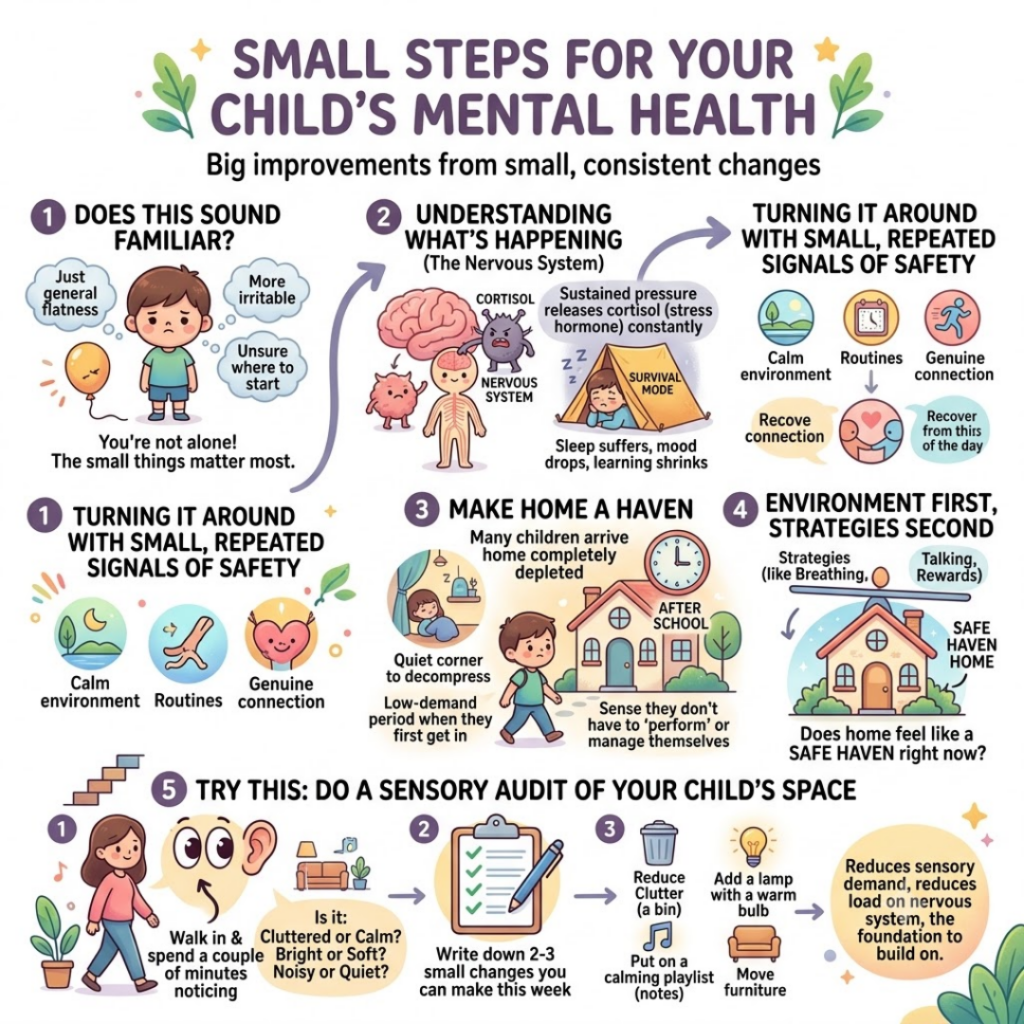
The brains and nervous systems of children and young people respond very well to repeated, gentle tweaks. One new habit, repeated daily, sends a strong message of safety and predictability. Over time, many small habits join together and your child’s mental health pathway starts to shift, boosting their mental wellbeing.
Lifestyle, including daily routine and structure, is a huge part of this. Sleep, food, movement and connection all feed into your child’s emotional world. You can read more about the lifestyle link in this guide to improving child mental health through daily routines, but for now, keep one idea in mind:
Choose one small step, make it easy, and keep repeating it.
Quick Wins For Connection With Self And Others
These first five strategies offer children’s mental health support by building two kinds of connection for emotional wellbeing:
• your child’s connection with themselves (self-awareness and self-calming)
• your connection with your child (emotional safety and trust)
1. Balloon Breathing: Teaching Your Child To Feel Calm On Purpose
Breathing is one of the fastest ways to calm the nervous system, especially for anxiety in children. When breathing is slow and deep, it sends a message to the brain that the body is safe. Heart rate slows, muscles soften and thoughts settle.
Balloon breathing is a simple way to teach this:
- Ask your child to place one hand on their tummy.
- Breathe in through the nose for about 5 to 6 seconds, so the tummy rises like a balloon filling with air.
- Pause for a second.
- Breathe out slowly through the mouth for 5 to 6 seconds, letting the “balloon” deflate and the tummy fall back.
Aim for 1 minute to start, perhaps five slow breaths. Over time you can build up to about 5 minutes, which is usually enough to bring the body back into balance in most situations.
You might like to pair this with other grounding techniques to calm anxious children, so your child has several ways to steady themselves.
If you want extra guidance, the NHS has a simple breathing exercise for stress and anxiety that works well for older children and young people too.
A helpful tip is to practise balloon breathing when your child is calm. It is much easier to use it during a meltdown or panic if it already feels familiar.

2. Bedtime Journaling: Helping Your Child Name Their Feelings
Children who can notice and name their feelings tend to cope better with life’s bumps. Psychologists call this social and emotional development, but in simple terms it is about three things:
- noticing how you feel
- understanding why you might feel that way
- choosing what to do with that feeling
A short bedtime journaling habit can gently build this skill, helping children and young people talk about feelings.
For younger children, you can sit with them for 5 minutes and use simple prompts such as:
- “What made you feel happy today?”
- “What made you feel proud today?”
- “What are you grateful for today?”
They might draw instead of writing. That still counts.
For older children and teens, you can offer a notebook and suggest they write freely about their day, or use prompts if that feels easier. Some like lists, some like doodles, some write in sentences.
If your child finds feelings hard, start with body sensations. You could ask:
- “Did your tummy feel fizzy or tight at any point today?”
- “Did your jaw, neck or shoulders ache or feel stiff?”
They can sketch a simple body outline and draw where they felt it. Over time, they will start to link those body clues to emotions like worry, anger or excitement.
This kind of reflection is a gentle way to grow your child’s emotional strengths. If you would like more ideas here, this article on identifying your child’s behavioural and emotional strengths gives helpful examples.
TAKE THE QUIZ!
3. One Minute Body Scan: Spotting Tension Before It Builds
A body scan is a quick “check-in” from head to toe. It trains your child to notice tension early, so they can self-regulate emotions, adjust their posture or take a short break before discomfort and stress build up.
Here is a simple one minute version you can teach:
- Sit or lie in a comfortable position. It may help to close the eyes.
- Start at the forehead. Notice any tightness or frowning. Soften that area.
- Move down to jaw and neck. Is the jaw clenched, neck stiff or hunched? Gently relax.
- Scan shoulders, chest and tummy. Notice breathing and any knotty feelings.
- Move down through hips, thighs, knees, calves and feet, all the way to the toes.
You are not fixing anything, just noticing and softening.
You might say, “We are being detectives of your body today,” which can make it fun for younger children.
One parent shared that her son used a body scan while doing homework. He realised his shoulders were up by his ears and his tummy was tight. A quick stretch and three balloon breaths helped him feel less grumpy and more able to carry on.
You can pair a body scan with bedtime journaling, so your child learns to connect what they feel in their body with the emotions of the day.
4. Coping Menu: A Personal Toolkit For Big Feelings
A coping menu is a visual list of support strategies that help your child when they feel stressed, angry, worried or overwhelmed with anxiety in children. Instead of trying to remember what might help in the heat of the moment, they can simply “look at the menu” and choose.
You build it together, based on trial and error.
Take Sophie, a 10 year old who often felt wound up after school. Through a bit of experimenting, she found that:
- bouncing on the trampoline
- having a warm bath and playing with toys
- stroking the family dog
all helped her body feel softer and her mind less busy. These went on her “Home Coping Menu” as small drawings on a sheet stuck to her bedroom wall.
She then created a “School Coping Menu” with things she could do without drawing attention to herself. Her list included:
- balloon breathing
- squeezing a small fidget toy in her pocket
- asking to take a quick drink of water
The power of a coping menu lies in practice. The more your child uses their tools, the more automatic they become, and the more in control your child will feel.
You can also quietly create your own coping menu as a parent. Children notice when adults have strategies too, and it sends a strong message that feelings are manageable.
5. Ten Minutes Of One To One Time: The Power Of Being Fully Present
As humans, we are wired for connection. Your child needs to feel that at least one adult “has their back” and can help share heavy feelings.
A simple way to build this is 10 minutes of one to one time each day. During this time:
- you put phones and distractions away
- you follow your child’s lead as much as possible
- you focus on enjoying their company, not correcting or teaching
Examples could include:
- a walk round the block or to the shop
- a hot drink and a snack at the table
- a short board game or card game
- sitting on the sofa with the pet, just chatting
You might be surprised what comes out in these small pockets of time. Children often open up when they sense you are fully available and not rushing to the next task.
Even on busy days, 10 minutes of real presence can make your child feel safer and more secure, which is a strong foundation for positive mental health.

Lifestyle Quick Wins For Child Mental Health
Lifestyle habits shape how your child’s brain and body function across the whole day. Food, sleep and movement are not just “nice to have”. They are core ingredients in emotional balance and child mental health.
You can find more depth in this article on lifestyle habits that boost child mental health, but here are three quick wins you can start straight away.
6. Breakfast That Steadies Mood And Focus
Skipping breakfast is common in older children and young people. The problem is that an empty stomach can send their brain into panic mode.
Low blood sugar makes it much harder to:
- concentrate and remember
- stay calm with friends or siblings
- cope with small frustrations in school
The brain reads a drop in blood sugar as a kind of emergency. Stress hormones rise, and your child may feel jittery, tearful, snappy or prone to aggressive behaviours.
You can help by making breakfast a gentle non-negotiable again, even if you start tiny. For a breakfast that keeps energy steady, try to include:
- a source of protein
- a source of complex carbohydrate (whole grains, beans)
Simple ideas include:
- wholemeal toast with peanut butter and banana slices
- beans on wholemeal toast
- yoghurt with oats and some fruit
If your teen says they are not hungry in the morning, start with just half a banana or a small yoghurt and build up gradually. The key is consistency.
7. Eating A Rainbow: Feeding The Brain As Well As The Body
Your child’s brain and nervous system need a wide range of nutrients to work well. This simple nutritional guidance is useful even for early years children. Many of these nutrients come from fruit and vegetables, nuts, seeds and beans.
“Eating a rainbow” is a simple way to think about this without getting lost in nutrition charts. The more natural colours on your child’s plate across the day, the better for their emotional wellbeing.
Here is a quick guide:
ColourSimple ideas children often acceptRedTomatoes, strawberries, red peppersOrangeCarrots, oranges, orange peppersYellowBananas, sweetcorn, yellow peppersGreenPeas, cucumber, broccoli, spinachPurpleBlueberries, grapes, purple carrots
You do not need to change everything at once. You could:
- add grated carrot or sweetcorn to pasta
- offer chopped cucumber or peppers with after-school snacks
- swap one snack for a piece of fruit a few days a week
Minerals like magnesium, found in many nuts, seeds and leafy greens, support the nervous system and your child’s ability to settle. Most UK children do not get enough, because their diet is low in fresh foods.
Small steps to eat more colours each day will support both physical health and emotional steadiness in children and young people.
8. A Clear Bedtime And A Calm Runway
Sleep is one of the strongest foundations for mental health. When children are short on sleep, they are more likely to be irritable, impulsive, tearful and anxious. Over time, chronic lack of sleep is linked with a range of mental health issues.
You are aiming for realistic sleep routines that allow for around 8 hours of sleep before wake-up time for school-age children and young people. You may need to work towards this slowly, especially if habits have drifted.
The “runway” before bed is just as important as bedtime itself. About an hour before sleep you can:
- switch off all personal devices
- stop gaming and scrolling on social media
- dim lights and lower noise levels
- move towards calming activities like reading, drawing, journaling or a warm bath
Imagine a 15-year-old who has been falling asleep at 1 am after gaming and YouTube. By agreeing a 10.30 pm lights-out and a 9.30 pm device cut-off, plus a hot shower and quiet music, their sleep window gradually shifts. Within a couple of weeks many parents notice fewer morning battles and fewer late-night tears.
If sleep is a big struggle in your home, you might find this guide on proven sleep solutions for children aged 5+ helpful.

Environment Quick Wins for Mental Wellbeing
Children’s surroundings have a strong effect on their nervous systems. Two simple shifts, one outside and one inside, can make a real difference.
9. Fifteen Minutes Outdoors Every Day
Most children and young people spend far more time indoors than previous generations. This often means less movement, less daylight and more screen time.
Time outdoors helps in several ways:
- Natural light helps reset the body clock, so the brain can tell day from night. This supports healthy levels of cortisol in the morning (for alertness) and melatonin at night (for sleep).
- Green spaces, trees and even a simple view down a long street help the brain relax. When you scan the horizon, your eyes move from “tunnel vision” (linked with threat) to a wider view, which tells the brain it is safe.
- Physical activity, such as running, scooting or climbing, helps release stress and boosts mood by linking movement to a positive mental state.
You do not need a forest on your doorstep. A walk round the block, a short trip to the local park or incorporating more physical activity by scooting up and down the pavement all help.
If you want more ideas on building movement into your child’s day, this article on movement activities that enhance child wellbeing has plenty of simple suggestions.
10. A Calming, Clutter-Light Bedroom
Bedrooms are often the most cluttered rooms in the house, especially for children and young people. Piles of clothes, bright posters, cables and blinking lights from devices can all compete for your child’s attention, even when they are trying to switch off.
Research links calmer, less cluttered bedrooms with better sleep and lower stress, providing essential children’s mental health support. The brain has fewer things to scan and worry about, so it can move into a more relaxed state that nurtures mental wellbeing. A calm space like this can also make it easier for your child to talk about worries.
You do not need a perfect Pinterest bedroom. Try one of these starting points:
- choose one corner to be a “calm zone” with fewer objects and softer colours
- move spare toys and clothes into boxes, cupboards or another room
- cover bright lights from chargers or devices at night
- encourage your child to help choose a couple of items that feel calming to have near their bed
If your teenager’s room looks like a small clothes shop exploded, pick one small area to work on together and agree that clutter is allowed in another area for now. Many families find that once one calm space exists, their child slowly begins to value it.
Putting It All Together: Choose One Win And Start Small
You have just read 10 quick mental health wins that draw on both clinical experience and research. You do not need to use them all at once.
To keep things manageable while supporting your child:
- Pick one strategy that feels most realistic for your family right now.
- Talk it through with your child, at their level, and invite their ideas.
- Try it consistently for two weeks.
- Notice any shifts in mood, energy, behaviour or family stress levels.
You might move from balloon breathing to breakfast, or from outdoor time to a calmer bedroom, as each new habit starts to bed in. Supporting your child in this way builds steady progress.
If your child is also finding friendships or school life hard, you may find it helpful to read about helping children who feel they do not fit in at school alongside these home-based strategies.
Every small change you make sends your child a powerful message:
“You are worth caring for. Your feelings make sense. We can handle this together.”
That sense of safety and connection is at the heart of flourishing child mental health, and it grows one tiny, repeatable step at a time. These approaches nurture positive child mental health from the ground up.
While these strategies offer valuable day-to-day support, watch for signs they are struggling. If concerns persist, seek children’s mental health support via your GP or health visitor, or professional help. This might include counselling services or referral to Child and Adolescent Mental Health Services (CAMHS), especially if severe mental health issues are suspected. These are examples of effective support strategies when addressing serious mental health issues.
Parents and carers, as you focus on supporting your child, remember the importance of looking after your own mental health too.
Dr Lucy Russell is a UK clinical psychologist and Clinical Director of Everlief Child Psychology. She qualified as a clinical psychologist from Oxford University in 2005 and worked in the National Health Service for many years before moving fully into her leadership and writing roles.
In 2019 Lucy launched They Are The Future, a support website for parents of school-aged children. Through TATF Lucy is passionate about giving practical, manageable strategies to parents and children who may otherwise struggle to find the support they need.
Lucy lives with her family, rescue cats and dog, and also fosters cats through a local animal welfare charity. She loves singing in a vocal harmony group and spending time in nature.
